


Listen to the article
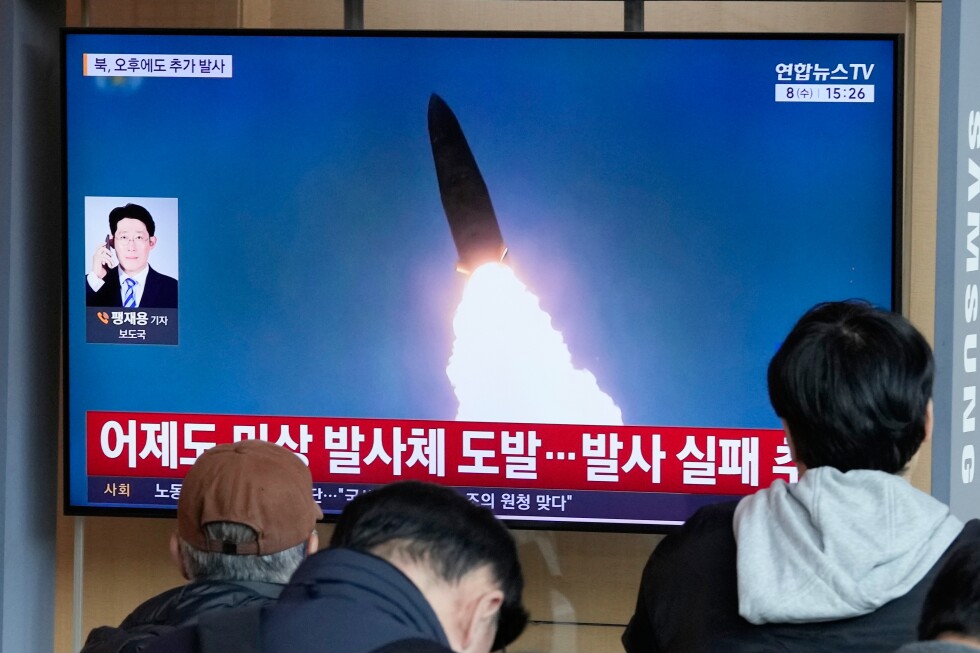
North Korea launched multiple short-range ballistic missiles toward its eastern waters on Wednesday, marking the second consecutive day of missile tests amid heightened tensions with South Korea, according to South Korean military officials.
The Joint Chiefs of Staff reported that several missiles were fired from North Korea’s eastern coastal Wonsan area early Wednesday, traveling approximately 240 kilometers (150 miles) each. An additional ballistic missile launched later in the day flew more than 700 kilometers (435 miles) off the east coast.
These launches follow an apparent failed missile test on Tuesday when South Korean military radars lost track of an unidentified projectile fired from Pyongyang’s capital region after it showed abnormal behavior during its initial launch stage.
The missile tests coincide with increasingly hostile rhetoric from North Korean officials. On Tuesday night, Jang Kum Chol, first vice minister at North Korea’s Foreign Ministry, described South Korea as the country’s “most hostile enemy state” and derided South Korean officials as “world-startling fools.”
Jang’s comments were specifically aimed at South Korean officials who had interpreted a recent statement by Kim Yo Jong, the influential sister of North Korean leader Kim Jong Un, as a positive diplomatic signal. After South Korean President Lee Jae Myung expressed regret over alleged civilian drone flights into North Korean territory, Kim Yo Jong had responded with what appeared to be measured praise for his “honesty and courage,” while still threatening retaliation for future incursions.
According to Jang, Kim Yo Jong’s statement was intended as a warning, not an olive branch. He quoted her describing South Koreans as “dogs affected by mange that blindly bark to the tune of neighboring dogs,” referring to South Korea’s recent co-sponsorship of a UN resolution condemning North Korea’s human rights record.
North Korea has consistently rebuffed South Korea’s attempts to restore dialogue since the collapse of Kim Jong Un’s diplomacy with former U.S. President Donald Trump in 2019. Instead, Pyongyang has focused on expanding its nuclear arsenal and strengthening ties with countries at odds with the United States, particularly Russia and China.
In a sign of these deepening international relationships, North Korean state media announced that Chinese Foreign Minister Wang Yi will visit North Korea on Thursday for a two-day trip. This visit follows Kim Jong Un’s travel to Beijing last September, where he attended a military parade alongside other foreign leaders and held his first summit with Chinese President Xi Jinping in six years.
The missile launches also come just days after North Korea reported that Kim Jong Un had personally observed a test of an upgraded solid-fuel engine for weapons. North Korean state media described this test as a significant advancement for the country’s strategic military capabilities.
Military experts note that solid-fuel missiles offer significant tactical advantages over liquid-fuel weapons, as they are easier to transport, can be launched with minimal preparation time, and maintain operational readiness for longer periods.
According to South Korean intelligence briefings to lawmakers, the engine test was likely part of North Korea’s efforts to develop a more powerful solid-fuel intercontinental ballistic missile (ICBM) capable of carrying multiple nuclear warheads. Such technology would potentially enable North Korean missiles to penetrate U.S. missile defense systems more effectively.
However, many defense analysts remain skeptical about whether North Korea has fully mastered the complex technologies required for reliable multiple-warhead missiles.
South Korea’s military stated it maintains a high level of readiness to respond to any provocations, backed by its solid military alliance with the United States.
Fact Checker
Verify the accuracy of this article using The Disinformation Commission analysis and real-time sources.

17 Comments
North Korea’s aggressive military posturing and hostile rhetoric towards the South are deeply troubling. Maintaining stability on the Korean peninsula should be the top priority for all parties involved. Constructive dialogue and confidence-building measures are essential to reduce tensions and work towards lasting peace.
The missile launches from North Korea are concerning. While their motivations are complex, these actions risk further destabilizing the region and deteriorating relations with South Korea. Diplomacy and restraint should be the priorities to prevent miscalculation and conflict.
I agree, the situation is very delicate. Both sides need to exercise caution and judgment to avoid a dangerous escalation.
These latest missile tests by North Korea are concerning and seem intended to provoke a reaction from the South. It’s crucial that both sides show restraint and prioritize diplomatic solutions to deescalate the situation and get talks back on track. Continued hostility will only lead to further instability in the region.
Unfortunate to see continued hostility and provocations from North Korea. Escalating military actions and inflammatory rhetoric won’t help improve ties with the South. Hoping both sides can find a diplomatic path forward to reduce tensions and work toward lasting peace on the peninsula.
You’re right, the missile tests and harsh rhetoric seem counterproductive. De-escalation and serious negotiations would be a better way forward.
North Korea’s aggressive posturing and missile launches are counterproductive and risk escalating tensions on the Korean peninsula. While their motivations are complex, these actions undermine efforts to improve inter-Korean ties and regional stability. Diplomacy and constructive engagement should be the top priority for all parties involved.
Absolutely right. Further escalation will only lead to more instability and suffering. Diplomatic solutions focused on mutual interests are the best path forward.
The latest missile tests by North Korea are deeply concerning and seem intended to provoke a reaction from the South. It’s crucial that both sides show restraint and prioritize diplomatic solutions to de-escalate the situation and get talks back on track. Continued hostility will only lead to further instability in the region.
The missile tests by North Korea are deeply concerning and threaten to unravel any progress made in inter-Korean relations. Both sides need to exercise restraint and prioritize dialogue to find a peaceful resolution to this crisis. Reckless actions will only lead to further instability and suffering for the people of the peninsula.
The missile tests by North Korea are deeply concerning and threaten to derail any progress made in improving ties with South Korea. Both sides need to exercise restraint and prioritize diplomatic solutions to find a peaceful resolution to this crisis. Reckless actions will only lead to further instability and suffering for the people of the region.
North Korea’s continued missile tests and hostile rhetoric towards the South are deeply troubling. While their motivations may be complex, these actions risk further destabilizing the region and undermining efforts to improve inter-Korean relations. Constructive engagement and a focus on shared interests should be the priority for all parties involved.
Well said. Diplomacy and restraint are essential to avoid a dangerous escalation of tensions on the Korean peninsula.
It’s disappointing to see North Korea responding to hopes for improved ties with more missile tests and inflammatory rhetoric. These actions risk further isolating the regime and undermining regional security. Constructive engagement and a focus on mutual interests would be a wiser path forward.
I agree, continued provocations are only likely to backfire on North Korea. A diplomatic approach focused on shared interests is the best way to reduce tensions.
North Korea’s aggressive actions, including the latest missile launches, are worrying and risk undermining progress in inter-Korean relations. While their motivations are complex, these provocations will only serve to further isolate the regime. Constructive dialogue and confidence-building measures are essential to reduce tensions and work towards lasting peace on the peninsula.
I agree, the path forward requires patience and a commitment to diplomacy from all parties. Escalating military actions will only make the situation more volatile.