


Listen to the article
Hundreds of Nicaraguans gathered in Miami this week to celebrate the Immaculate Conception with vibrant displays and traditional songs, creating a poignant connection to their homeland amid religious persecution in Nicaragua and immigration challenges in the United States.
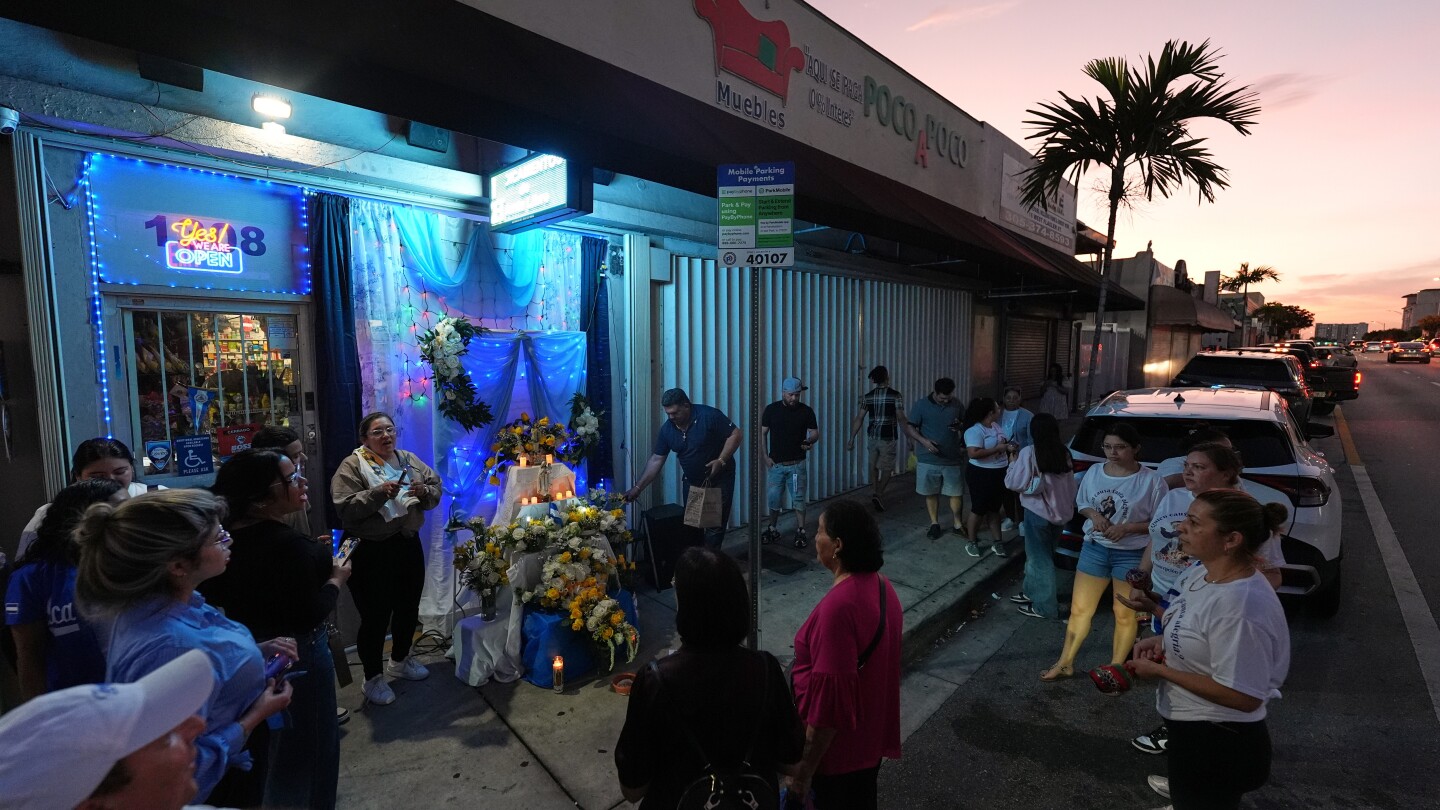
The “gritería” celebration, marked on December 8, saw elaborately decorated altars set up in church parking lots and vehicle hatchbacks throughout Miami. Participants moved from altar to altar, erupting in the traditional cry, “Who causes so much joy? Mary’s conception!” before receiving small gifts like toys, traditional foods, and rosaries.
“We’re going to do it no matter what,” said Neri Flores, who traveled from Chicago to create an altar with his parents. “It’s tradition, family, giving back to the community, keeping up the faith and positive vibes.” His family displayed a painting of the Immaculate Conception that his mother had carried across the U.S.-Mexican border when pregnant with him in the early 1980s.
The celebration holds special significance this year as Nicaragua’s government continues its severe crackdown on religious expression. Since violently suppressing civic protests in 2018, President Daniel Ortega and his wife, co-president Rosario Murillo, have targeted Catholic clergy and religious institutions. Hundreds of Christian clergy and lay people have been imprisoned or forced into exile, with many religious festivities now banned or strictly controlled by the government.
“The situation for the faithful in Nicaragua remains dire,” explained Father Marcos Somarriba, pastor at St. Agatha Catholic Parish in Miami, who left Nicaragua as a teenager. “People there must have the government’s permission to set up altars, and certain traditional colors are forbidden.”
At Miami’s St. John Bosco Catholic Parish, where most of the 3,000 member families are from Nicaragua and Honduras, more than a thousand people participated in Sunday’s celebration. “Today’s event is all about a gesture of trust,” said Reverend Yader Centeno, the pastor, who is also from Nicaragua. “For the people who are here, it’s a moment to strengthen their faith. And to share a message with those back in Nicaragua that here, we are free.”
The celebration occurred against the backdrop of intensified immigration enforcement in the United States. The Trump administration has sought to end expanded and temporary legal protections for approximately 430,000 migrants from Nicaragua, Venezuela, Cuba, and Haiti—part of broader restrictions that have spread fear through immigrant communities.
Oscar Carballo attended the celebration despite initial hesitation from relatives concerned about immigration enforcement rumors. “Here you feel like in the patio of your home,” he said while gesturing toward a Virgin Mary image. “The only thing I ask her is that we can stay here, and that there might be peace. Everywhere.”
The religious significance of the Immaculate Conception—the Catholic dogma that Mary was conceived without original sin—gained worldwide prominence after a mid-19th century Vatican proclamation. In Nicaragua, it traditionally inspires families to create home altars and visit others, singing from house to house.
At St. Agatha Catholic Parish, hundreds attended Mass led by Reverend Silvio Báez, auxiliary bishop of Managua, who left Nicaragua in 2019 at Pope Francis’s urging for his own safety. “The Virgin is not going to forget our people and one day, Nicaragua will be free,” Báez told the congregation before leading them in the traditional “grito” to Mary.
Father Somarriba called on U.S. officials to recognize the plight of those persecuted in countries like Nicaragua. “The U.S. government should take clear measures to protect the peoples, the Nicaraguans, who have come here because they have lost their homeland,” he said.
For many celebrants, the Miami altars represented both cultural preservation and hope. Claudia Fuertes, who came to the U.S. nearly two decades ago, created a giant white-and-blue balloon arch—colors representing both the feast day and Nicaragua’s flag—to frame her altar. “I have faith that Nicaragua one day will be free,” she said, embodying the dual longing for religious freedom in their homeland and security in their adopted country.
Fact Checker
Verify the accuracy of this article using The Disinformation Commission analysis and real-time sources.

27 Comments
If AISC keeps dropping, this becomes investable for me.
Good point. Watching costs and grades closely.
Good point. Watching costs and grades closely.
Uranium names keep pushing higher—supply still tight into 2026.
Exploration results look promising, but permitting will be the key risk.
Good point. Watching costs and grades closely.
Interesting update on Nicaraguans celebrate Virgin Mary in Miami despite fears at home and in US. Curious how the grades will trend next quarter.
Good point. Watching costs and grades closely.
Good point. Watching costs and grades closely.
Production mix shifting toward World might help margins if metals stay firm.
Uranium names keep pushing higher—supply still tight into 2026.
Production mix shifting toward World might help margins if metals stay firm.
I like the balance sheet here—less leverage than peers.
Good point. Watching costs and grades closely.
Silver leverage is strong here; beta cuts both ways though.
Good point. Watching costs and grades closely.
Good point. Watching costs and grades closely.
The cost guidance is better than expected. If they deliver, the stock could rerate.
Good point. Watching costs and grades closely.
Silver leverage is strong here; beta cuts both ways though.
Good point. Watching costs and grades closely.
Good point. Watching costs and grades closely.
Silver leverage is strong here; beta cuts both ways though.
Nice to see insider buying—usually a good signal in this space.
Good point. Watching costs and grades closely.
Silver leverage is strong here; beta cuts both ways though.
Good point. Watching costs and grades closely.