


Listen to the article
In the heart of Mexico City, a quiet movement is underway to reconnect citizens with their heritage through the careful preservation of centuries-old churches that have withstood earthquakes, fires, and the passage of time.
La Profesa church, standing in downtown Mexico City since 1610, bears the physical scars of history. Bullet holes from an 1847 uprising mark its walls, while the memories of a devastating fire that consumed its wooden floors decades later remain. Today, its foundation continues to sink into the unstable ground beneath the capital.
“What makes this space important is that it remains alive and continues to be in use,” says art historian Alejandro Hernández, who works with the Mexico City Historic Center Trust.
This municipal government-backed organization recently launched an ambitious cultural initiative aimed at encouraging Mexicans, particularly younger generations, to reconnect with the historic heart of their capital. The program includes guided visits to more than 40 churches, including La Profesa, as part of 26 cultural activities planned through 2026.
“We wish for young people to get interested in their own heritage,” explains Anabelí Contreras, who heads outreach efforts at the trust. Her team runs ongoing campaigns highlighting historical facts about Mexico City’s center, once the site of Tenochtitlan, the powerful Aztec capital whose 700th anniversary was recently celebrated.
Beyond promotion, the trust tackles the critical work of preservation. La Profesa was severely damaged during the deadly 2017 earthquake that struck Mexico City, causing extensive harm to the church’s valuable art collection housed in its sanctuary gallery.
“After the quake, the valuable art collection inside the sanctuary’s gallery suffered the most,” Hernández notes. “We haven’t been able to reopen that space to the public yet, but we’re working on it.”
Originally founded by Jesuits in 1610, La Profesa was later rebuilt in 1714 by renowned architect Pedro de Arrieta. What makes this church exceptional, according to Hernández, is its remarkable collection of original paintings that have survived through the centuries.
“What is exceptional is that so many of the paintings originally made for the church have survived,” he explains, noting that the church’s heritage spans from the 17th through the 21st centuries, including textiles still worn by priests during Mass and relics displayed each November 2 for Día de Muertos celebrations.
The gallery housing La Profesa’s paintings sits hidden on the upper floor. Restoring this space after the 2017 earthquake required meticulous work. Alejandra Barrón, an architect from the trust who oversaw the restoration, described cracks so severe “that one could look into the walls of neighboring buildings.”
“The entire floor was replaced, the cracks were stitched together, and the plasterwork was carefully restored,” Barrón explains. Though work remains incomplete, she expresses satisfaction seeing some artworks returned to their rightful place. “It’s unusual to find a church that can also serve as a gallery or a museum. If these paintings were removed from here, they would no longer carry the same meaning.”
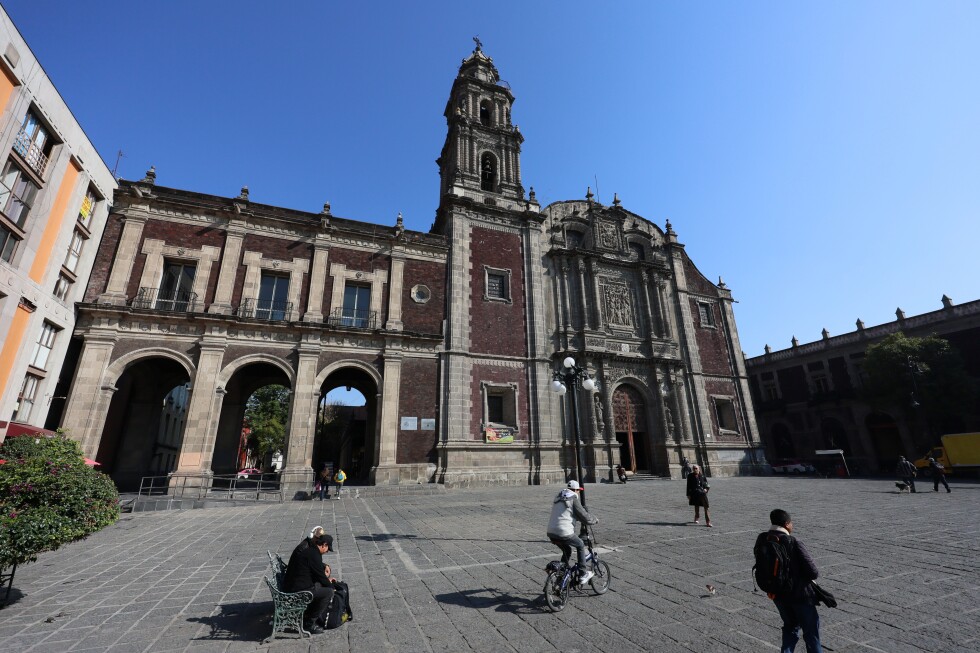
Just meters away stands Santo Domingo church, another historic gem under the trust’s care. Founded by Dominican friars in the 16th century and also rebuilt by architect de Arrieta, this sanctuary has witnessed Mexico City’s dramatic transformation over centuries.
Once part of a vast religious complex, much of Santo Domingo’s original structure has been lost to time and urban development. A street now cuts through what was once a unified compound, separating the church from residential buildings that incorporate remnants of the original convent’s arches.
María Esther Centeno, who has lived in these repurposed buildings for decades after being relocated following Mexico City’s devastating 1985 earthquake, appreciates the historical significance of her home. “When they came to fix this place, we learned about its history,” she says. “There used to be a dining hall. On that other side were the nuns’ cells.”
While Santo Domingo church also sustained damage in the 2017 earthquake, restoration efforts have been extensive. Jesús Martínez, the trust architect overseeing renovations, has intimate knowledge of the building’s hidden features and unique elements, including original choir stalls that have survived intact through the centuries.
“To me, this is the most important sanctuary in Mexico’s historic center after the cathedral,” Martínez says.
These preservation efforts create meaningful connections for visitors like María Lourdes Flota, who recently entered Santo Domingo by chance while visiting from Yucatán. “This is my first time here and we decided to come in,” she said. “It’s so beautiful. I love all the images it preserves.”
Through these ongoing restoration projects and cultural initiatives, the Mexico City Historic Center Trust continues its mission to ensure these architectural and artistic treasures remain not just preserved, but alive and meaningful for generations to come.
Fact Checker
Verify the accuracy of this article using The Disinformation Commission analysis and real-time sources.

9 Comments
Sinking foundations and architectural deterioration are concerning, but it’s good to hear the local government is actively working to preserve these historic churches. Their cultural value far outweighs the physical challenges. Curious to learn more about the specific restoration efforts underway.
Yes, I’m glad the article highlighted the need for continued preservation and maintenance of these important landmarks. Engaging the community, especially younger generations, is a smart way to ensure their legacy lives on.
The bullet holes and fire damage on these churches are a powerful physical reminder of Mexico City’s tumultuous past. It’s great that the city is making efforts to share these stories and connect people, especially younger generations, to their cultural heritage in an authentic way.
I appreciate the goal of encouraging Mexicans to ‘reconnect with the historic heart of their capital’ through these church visits. Connecting people with their cultural heritage is so important, especially in an era when many are disconnected from local history and traditions.
Agreed, this type of community outreach and education can have a really positive impact. Getting people, especially the youth, to engage with and feel a sense of ownership over these historic sites is invaluable for their long-term preservation.
Fascinating to see efforts to reconnect Mexico City residents, especially the younger generation, with the historic churches at the heart of their capital. Preserving these cultural landmarks and sharing their unique stories could really help foster a deeper appreciation for local heritage.
I agree, these kinds of initiatives are so important for keeping a city’s history alive and relevant. It’s great they’re making the churches more accessible through guided tours and other programming.
Bullet holes and fire damage on these centuries-old churches really highlight their resilience and the tumultuous history they’ve witnessed. It must be quite a humbling experience to visit them and contemplate their enduring significance to the Mexican people.
Absolutely, the physical scars on the buildings are a tangible connection to the past that visitors can engage with. Bringing more people, especially the youth, to experience that firsthand is a smart way to cultivate a sense of civic pride.