


Listen to the article
NATO Chief Navigates Trump’s Frustration Over Iran War Response
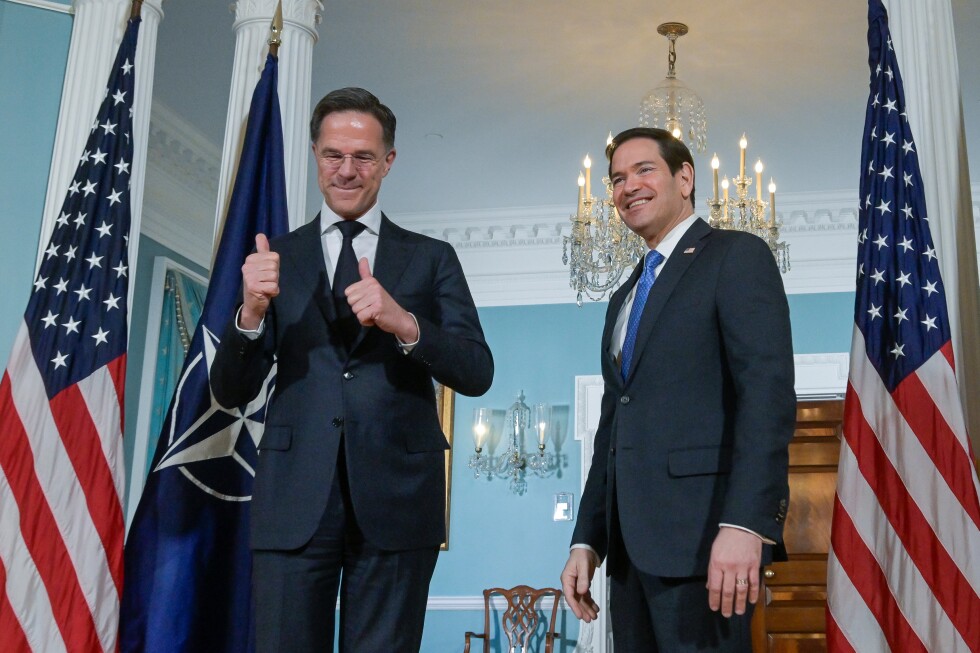
NATO Secretary-General Mark Rutte faced another challenging encounter with President Donald Trump, this time regarding the U.S.-Israel war on Iran – a conflict that falls outside NATO’s direct purview and about which the alliance was not consulted.
In recent days, Trump has openly criticized U.S. allies as “cowards,” dismissed NATO as “a paper tiger,” and compared UK Prime Minister Keir Starmer to Neville Chamberlain, infamous for his appeasement policy toward Nazi Germany before World War II.
The tensions come amid Trump’s ongoing threats regarding Greenland and his latest suggestion that the United States might withdraw from the alliance. Trump’s primary complaint centers on what he perceives as insufficient allied support as Iran effectively closed the Strait of Hormuz, a critical maritime chokepoint through which approximately 20% of global oil shipments pass.
Following discussions with Rutte on Wednesday, Trump took to social media to express his dissatisfaction: “NATO WASN’T THERE WHEN WE NEEDED THEM, AND THEY WON’T BE THERE IF WE NEED THEM AGAIN.”
When questioned about Trump’s potential NATO withdrawal plans during a CNN interview, Rutte diplomatically acknowledged, “He is clearly disappointed with many NATO allies, and I can see his point.”
Rutte, who assumed his NATO leadership role in 2024, has developed a reputation as a “Trump whisperer.” He helped orchestrate a plan whereby European allies and Canada purchase American weapons for Ukraine, maintaining U.S. involvement in Europe’s largest conflict in decades. One of his most pressing challenges has been keeping Trump engaged with NATO as American security priorities increasingly shift toward the Indo-Pacific region, Venezuela, and most recently Iran.
The NATO chief has employed strategic flattery, praising Trump for pushing allies to increase defense spending. He has also congratulated Trump regarding the Iran war while refraining from criticizing the president’s stark warning that “a whole civilization will die” should Iran not reopen the strait.
“This was a very frank, very open discussion but also a discussion between two good friends,” Rutte told CNN, while declining to confirm reports that Trump is considering relocating U.S. troops from European countries that haven’t supported the war. When asked if the world is safer due to the U.S.-Israel war, Rutte responded affirmatively: “Absolutely.”
The Iran conflict presents a unique situation for NATO, as the alliance has no formal role there. As a defensive organization, NATO has protected member state Turkey when Iranian missiles were fired at its territory in retaliation, but the war itself was initiated by a NATO member rather than against one.
Rutte has explicitly stated that NATO would not join the conflict, and there’s no public confirmation that the U.S. formally raised the matter at NATO headquarters in Brussels. When questioned about whether security for the strait had been officially discussed, NATO deferred to the United Kingdom, which is leading a non-NATO effort to secure the trade route once the ceasefire takes effect.
Estonian Foreign Minister Margus Tsahkna indicated his country’s willingness to consider NATO support for partners who request it. “If the U.S. or any other NATO ally is asking for our support, we are always ready to discuss it,” he told CNBC, adding, “But for that, we need of course the official ask to discuss then what is the mission, what is the goal?”
Rutte maintains that the alliance will only defend itself and not become involved in conflicts outside NATO territory, which encompasses much of Europe and North America. “This is Iran, this is the Gulf, this is outside NATO territory,” he emphasized.
While NATO has operated beyond the Euro-Atlantic area before, notably in Libya and Afghanistan, there is little appetite for similar engagements following the “chaotic U.S.-led exit” from Afghanistan in 2021, which former NATO Secretary-General Jens Stoltenberg characterized as a “defeat.”
Trump’s criticism appears primarily directed at Spain and France rather than NATO itself. Spain has closed its airspace to U.S. aircraft involved in the Iran war and denied American forces use of jointly operated military bases. After the announcement of a two-week ceasefire, Spanish Prime Minister Pedro Sánchez posted on X that his government “will not applaud those who set the world on fire just because they show up with a bucket,” adding that what’s needed is “diplomacy, international legality, and PEACE.”
France has also been critical, maintaining that the war was launched without respecting international law and without consultation with Paris. While France hasn’t imposed blanket restrictions on the use of joint bases or its airspace, French authorities have indicated they’re making such decisions on a case-by-case basis.
Fact Checker
Verify the accuracy of this article using The Disinformation Commission analysis and real-time sources.

8 Comments
The Strait of Hormuz is a critical global trade route, so I understand Trump’s concerns about securing it. However, a unilateral US-Israel war on Iran could have disastrous regional consequences. Rutte should push for a more multilateral approach.
This conflict with Iran seems to be a delicate geopolitical situation. While NATO may not have a direct role, I’m curious to see how Rutte navigates these tensions with Trump and coordinates a diplomatic response.
It will be interesting to see if Rutte can find common ground with Trump and rally more allied support, even if NATO isn’t directly involved.
While Trump may want more overt NATO support, the alliance likely wants to avoid getting drawn into another Middle East quagmire. Rutte will have to balance those competing priorities carefully.
Trump’s criticism of NATO’s ‘cowardice’ seems overly harsh. While the alliance may not be directly involved, its members likely want to avoid escalating the conflict with Iran if possible. Rutte will need to tread carefully in these discussions.
Rutte will need to balance placating Trump’s demands while also maintaining NATO’s diplomatic neutrality on this issue. Not an easy task.
This conflict seems to be straining the US-NATO relationship. Rutte will need to be a skilled negotiator to keep the alliance unified, even if it can’t directly intervene. Careful diplomacy will be key.
Agreed. Rutte will have to find a way to reassure Trump while also preserving NATO’s principles and cohesion. Not an enviable position.