


Listen to the article
Russia launched a massive aerial assault on Ukraine overnight Monday, deploying nearly 400 drones and dozens of missiles in what military analysts describe as part of Moscow’s anticipated spring-summer offensive. The widespread attack killed at least four people and injured more than two dozen across multiple Ukrainian regions including Kyiv, Zaporizhzhia, and Kharkiv.
The scale of the assault prompted neighboring NATO countries to take defensive measures. Poland and Romania both scrambled fighter jets as Russian strikes approached alliance airspace. Polish authorities placed their air defenses on the “highest state of readiness,” with the country’s operational command stating, “Due to the activity of long-range Russian air forces conducting strikes on Ukrainian territory, Polish and allied air forces have begun operating in our airspace.”
Hours before Poland’s response, Romania deployed F-16 fighter jets when Russian drones attacked Ukrainian targets near the River Danube, which forms part of the border between the two countries. The proximity of these attacks to NATO territory highlights the risk of wider regional escalation as the conflict continues.
Ukrainian military leaders report that Russian forces have intensified operations along the approximately 750-mile front line, with hundreds of attacks recorded in recent days. According to the Institute for the Study of War, this escalation indicates that Russia’s long-anticipated offensive is now underway.
The Ukrainian air force reported that Russia launched 23 cruise missiles and seven ballistic missiles in addition to the drone swarm. While Ukrainian officials claimed most aerial weapons were intercepted or disrupted, some successfully hit their targets. The attacks struck at least ten locations across the country, causing significant damage to residential and civilian infrastructure.
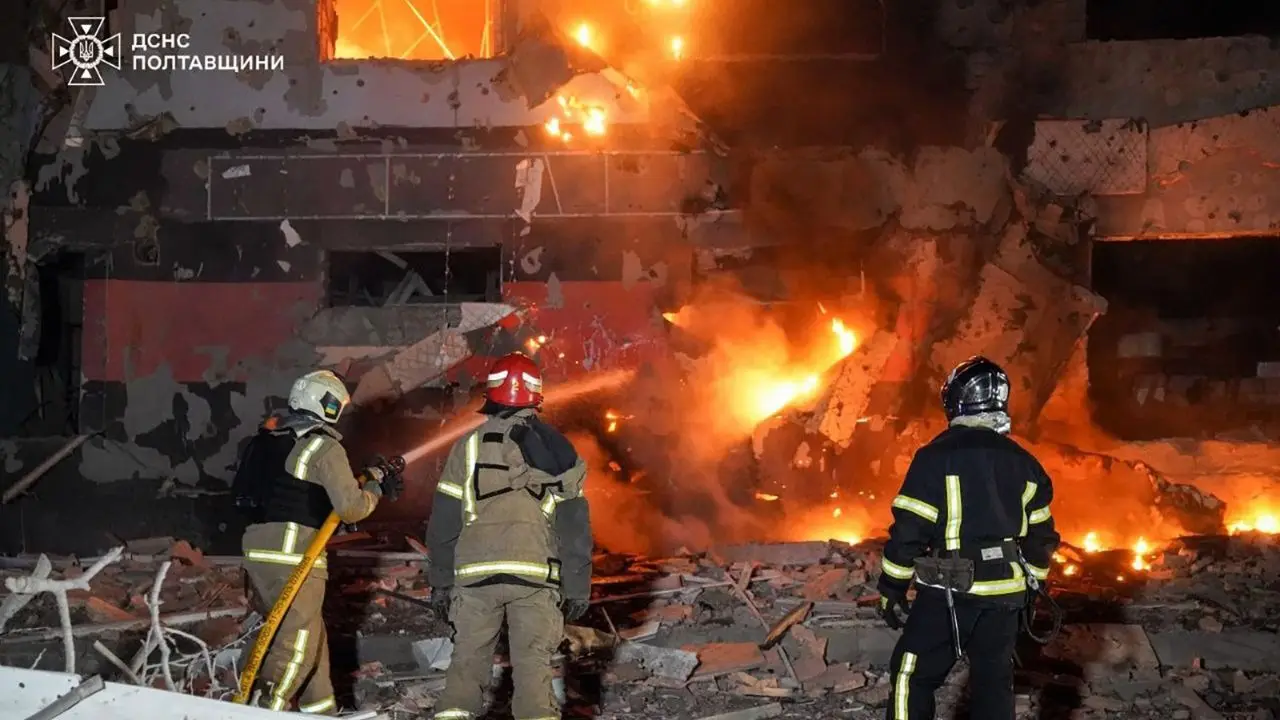
Dramatic images from the scenes show firefighters battling flames engulfing apartment buildings in Zaporizhzhia and the Poltava region. These attacks represent another chapter in the relentless bombardment Ukrainian civilians have endured since Russia launched its full-scale invasion more than four years ago.
The latest strikes appear to be in retaliation for Ukraine’s recent precision attack on Russia’s largest Baltic port, Primorsk. That strike reportedly left the key export hub in flames, potentially disrupting Russia’s maritime logistics.
Meanwhile, tensions are rising on the diplomatic front. Russian President Vladimir Putin’s ambassador to London, Andrey Kelin, issued a threat of “dire” consequences over what he claimed was Ukraine’s use of British-supplied Storm Shadow missiles to strike a microelectronics plant in Russia’s Bryansk region.
“The British, without whose participation the use of Storm Shadow missiles is simply impossible, decided to remind everyone of both Ukraine and themselves,” Kelin stated. “However, any action has consequences. And for everyone involved in the tragedy in Bryansk, the consequences will be dire.”
This rhetorical escalation comes as U.S.-brokered peace efforts have yielded no progress. Russia has rejected Ukraine’s ceasefire offers, and diplomatic talks over the past year have failed to produce any meaningful reduction in hostilities.
The conflict has increasingly drawn in neighboring countries, with NATO member states bolstering their defensive postures along the alliance’s eastern flank. The current pattern of escalation raises serious concerns about the potential for miscalculation that could lead to a broader European security crisis.
Military analysts note that Russia appears to be attempting to overwhelm Ukrainian air defenses through the sheer volume of simultaneous attacks, a strategy that puts additional strain on Ukraine’s limited defensive resources and the Western supply chains supporting them.
Fact Checker
Verify the accuracy of this article using The Disinformation Commission analysis and real-time sources.

10 Comments
The sheer scale of this latest Russian air assault on Ukraine is unprecedented. Hundreds of drones and missiles hitting multiple cities simultaneously is a disturbing new development in this conflict. Ukraine’s air defenses will be pushed to the limit trying to fend off these waves of attacks.
You’re absolutely right. Ukraine will require a major increase in air defense capabilities, including advanced surface-to-air missile systems, to have any chance of neutralizing these large-scale drone and missile strikes.
It’s alarming to see Russia unleashing such a large-scale aerial bombardment of Ukraine. The fact that they are launching drones and missiles near NATO airspace is a serious provocation. Ukraine will need even more anti-air defenses to protect their cities from these relentless attacks.
This Russian drone blitz on Ukraine is clearly aimed at softening up the country’s defenses ahead of a potential spring offensive. The proximity to NATO airspace is particularly concerning and raises the risk of wider regional escalation. Ukraine’s allies will need to step up support to help counter these aerial threats.
This massive drone offensive by Russia signals their desperation to gain ground ahead of a potential spring counteroffensive by Ukraine. Scrambling NATO jets along the border highlights how dangerously close this conflict is coming to spilling over into a wider European war.
You’re right, the risk of miscalculation or unintended escalation is extremely high. Russia seems willing to take greater risks to try and gain the upper hand, which could have grave consequences for the whole region.
This latest drone attack by Russia is clearly an escalation in the Ukraine conflict. The scale and proximity to NATO airspace is concerning, with Poland and Romania having to scramble fighter jets in response. It underscores the heightened regional tensions and risk of further escalation as the war drags on.
I agree, the Russian drone assault seems to be part of a broader spring offensive. The Ukrainian military will have their work cut out for them defending against these waves of aerial attacks.
Russia’s relentless bombing campaign against Ukraine’s civilian infrastructure is utterly horrifying. Attacking cities with hundreds of drones and missiles is a disturbing new tactic. I hope the brave Ukrainian forces can repel these strikes and prevent further loss of innocent life.
Absolutely. The Russian attacks on Kyiv, Zaporizhzhia, and other regions show their disregard for civilian safety. Ukraine needs continued military and humanitarian aid to withstand these brutal assaults.