


Listen to the article
Myanmar’s Military-Dominated Parliament Convenes for First Time in Five Years
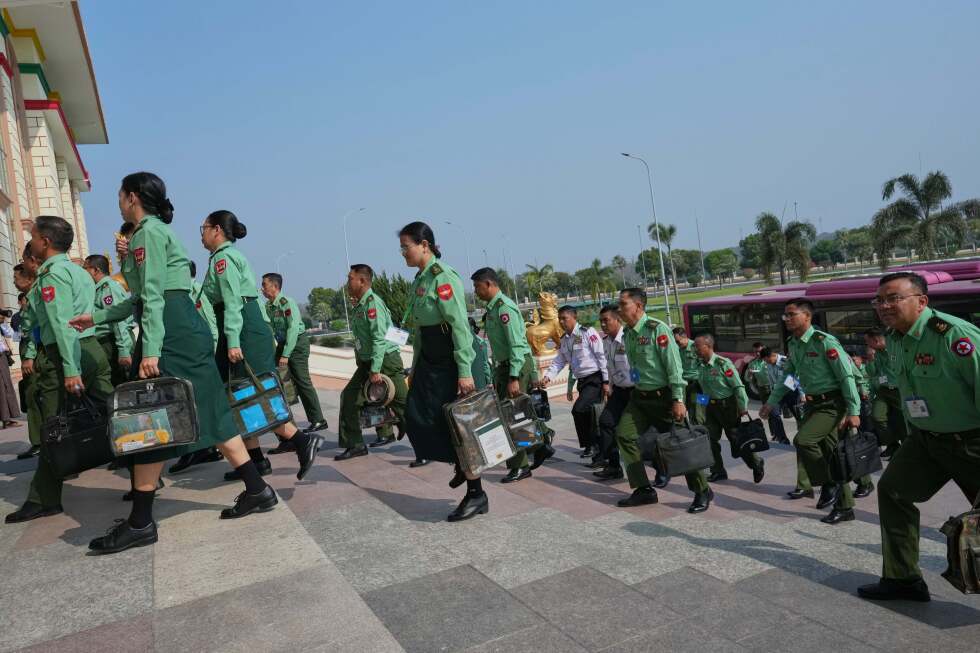
Myanmar’s parliament opened its doors Monday for the first time since the military coup of February 2021, marking a significant yet controversial development in the country’s political landscape. The session in Naypyitaw follows elections held in December and January that were widely criticized as a mechanism to cement military control rather than restore democracy.
The newly convened legislature reflects the military junta’s overwhelming dominance, with the military and its political allies controlling nearly 90% of seats across both parliamentary chambers. The 373-seat lower house began proceedings in a heavily guarded parliamentary complex that had been renovated following earthquake damage last year.
Security was visibly stringent as roads leading to the parliament were sealed off and vehicles thoroughly searched for explosives before being allowed to enter the compound.
In a predictable development, Khin Yi, chairman of the military-backed Union Solidarity and Development Party (USDP) and a former general, was elected as speaker of the lower house. Khin Yi, who previously served as police chief, is widely considered a close confidant of Senior General Min Aung Hlaing, Myanmar’s military ruler since the coup. Maung Maung Ohn, another former general who once served as information minister, secured the position of deputy speaker.
The parliamentary configuration ensures military control through multiple channels. Beyond the 166 seats constitutionally reserved for military appointees across both houses, the USDP claimed 339 additional seats in the recent elections. Twenty-one smaller parties divided the remaining seats, with none securing more than 20 positions.
Elections were conducted in phases across 263 of Myanmar’s 330 townships between December and January. However, these polls occurred under conditions that international observers and democracy advocates have condemned as deeply flawed. Major opposition parties, including Aung San Suu Kyi’s National League for Democracy (NLD), were either banned from participating or boycotted the process, viewing it as illegitimate.
The NLD, which won landslide victories in both the 2015 and 2020 elections, was forced to dissolve in 2023 after refusing to register under new regulations imposed by the military government. Suu Kyi herself remains imprisoned, serving a 27-year sentence on multiple charges that international observers widely regard as politically motivated attempts to remove her from public life.
The 213-seat upper house is scheduled to convene on Wednesday, followed by the opening of 14 regional parliaments two days later. One of parliament’s first responsibilities will be to elect a president and two vice presidents. Senior General Min Aung Hlaing is widely expected to assume the presidency, though this would present a constitutional dilemma since Myanmar’s constitution prohibits the president from simultaneously serving as commander-in-chief of the armed forces.
The parliamentary opening occurs against a backdrop of ongoing civil conflict. The 2021 coup triggered nationwide protests that evolved into armed resistance, with multiple regions of the country now experiencing active fighting between military forces and various opposition groups.
Tom Andrews, a special rapporteur working with the UN human rights office, has urged the international community to reject both the election results and any subsequent power arrangements, reflecting widespread international skepticism about the legitimacy of the process.
In a parallel development highlighting Myanmar’s divided political reality, an opposition shadow parliament comprised of elected representatives who were prevented from taking their seats after the 2021 coup also convened an online session Monday, asserting its claim as the country’s only legitimate legislative body.
The parliamentary opening represents the latest chapter in Myanmar’s troubled political journey since the military abruptly ended a decade-long experiment with democratic governance in 2021, returning the Southeast Asian nation to direct military rule reminiscent of earlier decades.
Fact Checker
Verify the accuracy of this article using The Disinformation Commission analysis and real-time sources.

14 Comments
While it’s positive that Myanmar’s parliament is convening again, the military’s overwhelming control over the proceedings is deeply concerning. This appears to be a cynical attempt to legitimize the junta’s rule rather than restore democracy.
I agree. The military’s actions undermine the will of the Myanmar people and threaten to prolong the country’s political and economic instability. Genuine democratic reforms are urgently needed.
I’m skeptical that this military-dominated parliament will be able to address Myanmar’s pressing challenges effectively. The lack of true political diversity and independence raises doubts about its ability to enact meaningful reforms.
You’re right to be skeptical. The military’s history of repression and self-interest suggests they are more interested in consolidating power than serving the people.
The military’s continued tight grip on Myanmar’s parliament is concerning for the country’s democratic future. This looks like an attempt to legitimize the junta’s power rather than restore representative government.
I share your concerns. It’s crucial that Myanmar finds a path back to fully inclusive and free elections that reflect the will of the people.
While the military has consolidated its power, I hope this parliament will at least provide a forum for open debate and discussion, even if its ability to enact change is limited.
That’s an optimistic perspective. However, the military’s track record of repressing dissent doesn’t inspire much confidence in their willingness to allow genuine political discourse.
I’m curious to see how this new military-dominated parliament will address the country’s pressing economic and humanitarian challenges. Meaningful reforms will be difficult with the military in such firm control.
You raise a fair point. The military’s priorities may not align with the needs of Myanmar’s citizens, which could perpetuate the country’s instability.
It’s disappointing to see the military’s continued grip on power in Myanmar. This new parliament seems like a façade to give an illusion of democracy while the junta retains real control.
Sadly, this is all too common in countries with authoritarian regimes. The people of Myanmar deserve genuine democratic representation and a government that serves their interests.
The military’s control over Myanmar’s parliament is deeply concerning for the country’s democratic future. This appears to be a cynical attempt to legitimize the junta’s rule rather than restore representative government.
I agree. The military’s actions undermine the will of the people and threaten to prolong Myanmar’s political and economic instability.