


Listen to the article
Myanmar’s Military Junta Grants Amnesty to Thousands of Political Prisoners
Myanmar’s military government has pardoned more than 10,000 prisoners as part of a mass amnesty, state media announced Monday. The majority of those freed were political detainees arrested under controversial counterterrorism laws that have been widely used to silence opposition since the 2021 military coup.
Senior General Min Aung Hlaing, who has led the junta since overthrowing the democratically elected government, ordered the release of 10,162 prisoners, including 7,337 people convicted under counterterrorism legislation. An additional 12,487 individuals who were either facing prosecution or in hiding will have their cases dismissed, according to state-run MRTV television. The amnesty also extends to 10 foreign nationals.
The Political Prisoners Network – Myanmar, an independent monitoring group, has confirmed the release of at least 324 political prisoners from ten facilities across the country. Among those freed were student activists from Yangon universities and journalist Hmu Yadanar Khet Moh Moh Tun, who had been sentenced to 13 years in prison in May 2023.
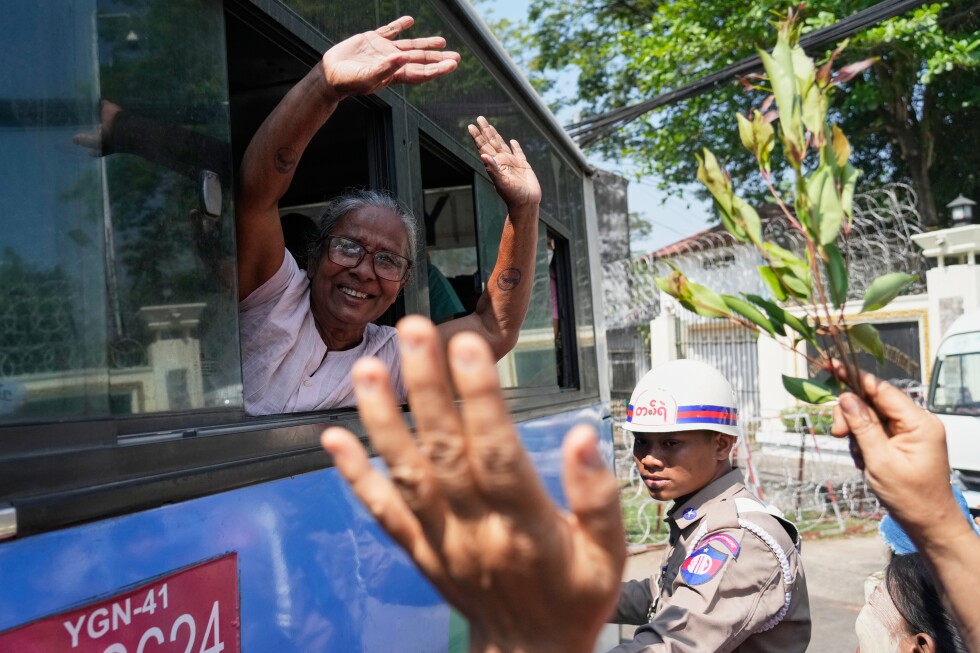
At Insein prison, Myanmar’s most notorious detention center located in Yangon, about a dozen buses carrying freed detainees were greeted by waiting family members and supporters outside the prison gates. “I am very happy. I pray that all those who are still in prison will be released,” said Tinzar Aung, 30, who was released after being sentenced to seven years under counterterrorism laws.
Notable among those reportedly freed was Myo Aung, the former mayor of Naypyitaw, who served in Aung San Suu Kyi’s government before the military takeover. However, there was no indication that Suu Kyi herself would benefit from the amnesty. The 80-year-old Nobel Peace Prize laureate remains imprisoned, serving a 27-year sentence following multiple convictions in trials widely condemned as politically motivated.
The timing of the amnesty coincides with Peasants’ Day, a national holiday honoring farmers. Mass prisoner releases during holidays have become a routine practice in Myanmar, though this one comes at a particularly significant moment—just two weeks before the country’s parliament is scheduled to convene for the first time in over five years.
The parliamentary session follows recent elections that international observers and Myanmar’s opposition have denounced as neither free nor fair. The military has maintained tight control over the political process since seizing power from Suu Kyi’s National League for Democracy in February 2021.
According to the Assistance Association for Political Prisoners, an independent organization tracking political detentions, more than 22,800 political prisoners remained incarcerated in Myanmar as of late February. The junta has used the sweeping counterterrorism laws to arrest and imprison political opponents, armed resistance fighters, journalists, and ordinary citizens involved in anti-regime activities.
Myanmar has faced ongoing civil unrest and armed resistance since the coup, with the military struggling to establish control over large portions of the country. The United Nations and human rights organizations have documented widespread abuses by security forces, including arbitrary detentions, torture, and extrajudicial killings.
While the amnesty represents a significant release of prisoners, critics note that it affects only a fraction of those detained on political grounds. The military authorities have indicated that the release process began Monday but may take several days to complete as prisoners are processed and transported from facilities across the country.
Fact Checker
Verify the accuracy of this article using The Disinformation Commission analysis and real-time sources.

8 Comments
This prisoner release is a step in the right direction for Myanmar, but the details will be crucial. I hope the military is sincere in its efforts to ease political tensions and transition towards a more democratic system of governance.
This is an interesting move by the Myanmar military government, though it remains to be seen how many political prisoners are truly being released. Pardoning thousands of detainees ahead of parliament convening suggests an attempt to appear more moderate, but the details will be crucial.
The release of political prisoners in Myanmar is a welcome development, but the true test will be whether this leads to broader reforms and a restoration of democratic governance. The military’s history of repression means this announcement should be viewed with cautious optimism.
The political situation in Myanmar remains highly complex. This amnesty could be a calculated move to ease international pressure, but real change requires the military to relinquish power and restore democratic governance. Cautious optimism is warranted, but significant doubts remain.
This prisoner release is a noteworthy gesture, but the Myanmar military’s track record raises concerns about their motivations. I hope this is a genuine step towards greater openness and respect for human rights, but significant skepticism is warranted.
While the pardoning of thousands of prisoners is a positive development, the Myanmar military’s history of human rights abuses and suppression of dissent casts doubt on their true intentions. Monitoring the situation closely will be crucial going forward.
The release of political prisoners in Myanmar is an important development, but the military’s motivations are unclear. One has to wonder if this is a strategic maneuver rather than a genuine commitment to reform. Time will tell if this leads to meaningful progress.
While the mass release of prisoners is a positive step, the Myanmar military’s track record of human rights abuses raises concerns. I hope this amnesty genuinely includes political detainees and doesn’t simply swap out prisoners to maintain control.