


Listen to the article
Myanmar’s Military-Backed Party Nears Parliamentary Majority in Contested Election
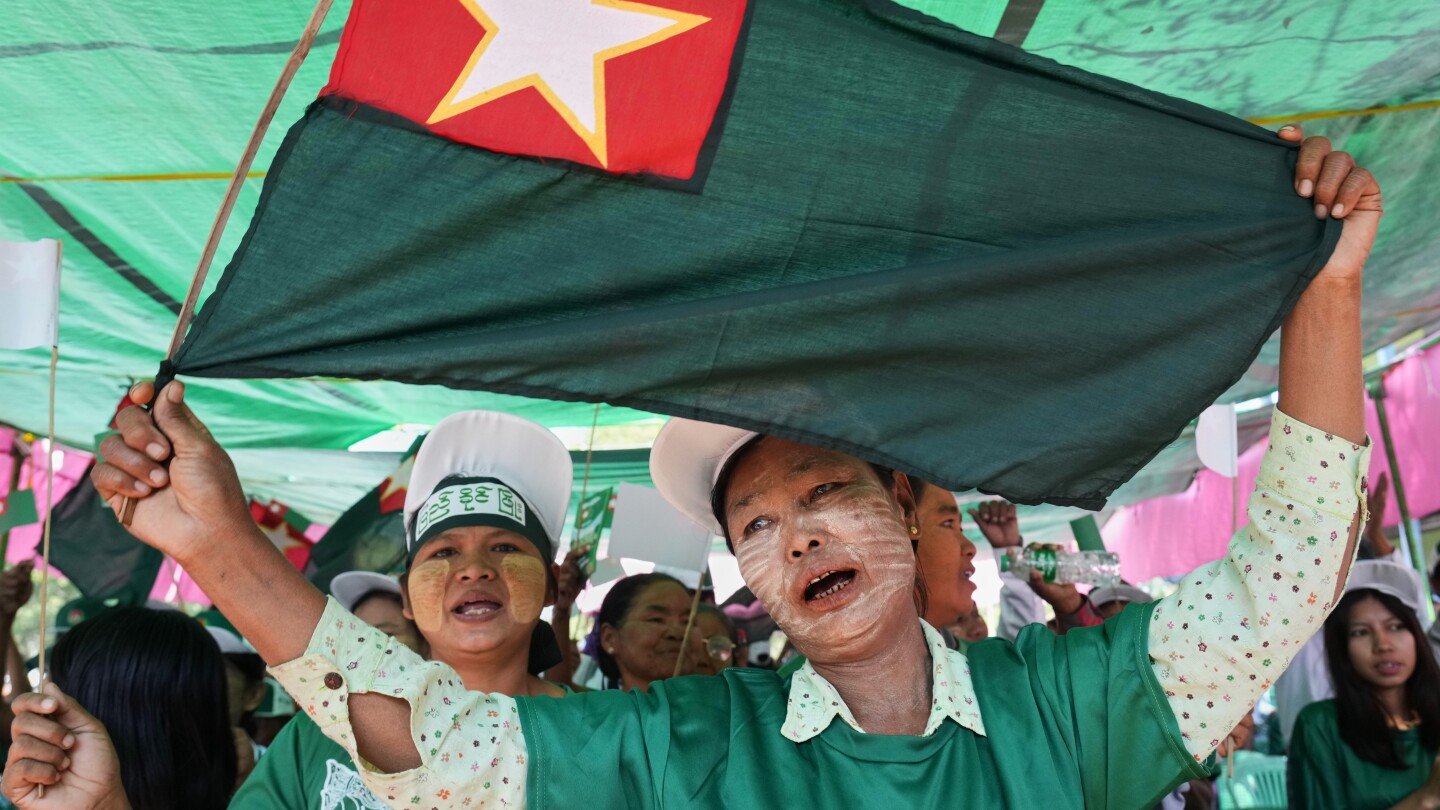
Myanmar’s military-backed Union Solidarity and Development Party (USDP) has strengthened its lead after the second round of voting in the country’s three-stage general election, putting it on course for a parliamentary majority amid widespread armed conflict and international skepticism.
According to figures released Friday by the Union Election Commission via state broadcaster MRTV, the USDP secured 86 of 100 contested seats in parliament’s lower house during the second phase of voting held last Sunday.
The results give the party a combined total of 182 seats from the first and second voting phases, representing more than half of the 330-member elected lower house with one round of voting still to come on January 25.
The election takes place against a backdrop of civil war that erupted after the military seized power from Aung San Suu Kyi’s democratically elected government in February 2021. The coup triggered widespread resistance that has evolved into armed conflict across much of the country.
Human rights organizations and opposition groups have denounced the election as neither free nor fair, characterizing it as an attempt by the military junta to legitimize its rule. The election is proceeding in three phases due to security concerns, with 202 of Myanmar’s 330 townships participating in the first two rounds. The final round will exclude 65 townships entirely because of intense fighting.
Myanmar’s legislative structure includes two houses totaling 664 seats. Under the constitution, the military automatically receives 25% of seats in each house. The party securing a combined parliamentary majority can select the new president, who then appoints the cabinet and forms the government.
Major General Zaw Min Tun, spokesperson for the military government, announced that both houses of parliament will convene in March, with the new government expected to take office in April.
The election has been marred by violence, with the military government reporting attacks by armed resistance groups against polling stations and government buildings during the first two rounds of voting. The junta has also implemented severe restrictions on political expression, enacting an Election Protection Law that imposes harsh penalties for public criticism of the electoral process.
Authorities have reportedly charged more than 330 people for activities such as distributing leaflets or posting online content critical of the election. This crackdown reflects the military’s determination to control the narrative surrounding the polls.
More than 4,800 candidates from 57 political parties are competing for seats in national and regional legislatures, though only six parties are contesting seats nationwide. Among them, the People’s Pioneer Party faces potential dissolution following legal scrutiny after its chairwoman, Thet Thet Khine, and another senior member allegedly held an unauthorized meeting with representatives from a foreign embassy in Yangon.
The USDP’s dominance was established in the first phase of voting when it won nearly 90% of contested lower house seats while also securing majorities in regional legislatures. Final results for all seats in both national and regional legislatures are expected to be announced by late January.
The election comes at a critical juncture for Myanmar, where the military’s grip on power faces unprecedented challenges from an increasingly coordinated resistance movement. The country’s economy has contracted significantly since the coup, while humanitarian conditions continue to deteriorate with millions displaced by conflict.
International observers have largely dismissed the election as a sham designed to provide a veneer of legitimacy to military rule, while Myanmar’s neighbors in ASEAN remain divided over how to address the ongoing crisis. The outcome of this election will likely determine the trajectory of Myanmar’s political landscape for years to come, though few expect it to resolve the fundamental conflicts that have torn the country apart since the 2021 coup.
Fact Checker
Verify the accuracy of this article using The Disinformation Commission analysis and real-time sources.

9 Comments
This is a complex and troubling situation. The military’s influence in the election process is deeply problematic and raises serious doubts about the integrity of the outcome. I hope the international community takes strong action to support democracy in Myanmar.
It’s troubling to see the military-aligned party extending its lead, especially given the ongoing armed conflict. I hope the international community closely monitors the situation and applies pressure for a more inclusive democratic process.
The military-backed party’s gains are worrying, as they seem to be consolidating power despite the unrest. I wonder what this means for the country’s future stability and prospects for democracy.
Agreed, the military’s grip on the political process is deeply problematic. This election will likely further entrench their control, which is concerning for Myanmar’s democratic trajectory.
The military’s continued dominance in Myanmar’s politics is very concerning. I hope the people’s voices can still be heard and that a path toward genuine democracy can be found, despite the challenges.
This election in Myanmar is highly contentious and concerning, given the military’s heavy involvement. I hope the people’s democratic will is respected, despite the ongoing armed conflict.
You raise a good point. The military’s outsized influence makes it difficult to have truly free and fair elections in the current climate.
This election seems to be unfolding in a highly contentious environment. I’m curious to see how the final round of voting plays out and whether there will be any meaningful international oversight or intervention.
You raise an important point. Given the military’s heavy hand, it will be crucial for there to be rigorous international monitoring and pressure for a fair and transparent process.