


Listen to the article
Millions of Vietnamese Cast Ballots in National Assembly Elections Following Party Congress
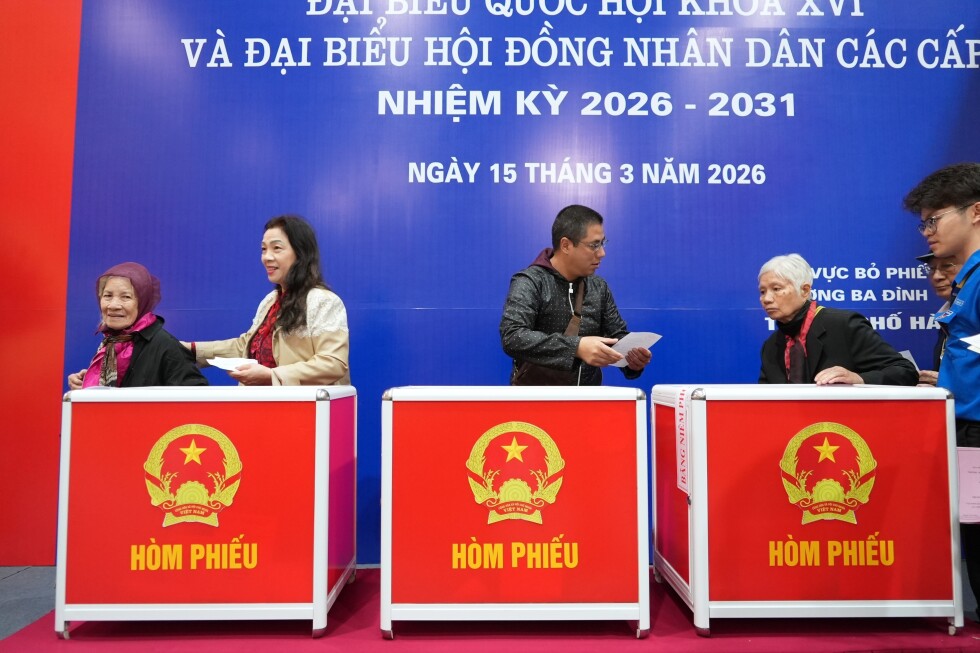
Millions of Vietnamese citizens headed to polling stations across the country on Sunday to elect representatives to the National Assembly, two months after the ruling Communist Party reaffirmed To Lam as the country’s top political leader.
Nearly 79 million eligible voters participated in selecting 500 representatives from a pool of 864 candidates. The election follows January’s Communist Party national congress, the quinquennial political gathering that established Vietnam’s leadership structure and policy priorities for the coming years.
After casting his ballot in Hanoi, General Secretary To Lam characterized the election as a national celebration. “We have the people’s support in this election,” Lam stated, describing the vote as an opportunity for citizens to choose representatives who will guide development and protect the nation’s sovereignty and stability.
While Vietnamese elections typically generate high turnout rates exceeding 90 percent, the political process remains tightly controlled. All candidates undergo thorough vetting and pre-approval by the Communist Party, ensuring the National Assembly maintains alignment with the party’s policy direction. The party defends this centralized leadership approach as necessary to pursue long-term development goals without disruption.
Retired official Doan Thi Bich expressed optimism about the process, stating, “As a voter in this election, I believe I will be able to choose candidates with morals, dedication and competence to serve the country, bringing development and prosperity to our country and our people.”
The new assembly inherits a Vietnamese economy that has transformed dramatically over the past decade. Rapid growth driven by manufacturing exports, foreign investment, and an expanding role in global supply chains has positioned Vietnam as a rising economic force in Southeast Asia. The country has become an increasingly attractive alternative for multinational corporations seeking to diversify production beyond China, particularly in electronics and textiles manufacturing.
Vietnam’s economic policy has evolved significantly in recent years. The government has established an ambitious target of 10 percent or higher annual economic growth over the next five years—a bold aspiration that signals confidence in the country’s development trajectory. Notably, this strategy places the private sector at the center of Vietnam’s development model, representing a meaningful shift for the communist state that historically emphasized state-owned enterprises.
Policymakers are now focusing on advancing Vietnam beyond low-cost manufacturing toward higher-value industries. This transition involves modernizing production methods and more extensively integrating science, technology, and digital tools throughout the economy.
However, the incoming National Assembly faces significant challenges. Vietnam’s export-dependent economy remains vulnerable to global trade tensions, including potential impacts from tariffs introduced by U.S. President Donald Trump. The assembly must also address domestic concerns related to income inequality, environmental sustainability, and navigating geopolitical competition between major powers in the region.
Vietnam’s political and economic evolution occurs against a backdrop of shifting global supply chains. As companies reassess their manufacturing footprints in Asia, Vietnam has positioned itself as a beneficiary of this realignment, with its political stability, growing industrial capacity, and strategic location attracting significant investment.
The new National Assembly is expected to convene its inaugural session in April. During this meeting, representatives will formally approve key government appointments and begin implementing the policy framework established during January’s party congress.
While the election results are unlikely to bring significant political changes given the Communist Party’s comprehensive control over the nomination and approval process, the assembly will play an important role in formalizing and executing Vietnam’s economic and social development plans for the coming years.
Fact Checker
Verify the accuracy of this article using The Disinformation Commission analysis and real-time sources.

16 Comments
I’m curious to learn more about the key issues and policy priorities that will guide Vietnam’s development in the coming years. Does the election provide a window into the government’s plans for the economy, infrastructure, and international relations?
That’s a great question. The article mentions the election follows the Communist Party’s national congress, so the results will likely reflect the party’s policy agenda rather than a wide-open debate of ideas.
It’s interesting to see how Vietnam is navigating the transition of political leadership, with the Communist Party reaffirming To Lam as the country’s top political leader. I wonder how this continuity in leadership will shape the policy priorities and development trajectory for Vietnam in the coming years.
That’s a valid question. The stability of Vietnam’s leadership may provide a sense of continuity, but it also raises concerns about the potential for political stagnation or a lack of new ideas. It will be worth monitoring how the new National Assembly approaches key challenges and opportunities.
It’s interesting to see how Vietnam’s political system works, with the Communist Party tightly controlling the candidate selection process. I wonder how much room there is for independent or opposition voices to emerge in these elections.
That’s a good point. The high voter turnout suggests the people feel they have a stake in the process, even if it is heavily managed by the party.
The high voter turnout in Vietnam’s elections is impressive, but the article also notes that the political process remains tightly controlled by the Communist Party. I’m curious to learn more about how this balance between popular participation and authoritarian oversight plays out in practice.
That’s a good point. The combination of high turnout and party control suggests the Vietnamese government is trying to maintain a veneer of democratic legitimacy, even if the actual decision-making power remains concentrated at the top.
The article mentions that while Vietnamese elections typically have high turnout, the political process remains tightly controlled by the Communist Party. I’m curious to learn more about the level of genuine public participation and the ability of citizens to influence the policy agenda through these elections.
That’s a good point to raise. The high turnout may indicate a sense of civic engagement, but the party’s control over the candidate selection process suggests the scope for meaningful public input is still quite limited. It will be interesting to see if there are any signs of gradual political reforms in the future.
It’s impressive to see such high voter participation rates in Vietnam’s elections, even if the process is tightly controlled. I wonder how this compares to voter turnout in other one-party political systems around the world.
Good point. High turnout doesn’t necessarily equate to a truly democratic process, but it does suggest the Vietnamese people feel invested in the political system to some degree.
The article mentions the election follows January’s Communist Party national congress, which established Vietnam’s leadership and policy priorities. I’m curious to see if the election results will align closely with the party’s agenda or if there will be any surprises.
That’s a fair question. Given the party’s tight control over the candidate selection, significant deviations from the party line seem unlikely. But it will be interesting to see if any new voices or ideas emerge within the confines of the system.
It’s notable that all candidates in Vietnam’s elections must undergo vetting and approval by the Communist Party. This suggests the political process is highly centralized and leaves little room for independent or opposition voices. I wonder how this affects the diversity of views represented in the National Assembly.
That’s a valid concern. The tight party control over the candidate selection process likely limits the range of perspectives and policy proposals that get heard. It will be interesting to see if there are any signs of gradual political liberalization in Vietnam over time.