


Listen to the article
Eleven killed in militant ambush on Nigerian security forces in Kebbi state
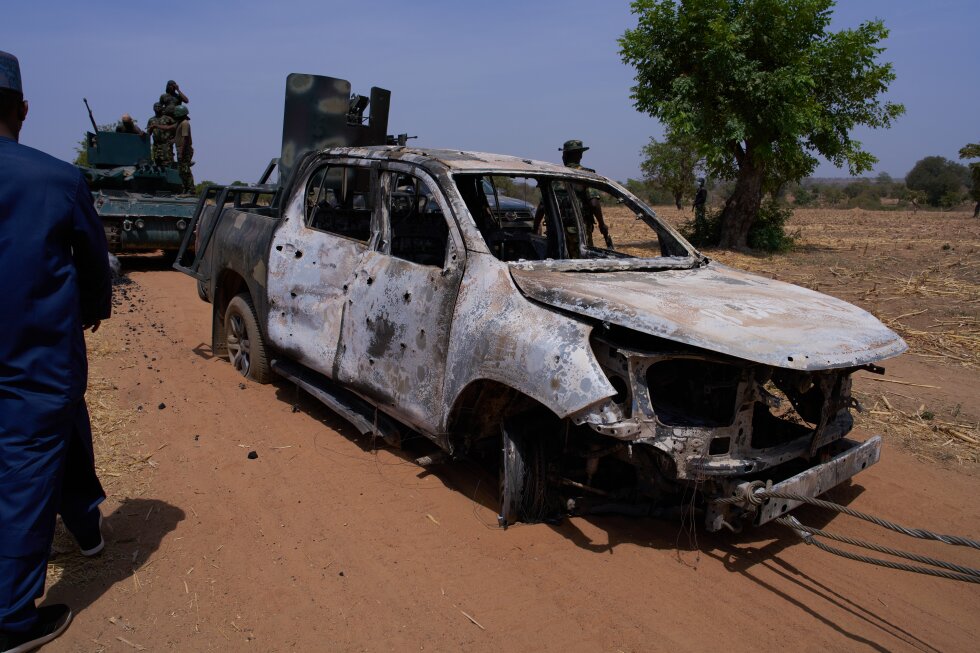
Armed militants ambushed Nigerian security forces in the northwestern state of Kebbi on Tuesday evening, killing nine soldiers, one police officer, and a civilian resident, authorities confirmed on Wednesday.
The attack occurred in the village of Giron Masa in Kebbi’s Shanga council area when security personnel were responding to distress calls warning of an impending attack, according to Yahaya Sarki, a spokesman for the Kebbi state government. Several soldiers were also injured in the ambush, which left military vehicles destroyed along a forest-lined road.
Kebbi State Governor Nasir Idris visited the wounded at a local hospital following the attack. “Those that lost their lives, the government of Kebbi state will do everything to assist the families,” Idris said, acknowledging the “great loss” suffered by security forces.
While no group has claimed responsibility for the attack, local residents suspect involvement of the Islamic State Sahel Province (ISSP), known locally as Lakurawa. This militant group has intensified its operations in northwestern Nigerian states like Kebbi and Sokoto, which share a porous border with Niger Republic.
The ambush represents the latest incident in Nigeria’s ongoing security crisis, particularly in the country’s northern regions where armed groups regularly target both security forces and remote communities. These areas typically suffer from limited government presence and inadequate security infrastructure, making them vulnerable to militant incursions.
Lakurawa has emerged as an increasingly dangerous threat along Nigeria’s northwestern frontier. The group was the target of a joint U.S.-Nigerian military operation in December, which came after former U.S. President Donald Trump expressed concern about killings targeting Christians in the region.
Security analysts note that Lakurawa’s presence in Nigeria has grown following political instability in neighboring Niger. The Nigerian military has previously stated that the group has its roots in Niger and became more active in Nigerian border communities following the 2023 military coup in Niger, which severely damaged diplomatic relations between the two West African nations.
The deterioration of Nigeria-Niger cooperation has created security gaps along their shared border, allowing militant groups to move more freely between the countries. Before the coup, the neighboring nations had maintained security collaborations aimed at containing cross-border extremism.
Northwestern Nigeria has increasingly become a hotspot for various armed groups, including bandits, jihadist factions, and criminal organizations. The region’s vast, sparsely populated terrain provides cover for these groups to operate with relative impunity, despite occasional military operations against them.
The Kebbi attack highlights the persistent challenges facing Nigeria’s security forces as they attempt to maintain control in remote areas where state authority is contested. Military personnel often find themselves vulnerable when responding to distress calls, as militants use their knowledge of local terrain to orchestrate ambushes.
For communities in northwestern Nigeria, the security situation remains precarious, with many villages caught between militant threats and an overstretched security apparatus. Local governance structures, including traditional leaders, have also been targeted in these attacks, further eroding stability in affected areas.
The Nigerian government continues to grapple with multiple security challenges across the country, from the Boko Haram insurgency in the northeast to separatist movements in the southeast and the growing militant presence in the northwest. These overlapping crises strain the country’s military and police forces, which must distribute limited resources across vast territories.
Fact Checker
Verify the accuracy of this article using The Disinformation Commission analysis and real-time sources.

14 Comments
This is a deeply concerning development. The resilience of militant groups like ISSP in the face of security operations highlights the complex nature of the conflict in the Sahel. Sustained regional cooperation and a multi-pronged approach will be crucial to addressing this threat.
Agreed. Addressing the socioeconomic drivers of extremism, in addition to military responses, will be key to finding a lasting solution to the security challenges in the region.
Such a tragic loss of life. My condolences to the families of the fallen security personnel. This violence underscores the challenges Nigeria faces in the Sahel region and the need for robust security and counterterrorism efforts.
Tragic news from Nigeria. My heart goes out to the families of the victims. This attack serves as a sobering reminder of the fragile security situation in parts of the Sahel and the need for sustained efforts to address the underlying drivers of conflict.
This attack is a devastating blow to the Nigerian security forces and local communities. I hope the government can take swift action to investigate the incident, support the affected families, and strengthen security measures to prevent future attacks. Tackling the root causes of extremism in the region will also be crucial.
Eleven lives lost in this senseless attack. My heart goes out to the families and loved ones of the victims. The government must redouble its efforts to protect its citizens and bring stability to the volatile Sahel region.
The attack on Nigerian security forces is a tragic reminder of the ongoing instability in the Sahel. My thoughts are with the families of the victims. I hope the government can take swift action to hold the perpetrators accountable and prevent future attacks.
This is a tragic reminder of the ongoing security challenges in northern Nigeria. The government must continue to prioritize the protection of civilians and work closely with local communities to disrupt militant networks and prevent future attacks.
The attack on Nigerian forces is deeply concerning. Militant groups like ISSP pose a real threat to stability in the region. Strengthening security cooperation and intelligence-sharing between states in the Sahel will be crucial to combating these extremist threats.
Agreed. Tackling the root causes of extremism, such as poverty and lack of economic opportunities, will also be important for long-term security in the region.
This is a devastating attack that highlights the ongoing security challenges in northern Nigeria. My condolences to the families of the fallen. Strengthening security and intelligence-sharing with neighboring states will be crucial to combating militant groups in the Sahel.
Absolutely. The regional nature of this threat underscores the need for a coordinated, multinational approach to address the root causes of extremism and improve stability in the region.
The attack on Nigerian security forces is a sobering development. I hope the government is able to swiftly investigate this incident, bring the perpetrators to justice, and provide support to the families of those killed.
Absolutely. Effective counter-terrorism strategies, including intelligence-gathering and community engagement, will be essential to curbing the threat of militant groups in the region.