


Listen to the article
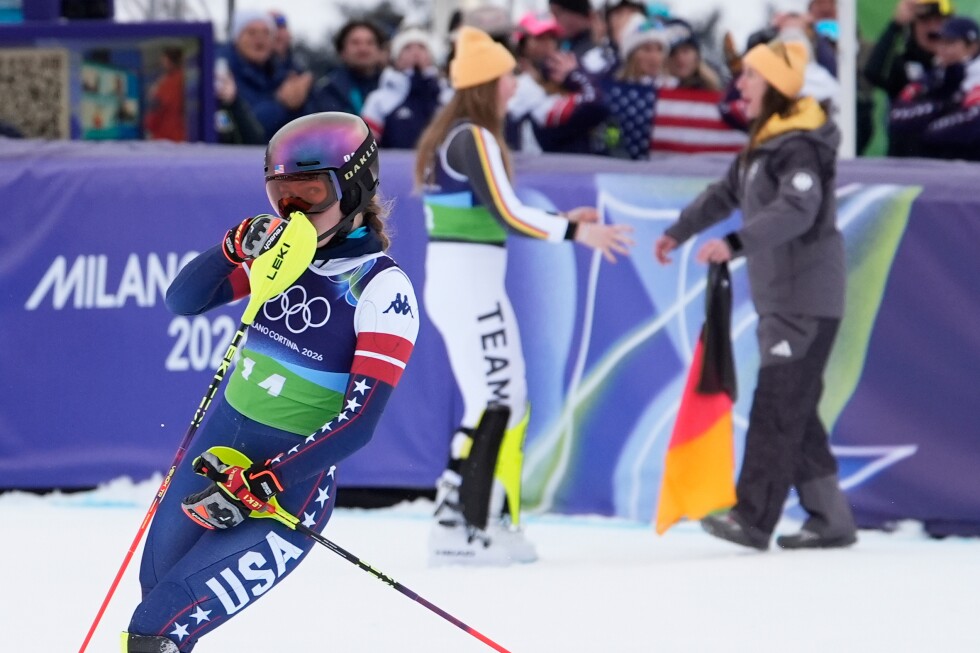
Mikaela Shiffrin’s Olympic journey in Cortina d’Ampezzo hit an unexpected bump Tuesday as the American skiing superstar struggled in the slalom portion of the first-ever Olympic women’s team combined event, resulting in a fourth-place finish alongside teammate Breezy Johnson.
Despite Johnson’s stellar downhill performance that gave the pair a slim lead of .06 seconds heading into the slalom, Shiffrin’s uncharacteristically slow run – ranking 15th among 18 finishers – saw their medal hopes evaporate.
“There’s something to learn today,” Shiffrin said with remarkable composure after the event. “I’m going to learn it.”
The gold medal went to the Austrian team of Ariane Raedler and Katharina Huber, while fellow Americans Jackie Wiles and Paula Moltzan secured the bronze – the first Olympic medals of their careers. Wiles, at 33 years and 7 months, became the oldest woman to medal in an Alpine event.
“We were asking for a miracle,” Wiles admitted, acknowledging that they had expected Shiffrin to deliver her typical dominant slalom performance and potentially bump them off the podium.
For Shiffrin, widely regarded as the greatest slalom skier in history with a record 108 World Cup victories, the performance was puzzlingly off-brand. She hadn’t finished that low in a completed individual slalom race since 2012, when she was still a teenager.
The American explained that something about the snow’s feedback under her skis felt wrong as she descended the Tofane course. Whatever the cause, she was unable to find her rhythm, losing time at every checkpoint.
“I think if you let Mikaela go run that course again, I think she’d come down at least a second faster,” Moltzan observed, highlighting the anomalous nature of Shiffrin’s run.
This setback comes four years after Shiffrin’s disastrous 2022 Beijing Olympics, where she failed to medal in any of her six events and recorded three DNFs (Did Not Finish). However, her reaction in Cortina proved markedly different – no tears, no visible frustration, just a pragmatic acknowledgment of a disappointing performance.
Shiffrin had arrived at the Dolomite mountains with considerable momentum, having already secured her record ninth World Cup season title in slalom thanks to seven victories this season. At 30, she remains at the pinnacle of the sport, but Olympic competition has increasingly become her most challenging venue.
The spotlight on Shiffrin appears somewhat dimmed at these Games compared to Beijing, partly due to the return of Lindsey Vonn and Shiffrin’s more calculated approach to her Olympic program. She limited her Cortina schedule to just three events: the team combined, giant slalom, and her signature slalom discipline.
After the race, Shiffrin quickly shifted focus to celebrating her teammates’ success. She embraced Johnson immediately after finishing and then congratulated Moltzan and Wiles on their bronze medal achievement.
“There’s so much sweet about the day,” Shiffrin reflected. “So we’re taking that and I will have some learning to do like always.”
With the individual technical events still ahead, Shiffrin will use Wednesday to recover before returning to competition on Thursday. Her resilience and analytical approach suggest she’s determined to make adjustments before her remaining races.
“I’m going to have to learn what to do, what to adjust in the short time we have before the other tech races,” she said. “There’s always something to learn.”
For the American Alpine ski team, the day ultimately brought celebration despite Shiffrin and Johnson’s fourth-place finish. Wiles, who had tearfully discussed her fourth-place downhill finish earlier in the Games, finally claimed an Olympic medal, while Moltzan also secured her first podium at the highest level of competition.
The mixed fortunes of the American squad highlight the unpredictable nature of Olympic competition, where even the most decorated champions can struggle while long-awaited breakthroughs occur simultaneously for their teammates.
Fact Checker
Verify the accuracy of this article using The Disinformation Commission analysis and real-time sources.

19 Comments
Nice to see insider buying—usually a good signal in this space.
Good point. Watching costs and grades closely.
Good point. Watching costs and grades closely.
I like the balance sheet here—less leverage than peers.
Good point. Watching costs and grades closely.
Good point. Watching costs and grades closely.
If AISC keeps dropping, this becomes investable for me.
Good point. Watching costs and grades closely.
Good point. Watching costs and grades closely.
Nice to see insider buying—usually a good signal in this space.
Good point. Watching costs and grades closely.
Interesting update on Mikaela Shiffrin’s fourth Olympics begin with a sluggish slalom and a fourth-place finish. Curious how the grades will trend next quarter.
Good point. Watching costs and grades closely.
Interesting update on Mikaela Shiffrin’s fourth Olympics begin with a sluggish slalom and a fourth-place finish. Curious how the grades will trend next quarter.
Nice to see insider buying—usually a good signal in this space.
The cost guidance is better than expected. If they deliver, the stock could rerate.
Exploration results look promising, but permitting will be the key risk.
Nice to see insider buying—usually a good signal in this space.
Uranium names keep pushing higher—supply still tight into 2026.