


Listen to the article
Mexico’s Supreme Court Goes Local, Holds Historic Session in Indigenous Town
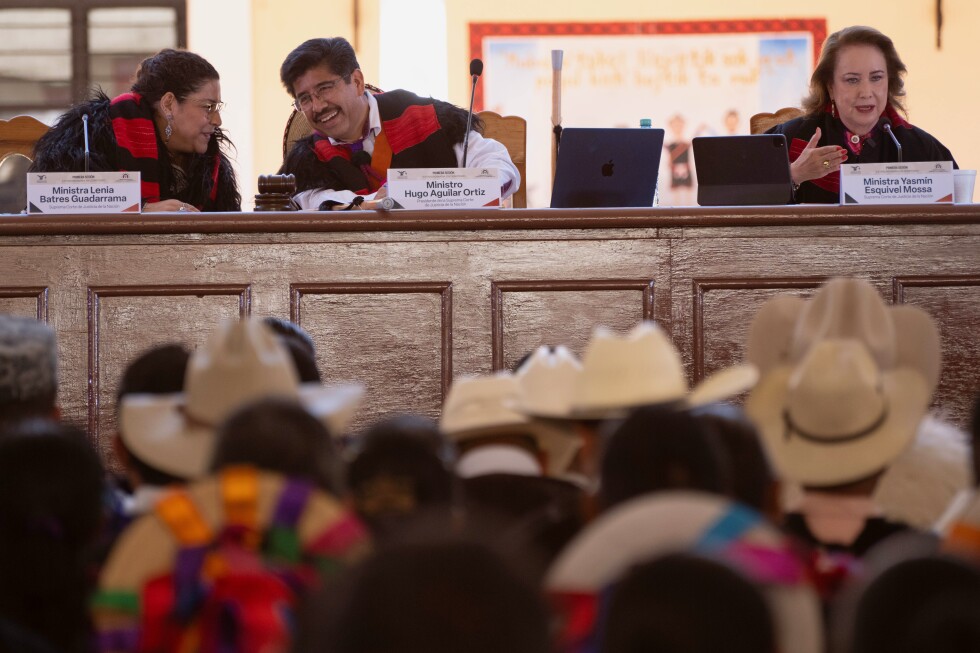
In an unprecedented move to bring justice closer to the people, Mexico’s Supreme Court conducted its first-ever session outside Mexico City on Thursday, convening under a tent in the central square of Tenejapa, a mountain town in the southern state of Chiapas.
Around 2,000 people gathered to witness the court’s deliberations in this historic session, marking the beginning of an initiative to make the country’s highest judicial body more accessible to citizens in remote regions.
“Often in our communities we only feel the effects of a decision” taken far away, said Chief Justice Hugo Aguilar during the session. “Now, the goal is that you see how we deliberate, that you know what we say, how we consider and make a decision.”
Aguilar, an Indigenous lawyer from neighboring Oaxaca state, leads the first Supreme Court to be popularly elected under a recent constitutional reform. His presence in Tenejapa carried particular significance for the largely Indigenous audience.
Among those attending were Indigenous leaders and local authorities, some holding signs declaring “right to self-determination.” The session addressed several regional cases, including one from the community of La Candelaria in San Cristobal de las Casas, which has been seeking self-governance for years.
María de la Cruz Velasco, president of a foundation supporting femicide victims, expressed her approval of the court’s outreach efforts. “It makes me happy that this new minister comes out to the towns, to cities to carry out justice because we really need to listen to the people,” she said.
Velasco shared her personal experience with Mexico’s justice system, recalling how local courts initially refused to classify her daughter’s murder as femicide. The Supreme Court eventually intervened, recognizing the gender-based nature of the crime. “Today my daughter’s killer is serving 55 years in prison,” she noted.
While Supreme Court proceedings are typically technical and difficult for non-lawyers to follow, the institution has built a reputation for defending human rights with a progressive perspective, particularly for Indigenous communities and victims of violence. This commitment to justice has earned the court credibility among marginalized populations, even when local authorities have failed to implement its rulings.
The move to hold sessions outside the capital reflects broader reforms to Mexico’s judicial system. Last year’s constitutional changes introduced popular elections for Supreme Court justices, a controversial measure intended to make the court more responsive and accountable to citizens.
Critics widely condemned the electoral process as an attempt to politicize the country’s highest court. Voter turnout was notably low, and candidates aligned with the ruling party secured a majority of seats. These concerns, however, were not raised during Thursday’s session in Tenejapa, where the focus remained on the court’s unprecedented outreach.
The decision to begin this series of external sessions in Chiapas holds particular significance. The state is home to numerous Indigenous communities that have historically struggled to access justice through Mexico’s legal system. By bringing the court directly to these communities, the justices are signaling a commitment to addressing long-standing concerns about judicial accessibility.
For the residents of Tenejapa and surrounding areas, the Supreme Court’s visit represented more than a symbolic gesture. It offered a rare opportunity to witness firsthand the deliberative process that shapes legal decisions affecting their lives and communities.
As Mexico continues to navigate complex issues of justice reform and Indigenous rights, this initiative may serve as a model for making other government institutions more accessible to citizens throughout the country, particularly those in traditionally underserved regions.
Fact Checker
Verify the accuracy of this article using The Disinformation Commission analysis and real-time sources.

12 Comments
The presence of the Indigenous Chief Justice in this session in Chiapas is particularly meaningful. His leadership sets an important precedent for greater representation of underserved communities in Mexico’s highest courts.
Absolutely, this shows a commitment to diversifying the judiciary and recognizing the rights and perspectives of Indigenous peoples.
The inclusion of local authorities and Indigenous leaders as attendees is a positive sign that the court is seeking broader engagement with affected communities. This inclusive approach seems crucial for addressing issues of self-determination.
Agreed, involving local stakeholders in the court’s proceedings is an important step towards more representative and responsive justice.
It will be interesting to see if this becomes a regular practice for the Mexican Supreme Court. Holding sessions in remote areas could help bridge the gap between the justice system and marginalized communities.
A valid point. Maintaining this outreach effort could be an effective way to build trust and accountability between the court and citizens across the country.
This is an interesting move by Mexico’s Supreme Court to hold a session outside the capital. Bringing the highest judicial body closer to remote and Indigenous communities is a positive step towards making the justice system more accessible and inclusive.
I agree, it’s a welcome initiative to demystify the court’s proceedings and allow citizens to observe the deliberation process firsthand.
The large turnout of around 2,000 people suggests a strong public interest in witnessing the Supreme Court’s deliberations. This level of civic engagement is encouraging and could help build momentum for further judicial reforms.
Definitely, the enthusiastic public response underscores the importance of this initiative and the potential for it to catalyze greater transparency and accountability in Mexico’s justice system.
While this is a commendable initiative, it remains to be seen whether it will lead to tangible improvements in access to justice and respect for Indigenous rights in Mexico. Continued monitoring and follow-through will be key.
That’s a fair point. The true test will be whether this session translates into meaningful changes in the court’s rulings and policies that benefit marginalized communities.