


Listen to the article
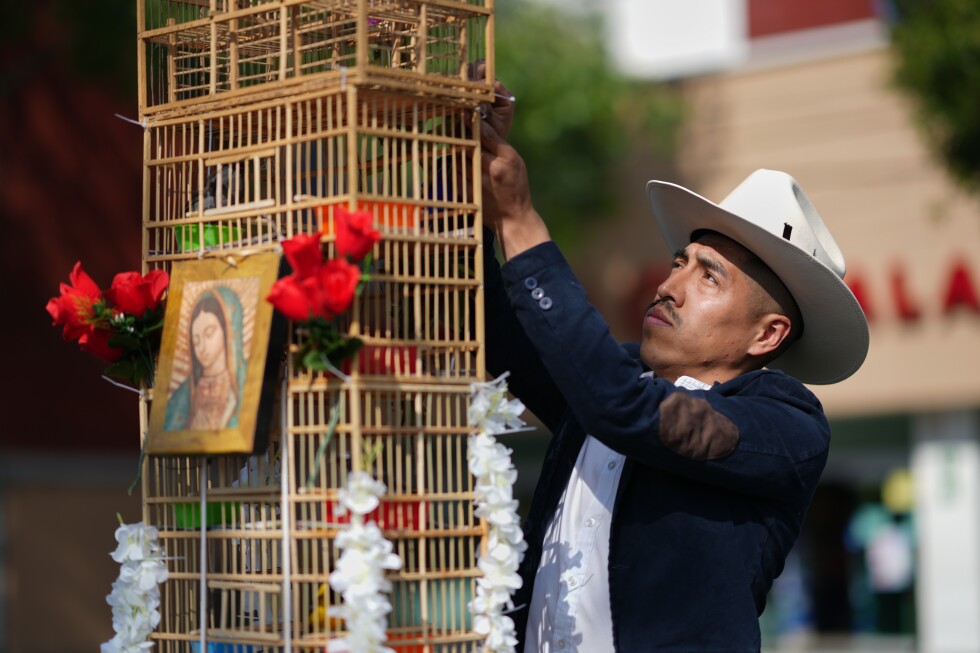
For 32 years, Cruz Monroy has walked the streets of San Bartolo Morelos on the outskirts of Mexico City, carrying towering stacks of bird cages filled with a kaleidoscope of feathered creatures. The melodious calls of red cardinals, green and blue parakeets, and multicolored finches have become his daily soundtrack.
“Hearing their songs, it brings people joy,” says Monroy, as bird melodies echo around his home where he raises and cares for his avian inventory. “This is our tradition, my father was also a bird-seller.”
These “pajareros,” or street bird vendors, represent a cultural practice that has spanned generations in Mexico. The sight of men carrying stacks of cages, sometimes towering above their own height, has long been commonplace in Mexican markets. They form part of the estimated 1.5 million street vendors that make their living in Mexico’s informal economy.
The tradition reaches its colorful apex during Palm Sunday celebrations, when hundreds of pajareros from across the country converge on Mexico City. For this special occasion, they transform their already eye-catching displays into spectacular mobile aviaries, decorating the 10-foot-tall cage stacks with bright flowers, tinsel, and images of the Virgin of Guadalupe, Mexico’s patron saint.
During this annual pilgrimage, vendors and their families walk miles through Mexico City’s streets to reach the Basilica of Guadalupe, creating a moving spectacle that has become an integral part of the city’s cultural tapestry.
However, this distinctive tradition faces an uncertain future. In recent years, the number of pajareros has steadily declined amid increasing regulatory pressure and growing criticism from animal rights organizations. These groups contend that the practice constitutes animal abuse and contributes to wildlife trafficking, particularly concerning protected species.
Mexican authorities have implemented stricter regulations on the capture and sale of certain birds, especially tropical species like parrots, which they emphasize are “wild birds, not pets.” These increasing constraints have made the profession increasingly precarious.
Monroy and his fellow bird vendors defend their practices, maintaining that they don’t capture prohibited species and often breed their birds themselves. They take pride in the care they provide their animals and see themselves as preserving an important cultural tradition.
“Because of the restrictions, harassment by certain authorities, many friends have left selling birds behind,” Monroy explains, his face showing the weariness of someone fighting a losing battle against changing times and attitudes.
The economic instability has forced Monroy to reconsider the family tradition. Despite following in his father’s footsteps, he doesn’t want his own sons to continue the practice. “For my children, it’s not stable work anymore. We have to look for other alternatives,” he says.
The decline of the pajareros reflects broader tensions in Mexican society between preserving cultural traditions and addressing modern environmental and ethical concerns. As urban Mexico modernizes, these colorful, musical street vendors represent a disappearing way of life that once formed an essential part of the country’s cultural identity.
For communities like San Bartolo Morelos, the potential loss of the pajarero tradition represents more than just an economic shift—it signifies the fading of cultural knowledge, specialized skills, and community practices that have been passed down through generations.
As regulatory pressures mount and public attitudes continue to evolve regarding the keeping of wild birds, Monroy and his fellow vendors find themselves at a crossroads. The towers of brightly decorated bird cages that once dominated markets and streets may eventually become a memory, their cheerful melodies silenced by changing times.
Yet for now, in the early mornings across small towns surrounding Mexico City, the distinctive songs of dozens of birds still announce the arrival of the pajareros, preserving—at least for a little while longer—a tradition that has colored Mexican street life for generations.
Fact Checker
Verify the accuracy of this article using The Disinformation Commission analysis and real-time sources.

11 Comments
The article highlights how these bird vendors are part of Mexico’s rich cultural heritage, passed down through generations. It’s heartening to see them finding joy in their work and sharing it with their community. I hope the authorities can find ways to support this tradition while also addressing any animal welfare concerns.
The bird vendor tradition seems to embody the creativity, resilience, and community spirit of Mexico’s informal economy. While there may be challenges to overcome, I hope the authorities can find ways to support these vendors and ensure their cultural practices can continue to thrive. Their joyful bird songs must be a delightful part of daily life for many Mexicans.
It’s wonderful to learn about this unique cultural tradition of street bird vendors in Mexico. Their colorful displays and the melodious calls of the birds must create a truly captivating atmosphere in local markets. I hope the authorities can find ways to support these vendors and ensure their livelihoods and cultural practices can continue, while also addressing any valid concerns about animal welfare.
Yes, finding that balance between preserving cultural traditions and addressing modern-day concerns is crucial. I’m glad the article highlighted this issue, as it speaks to the complex challenges facing many traditional livelihoods around the world.
This article highlights the importance of preserving traditional livelihoods and cultural practices, even as societies modernize. The bird vendors seem to play an important role in the vibrancy and character of Mexican markets and communities. I’m curious to learn more about the environmental and animal welfare considerations around this trade, and how a balance can be struck to sustain this longstanding tradition.
It’s fascinating to learn about this long-standing tradition of bird vendors in Mexico. Hearing their joyful song must be a wonderful experience for locals and visitors alike. I wonder how the vendors are adapting to changing times and regulations – hopefully they can find ways to preserve this cultural practice.
This is a fascinating glimpse into a unique aspect of Mexico’s informal economy and cultural landscape. The vibrant displays of the bird vendors during the Palm Sunday celebrations must be a sight to behold. I wonder what other traditional livelihoods and practices are at risk of dying out in the face of modernization, and how communities can work to preserve them.
The article paints a vibrant picture of the bird vendor tradition in Mexico, which seems to be an integral part of the country’s cultural fabric. While change is inevitable, I hope the authorities can work with these vendors to find ways to sustain this longstanding practice in a responsible manner. Their colorful displays and the joy they bring to their community are truly special.
The bird vendors seem to play an important role in the informal economy and cultural life of Mexico. I’m curious to learn more about the challenges they face, like competition from online retailers or concerns about animal welfare. Their colorful displays during Palm Sunday celebrations sound like a beautiful sight to behold.
Yes, it would be interesting to understand the economic and regulatory pressures the vendors face. Maintaining these long-held traditions in the modern world can’t be easy, but their cultural significance is clearly important to preserve if possible.
This is a really fascinating look at a unique cultural tradition in Mexico. The street bird vendors and their joyful displays sound like such a delightful part of daily life. I’m curious to learn more about the challenges they face, both in terms of economic pressures and any animal welfare concerns. Hopefully solutions can be found to preserve this tradition while also addressing modern-day realities.