


Listen to the article
U.S. and Mexico Reach Water-Sharing Agreement Under Tariff Pressure
Mexico and the United States announced Tuesday they have reached a new agreement on cross-border water sharing, with Mexico committing to deliver a minimum annual amount of water to its northern neighbor. The deal comes after months of negotiations and amid pressure from Washington, including threats of tariffs.
Under the terms of the agreement, Mexico will provide at least 350,000 acre-feet of water annually to the United States during the current five-year cycle. An acre-foot represents the volume of water needed to cover one acre of land to a depth of one foot—roughly 326,000 gallons.
This arrangement marks a significant departure from the framework established in the 1944 Water Treaty, which has governed water distribution between the two nations for nearly eight decades. The existing treaty requires Mexico to deliver 1.75 million acre-feet of water from six tributaries every five years—averaging 350,000 acre-feet annually—but does not mandate specific yearly deliveries.
U.S. officials have long complained that Mexico’s delivery pattern causes problems for American farmers, particularly in Texas. Historically, Mexico has accumulated water deficits in the early years of each five-year cycle before making larger deliveries later, creating unpredictability for agricultural planning across the border.
“Mexico confirmed its willingness to guarantee the delivery of an annual minimum quantity agreed to by both countries,” stated Mexico’s Foreign Affairs, Environmental and Agriculture ministries in a joint announcement, though their statement notably omitted mentioning the specific 350,000 acre-feet figure.
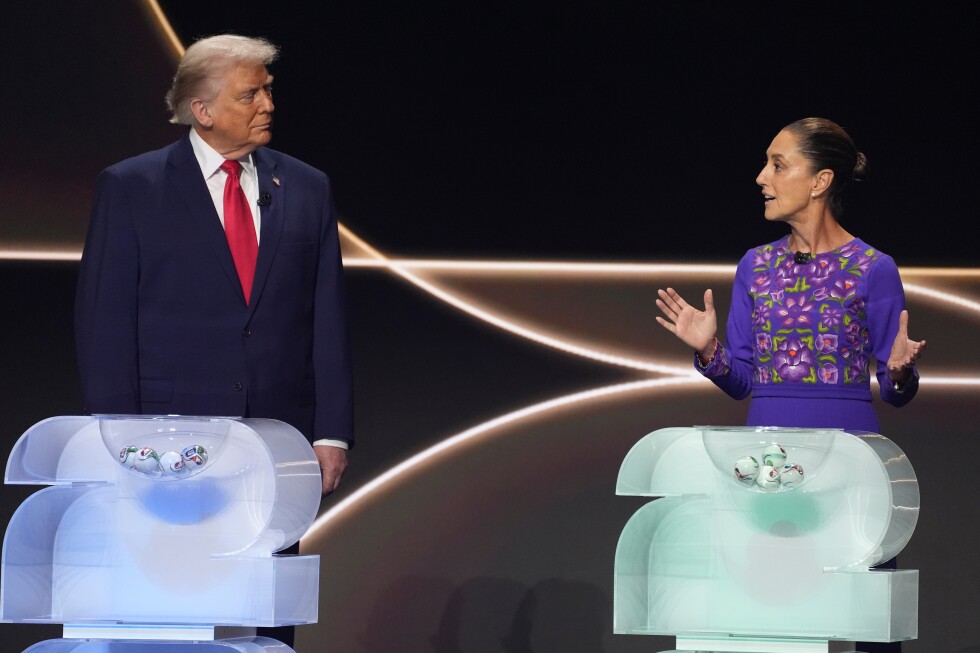
The agreement follows direct communication between President Donald Trump and Mexican President Claudia Sheinbaum. Trump had threatened to impose a 5% tariff on Mexican imports if water deliveries were not increased—a significant economic threat considering the extensive trade relationship between the countries. Last week’s phone conversation between the two leaders appears to have been pivotal in finalizing the deal.
While the U.S. government portrays the agreement as a diplomatic victory, the water-sharing issue remains contentious in Mexico, particularly among farming communities in the country’s drought-stricken northern states. Farmers in Tamaulipas, which borders Texas, have reported that water shortages have already forced some to abandon planting crops this season.
The bilateral water relationship is actually more complex than often portrayed. Under the same treaty, the United States provides Mexico with even larger quantities of water from other sources farther west along the 1,954-mile shared border, including from the Colorado River system. This reciprocal arrangement reflects the complex hydrology and water needs of the arid border region.
In December, President Sheinbaum had already indicated Mexico would increase water deliveries to address existing deficits, suggesting the current agreement builds on commitments already under consideration by her administration.
The water-sharing arrangement comes at a time when climate change and extended drought conditions have intensified competition for water resources throughout North America. The Rio Grande/Rio Bravo watershed, which forms much of the border between the two countries, has experienced significant stress in recent years.
Water management experts note that this agreement could provide more predictability for agricultural and municipal water users on both sides of the border, though implementation will depend on rainfall patterns and reservoir management in the coming years.
The deal represents one of the first major bilateral agreements between the Sheinbaum administration and the United States since she took office in October, highlighting the importance of water issues in the complex relationship between the neighboring countries.
Fact Checker
Verify the accuracy of this article using The Disinformation Commission analysis and real-time sources.

8 Comments
I’m curious to see how this new agreement will impact commodity prices and supply chains related to agriculture in the region. Reliable water access is so crucial for food production.
Good point. This could have ripple effects on markets for key crops and livestock that rely on the shared water resources.
Water scarcity is a growing challenge globally, so it’s good to see the US and Mexico working to manage their shared water resources more effectively. Hopefully this sets a positive precedent for other transboundary water disputes.
While a positive step, the details of the new water-sharing deal will be important. Ensuring fair and transparent implementation will be critical to maintaining good relations between the US and Mexico.
Interesting development in the long-running water dispute between the US and Mexico. Ensuring predictable water deliveries is crucial for agriculture and water management on both sides of the border.
Glad to see the two countries reaching a new agreement to provide more stability around this critical shared resource.
The 1944 Water Treaty has clearly needed updating for some time. This new deal appears to be a pragmatic compromise that should benefit both nations’ farmers and water users.
It will be important to monitor how well the new terms are implemented and whether they provide the intended stability.