


Listen to the article
The Virgin of Guadalupe: Mexico’s Enduring National Symbol
There’s a saying in Mexico: “Not all Mexicans are Catholic, but all are Guadalupan.”
This phrase captures the profound relationship between Our Lady of Guadalupe and Mexican identity. In a nation of 130 million people—where most identify as Catholic—this apparition of the Virgin Mary transcends religious boundaries to become a unifying cultural force.
“After Mexico emerged as an independent nation, she came to embody not just religious devotion but a sense of national identity,” explains Nydia Rodríguez, director of the museum dedicated to the Virgin at Mexico City’s Basilica. This sanctuary draws up to 12 million pilgrims during her feast day each December 12.
Mexico’s official emblem features an eagle perched on a cactus devouring a serpent. Yet the Virgin’s likeness frequently appears alongside it in government buildings, on banners, and in portraits of political leaders.
“Mexico is a secular state, but in its history there has always been religion,” Rodríguez notes. “Our pre-Hispanic ancestors and Spanish society were deeply religious and there’s a point where both traditions meet.”
Among the museum’s treasures is a 19th-century painting known as the “Virgin of Congress.” The artwork occupies a prominent position in the main hall, flanked by golden eagles and framed by Mexican flags.
“This was a gift for the first Constitutional Congress,” Rodríguez says. “In a way, it legitimized those political leaders as if Our Lady of Guadalupe was backing up that Congress.”
Origins of a National Devotion
The museum’s “Virgin of Congress” belongs to a category of artworks classified as “touched by the original”—a term Mexican scholars use to describe devotional copies of the first miraculous image.
According to Catholic tradition, that original icon appeared through divine intervention. The story begins on a December night in 1531, when an Indigenous man named Juan Diego encountered the Virgin Mary near Tepeyac Hill, where the Basilica stands today.
She reportedly instructed him to build a temple honoring her son, Jesus Christ. When the local bishop expressed doubt, Juan Diego followed her guidance and gathered flowers in his cloak. Upon opening it later, a colorful image of the Virgin appeared on the fabric.
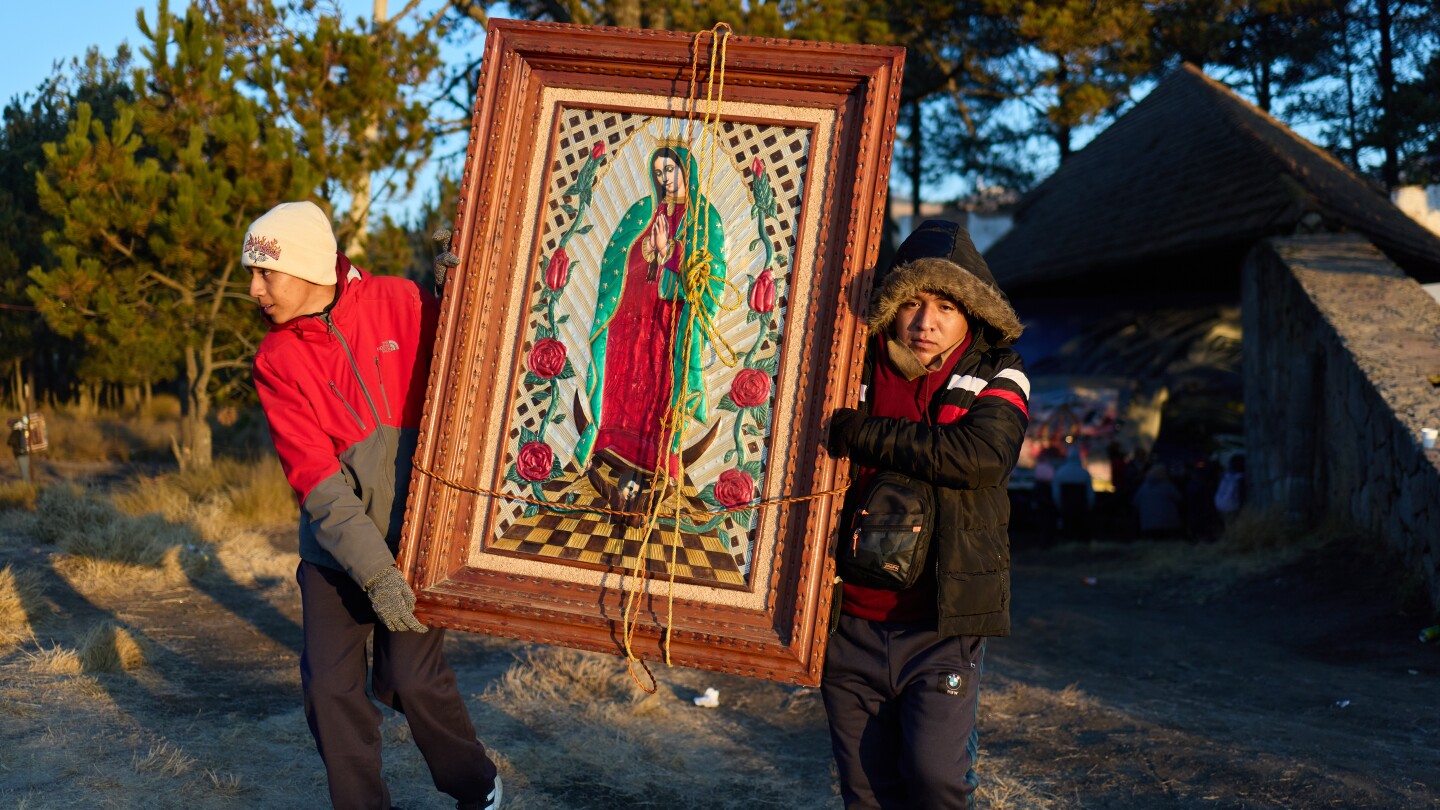
That same cloth now hangs at the Basilica’s center. Pilgrims journey from across Mexico year-round to express gratitude for miracles they attribute to the Virgin.
Teresa Morales, 85, recently visited the shrine ahead of the December celebration to give thanks for her improved health. She described suffering from debilitating knee pain that severely limited her mobility. While praying to an image of Our Lady of Guadalupe in her home, she experienced relief from her suffering.
“The other day I came for confession and the priest told me to spread the word,” she said. “To tell everyone that her miracles are real.”
A Symbol of Independence and Unity
Our Lady of Guadalupe’s ability to unite people proved crucial during Mexico’s independence movement in 1810.
The struggle against Spanish colonial rule was led by Miguel Hidalgo y Costilla, a priest now considered the nation’s founding father. Recognizing the Virgin’s symbolic power, Hidalgo took a painting of her that hung in a central Mexico sanctuary, attached it to a lance, and carried it as his revolutionary banner.
“The priest was leading the people against the bad government,” explains Salvador Rueda, historian and director of Mexico’s National Museum of History, where this iconic canvas is displayed. “And why did everybody follow? Because Our Lady of Guadalupe represents us all.”
The museum’s multiple galleries illustrate the Virgin’s dual function throughout recent centuries. Her presence appears in various forms—private lockets, a mural by modernist architect Juan O’Gorman, medals granted by Mexico’s first emperor for patriotic service—demonstrating how she has served as both a devotional image and a civic symbol.
According to Rueda, museum visitors often cross themselves when viewing the first painting in the exhibition. Their reaction changes, however, as they approach Hidalgo’s banner. “One is followed by devotion,” he observes. “The other is a flag.”
In subsequent conflicts, various armies incorporated the Virgin’s image into their cause. Both the Cristeros and the Zapatistas displayed her on their flags during the early 20th century.
“What started as a devotion ended up becoming a public image,” Rueda explains. “A reference to one’s identity not as Catholic, but as Mexican.”
While some scholars have questioned whether the cloth at the Basilica is a painting rather than a miraculous artifact, Rueda dismisses this debate as irrelevant.
“Why would that matter?” he asks. “It’s real because it’s part of reality, of history. Because it shapes an entire world.”
Fact Checker
Verify the accuracy of this article using The Disinformation Commission analysis and real-time sources.

16 Comments
The Virgin of Guadalupe is truly a powerful cultural symbol that transcends religious boundaries in Mexico. It’s fascinating to see how this Marian apparition has become so deeply woven into the national identity.
I agree, the blending of pre-Hispanic and Spanish religious traditions is a unique part of Mexico’s history and cultural heritage.
I appreciate the insight that Mexico’s secular state still has deep historical and cultural ties to religion, as seen in the intertwining of the Virgin of Guadalupe and national symbolism.
Absolutely, the article highlights how religious tradition and national identity can become deeply intertwined, even in a secular political context.
The museum’s treasures related to the Virgin of Guadalupe must be fascinating to explore. I’d be very interested to learn more about the historical and cultural evolution of this Marian figure in Mexico.
Me too, the museum sounds like an incredible resource for understanding the profound significance of the Virgin of Guadalupe in Mexican society.
I’m curious to learn more about the historical origins and evolution of the Virgin of Guadalupe’s significance in Mexico. How did this Marian apparition become so central to national identity?
That’s a great question. The article suggests there was an interweaving of pre-Hispanic and Spanish religious traditions, which would be fascinating to explore further.
The statistic of 12 million pilgrims visiting the Basilica during the Virgin’s feast day is truly staggering. It underscores the immense devotion Mexicans have towards this Marian figure.
That’s an incredible number of pilgrims – it really highlights the deep and widespread veneration of the Virgin of Guadalupe in Mexican society.
The statement that ‘not all Mexicans are Catholic, but all are Guadalupan’ is quite thought-provoking. It speaks to the transcendent nature of this Marian figure in Mexican identity.
Yes, that phrase really captures the unique status of the Virgin of Guadalupe as something beyond just a religious icon – she has become a core part of Mexican cultural identity.
It’s interesting to see how the Virgin of Guadalupe’s image is so prominently displayed alongside Mexico’s official national emblem. This symbolic pairing reflects the deep spiritual and cultural ties.
Absolutely, the frequent appearances of the Virgin’s likeness in government buildings and political imagery underscores her profound significance as a unifying national symbol.
It’s remarkable how the Virgin of Guadalupe has become so ubiquitous in Mexican society, appearing alongside the national emblem in government buildings and political imagery. This speaks to her profound significance.
You’re right, the Virgin’s enduring popularity as a unifying cultural force is quite remarkable, even in Mexico’s officially secular state.