


Listen to the article
Doctors Without Borders Withdraws from Gaza Hospital Amid Armed Presence
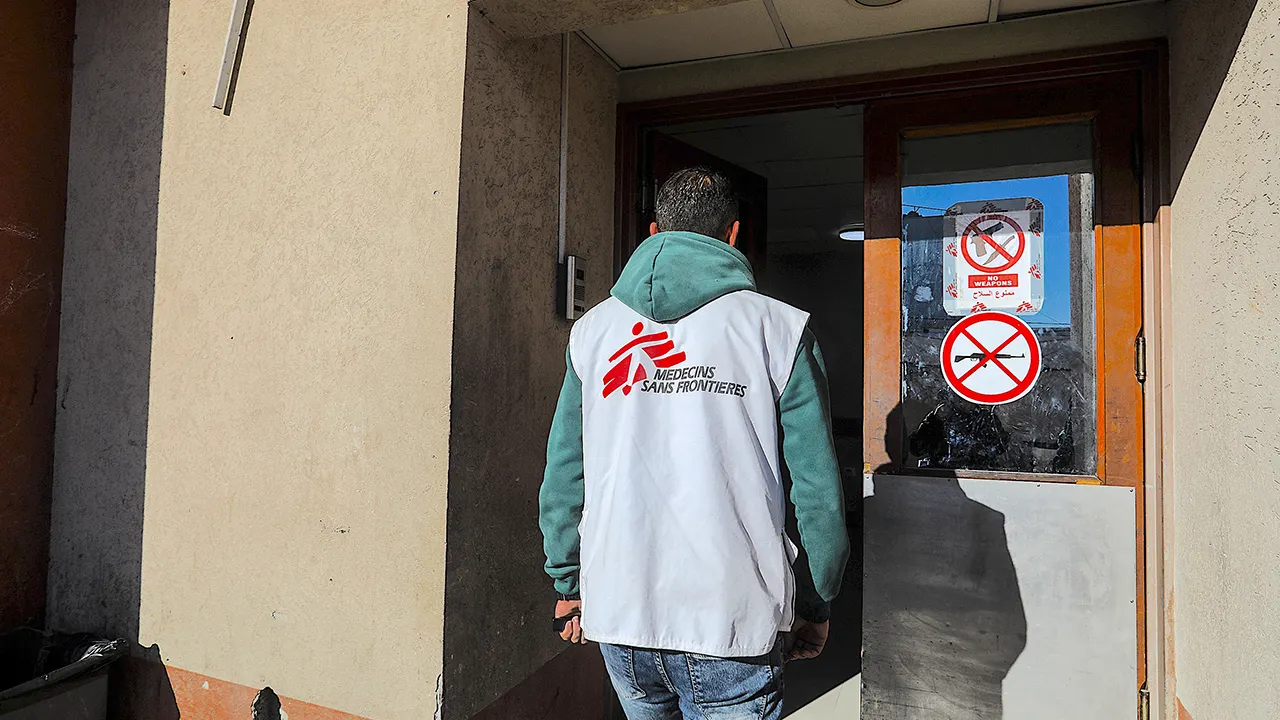
Médecins Sans Frontières (MSF), also known as Doctors Without Borders, has suspended its operations at Nasser Hospital in Khan Younis, Gaza, citing security concerns due to the presence of armed personnel—a remarkable shift from the organization’s previous rhetoric regarding Israeli military operations in the area.
The humanitarian organization, which has faced accusations of anti-Israel bias, announced it was ceasing work at the facility after its teams “reported a pattern of unacceptable acts, including the presence of armed men, intimidation, arbitrary arrests of patients, and a recent situation of suspicion of movement of weapons.” MSF stated these incidents posed “serious security threats to our teams and patients.”
Salo Aizenberg, director of media watchdog group HonestReporting, pointed out that MSF “buried its acknowledgment of seeing armed gunmen at Nasser Hospital at the very end of a 2,500-word Gaza projects update, but still wouldn’t name who those gunmen were. Hamas.”
The development comes amid the ongoing implementation of a U.S.-brokered ceasefire, which explicitly requires the disarmament of Hamas. Critics have noted the timing of MSF’s admission is significant, as the organization had strongly condemned Israel’s military operations at the same facility earlier this year.
The Israel Defense Forces (IDF) responded to MSF’s announcement with a pointed statement, noting they have long possessed “intelligence indicating that Nasser Hospital is being used as a headquarters and military post for senior Hamas commanders and operatives in the southern Gaza Strip.” The IDF added that while MSF’s decision was “important,” it “comes too late” and “further reinforces the necessity for the disarmament of the Hamas terror organization.”
When the IDF conducted operations at Nasser Hospital in February 2024, claiming Hamas operatives and hostages were believed to be inside, they faced widespread condemnation from international organizations, including MSF, which characterized the raid as an illegal attack on a medical facility. During that operation, the IDF reported discovering a large cache of weapons, some hidden in vehicles allegedly used by Hamas during the October 7 attack.
The White House, when asked about potential ceasefire violations, stated they “can’t confirm Médecins Sans Frontières’ claims,” but emphasized that “any threatening presence of Hamas is one of the reasons why we continue to emphasize that Hamas must disarm.”
This incident is not the first time MSF has faced scrutiny for its operations in Gaza. The U.S.-backed Gaza Humanitarian Foundation (GHF), which has provided over 187 million meals to Gazans between May and November 2025, previously accused Nasser Hospital of routinely issuing “false reports” of civilian deaths at GHF sites to media organizations.
MSF’s credibility has been further questioned in U.S. political circles. In September, Rep. Elise Stefanik (R-N.Y.) requested that Attorney General Pam Bondi investigate the organization under the Anti-Terrorism Act, claiming it “mirrored propaganda continuously pushed by Hamas.” The IDF had previously banned MSF from operating in Gaza beginning March 1, citing the organization’s failure to provide a complete list of its Palestinian staff.
The controversy surrounding MSF is part of a broader pattern of scrutiny facing international NGOs operating in the region. Former Oxfam UK CEO Dr. Halima Begum is currently taking that charity to court over accusations of sexism, racism, and antisemitism, stating that “it always felt as though we were disproportionately working around the crisis in Gaza.” Israel’s Ministry for Diaspora Affairs and Combating Antisemitism has reportedly ruled that Oxfam will no longer be permitted to operate in Gaza starting February 28.
Watchdog organization NGO Monitor told Fox News Digital that these developments demonstrate that “slowly, superpower NGOs are being exposed from the inside – their anti-Israel rot bared for all to see. A major return to founding principles is required to ensure that human rights once again become driving ideals inside the world’s most influential NGOs.”
Fact Checker
Verify the accuracy of this article using The Disinformation Commission analysis and real-time sources.

10 Comments
Interesting development. It’s concerning to hear of armed presence and intimidation at a medical facility, regardless of the parties involved. Transparency and accountability should be paramount when it comes to humanitarian operations.
I agree. The safety and neutrality of medical NGOs must be protected, even in conflict zones. Hopefully this incident can be resolved through open dialogue and adherence to international humanitarian laws.
The withdrawal of this medical NGO is concerning. Hospitals should be sanctuaries, free from armed presence and interference. I hope the situation can be resolved in a way that preserves the neutrality and security of humanitarian operations.
I agree, this is a troubling development. The ability of medical NGOs to operate freely and safely, without fear of threats or intimidation, is crucial. All sides should work to find a solution that upholds international humanitarian laws and principles.
This is a troubling development. Medical NGOs play a crucial role in providing care, especially in conflict zones. Their ability to operate safely and independently must be protected. I hope a resolution can be found that upholds humanitarian principles.
You make a good point. Maintaining the integrity and security of medical facilities is essential, regardless of the political or military situation. All parties involved should work towards a solution that allows these vital services to continue unimpeded.
This raises important questions about the challenges of providing aid in volatile regions. Ensuring the security of medical staff and patients while maintaining impartiality is a delicate balancing act. I wonder what steps can be taken to improve the situation.
You’re right, it’s a complex issue. Maintaining neutrality while operating in conflict zones is incredibly difficult. All parties involved should work to find a resolution that prioritizes the safety and independence of humanitarian organizations.
The withdrawal of this medical NGO is concerning. Hospitals and clinics should be safe havens, free from armed presence and intimidation. I hope discussions can lead to a resolution that allows for the unimpeded provision of medical care.
Agreed. The presence of armed personnel at a healthcare facility is unacceptable. All sides should respect the neutrality of humanitarian organizations and ensure their staff can operate without fear of threats or violence.