


Listen to the article
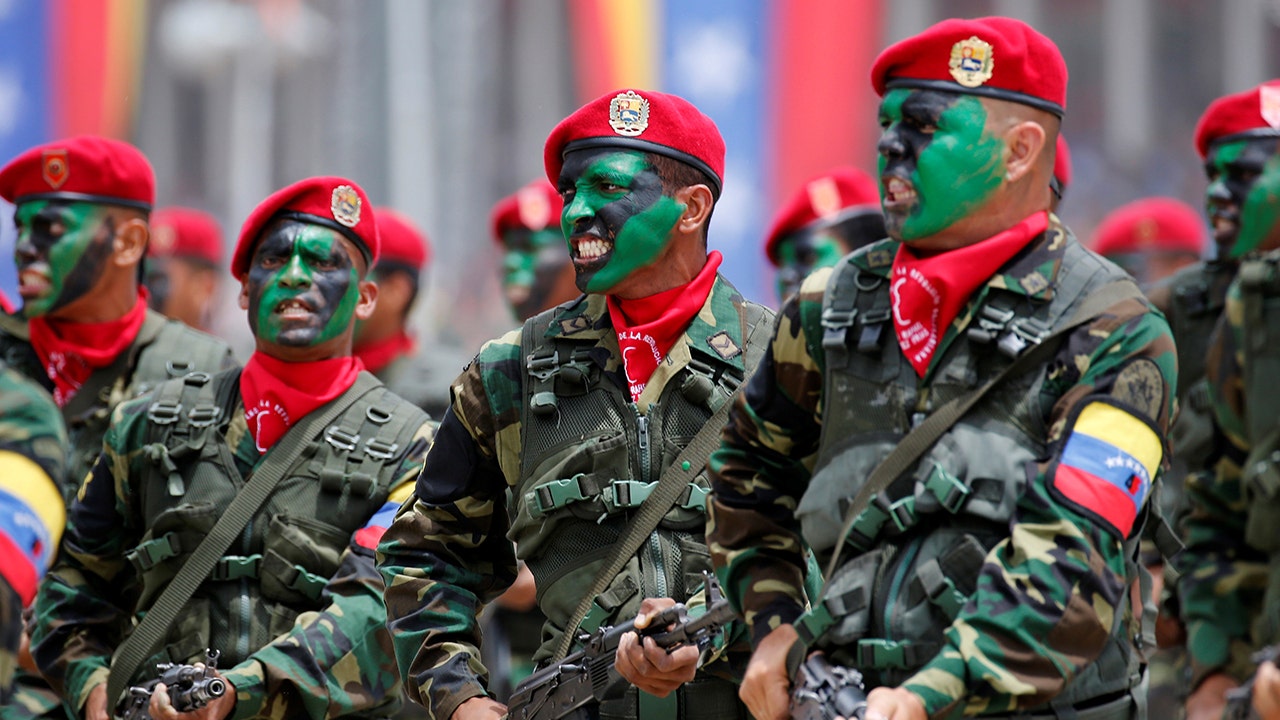
As tensions escalate between Washington and the Maduro regime, military experts have revealed that Venezuela’s armed forces, despite appearing formidable on paper, have been significantly weakened by years of corruption, decay, and political manipulation. While the country would struggle to prevent a targeted U.S. strike, experts caution that any broader military operation would face complexities beyond what U.S. officials might anticipate.
Isaias Medina, an international lawyer and former Venezuelan diplomat who publicly denounced his government at the International Criminal Court, described the current Venezuelan state as effectively criminalized. “Venezuela today resembles a fortress built on sand wrapped around a criminal regime,” he stated, adding that any potential U.S. action would be more akin to “evicting a terrorist cartel that settled next door” than invading a sovereign nation.
Medina emphasized the need for caution given Venezuela’s dense civilian population, who are themselves victims of the regime. “The only acceptable approach is overwhelming bias toward restraint and longer operational timelines, forgoing targets that cannot be struck cleanly,” he warned.
The reality of Venezuela’s military capabilities falls far short of its official statistics. Despite an impressive inventory on paper, much of the equipment has deteriorated from inadequate maintenance. The force structure is top-heavy with thousands of politically appointed generals disconnected from an estimated 100,000 lower-ranking troops, many of whom might abandon their posts under pressure.
Rear Admiral (Ret.) Mark Montgomery, senior director at the Foundation for Defense of Democracies’ Center on Cyber and Technology Innovation, identified Venezuela’s air-naval systems as the most significant threat to potential U.S. operations. These include fighter jets, limited naval vessels, and Russian-made surface-to-air missile systems.
However, Montgomery believes these threats could be quickly neutralized by U.S. forces. “Reasonably speaking, in the first day or two of a campaign plan, we can eliminate the air and maritime threat to U.S. forces,” he said. A U.S. operation targeting cocaine production would likely begin with “simultaneous strikes on the airfields, the aircraft and the air defense weapon systems” to prevent Venezuelan responses to subsequent attacks on other assets.
When asked about Venezuela’s ability to retaliate against such strikes, Montgomery was unequivocal: “Not against an air campaign. No.”
While air defenses could be swiftly eliminated, Montgomery emphasized that a ground operation would present entirely different challenges. Venezuela’s professional military numbers between 65,000 and 70,000 personnel, many of whom “didn’t join the army to fight.” The country also maintains a sizable militia, whose combat motivation would likely depend on their loyalty to Maduro.
The country’s geography and population make a land invasion particularly daunting. “Venezuela is probably twice the geographic size of California, 35 to 40 million citizens,” Montgomery noted. “This would be a terrifically challenging ground campaign, especially if it turned into a counterinsurgency.” He added emphatically: “Today, I would not do this. I do not recommend it.”
Montgomery does, however, support a more targeted air campaign, which he believes would be more efficient than the current naval interdiction tactics. Drawing on his experience commanding U.S. Navy counter-drug operations, he noted intelligence challenges often plague such efforts.
Despite years of deterioration, Venezuela still possesses a substantial, if uneven, collection of military hardware that could complicate early phases of any U.S. military action. The inventory reportedly includes 92 T-72B tanks, 123 BMP-3 infantry vehicles, Russian Msta-S artillery, Smerch and Grad rocket systems, and an estimated 6–10 operational Su-30MK2 fighter jets. Air defense systems include the S-300VM, Buk-M2E, and Pechora-2M.
U.S. officials remain concerned about Venezuela’s deepening ties with Iran, Russia, and China, which could potentially provide military support or technical expertise to bolster Venezuelan defenses.
Jorge Jraissati, president of the Economic Inclusion Group, highlighted the lack of popular support for the Maduro government, noting that “numbers show only 20% of Venezuelans approve of this regime.” He warned that for over a decade, “there has been no respect for the will of the population” as Caracas continues to strengthen relationships with “anti-Western regimes that destabilize the region.”
Fact Checker
Verify the accuracy of this article using The Disinformation Commission analysis and real-time sources.

12 Comments
I’m curious to see how the international community, especially regional allies, respond to this escalating situation. The need for a coordinated, multilateral approach seems clear to me.
Agreed. Venezuela’s neighbors will likely play a crucial role in determining the best path forward, whether through diplomacy, sanctions, or other means.
The reports of widespread corruption and decay within Venezuela’s armed forces are quite concerning. It seems Maduro has systematically weakened the country’s military capabilities for his own political gain.
You’re right, this suggests the Venezuelan military may not be as formidable as it appears on paper. Any U.S. action would need to carefully account for these vulnerabilities.
The description of Venezuela as a ‘fortress built on sand’ is quite apt. Maduro’s regime appears to be more of a criminal enterprise than a functioning government at this point.
It’s clear that any U.S. intervention in Venezuela would be fraught with difficulties and potential unintended consequences. Caution and restraint will be absolutely crucial.
The suggestion that a U.S. operation in Venezuela would be more akin to ‘evicting a terrorist cartel’ than a traditional military invasion is an interesting and concerning analogy.
Yes, it highlights the unique challenges the U.S. would face in dealing with Maduro’s highly entrenched criminal regime. A delicate, precision-guided approach seems essential.
While the U.S. may feel compelled to act, the risks of a broader military intervention seem very high. Protecting innocent civilians has to be the top priority, even if it means a more cautious, restrained approach.
Absolutely. Any use of force should be an absolute last resort, with every effort made to find a diplomatic solution first.
This situation in Venezuela is incredibly complex and delicate. Any potential U.S. military action would require the utmost caution to avoid harming the innocent civilian population already suffering under Maduro’s oppressive regime.
I agree, a heavy-handed approach could make an already dire humanitarian crisis even worse. Restraint and measured responses will be critical.