


Listen to the article
In a quiet triumph of literary intervention, a four-decade-old initiative bringing poetry to London’s subway commuters celebrated its milestone anniversary this week. Poems on the Underground, a project that has placed verses where millions of daily travelers can encounter them, marked 40 years of injecting literature into the daily transit routine.
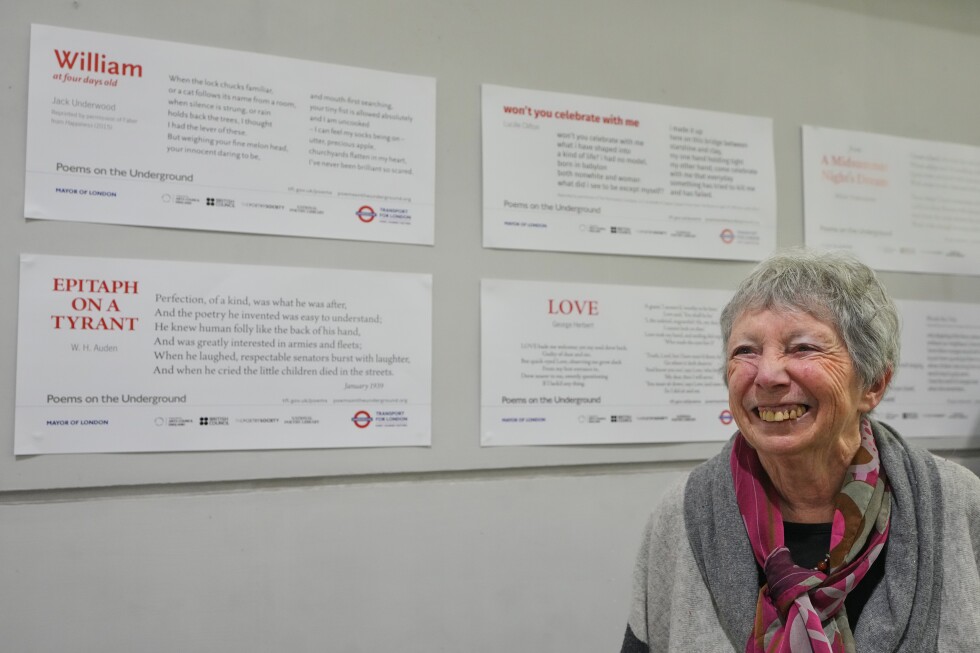
Founded in 1986 by American writer Judith Chernaik, the program has transformed subway cars into moving galleries of verse, with poems nestled among advertisements providing unexpected moments of reflection for harried commuters.
On Friday, more than a dozen poets whose work has appeared in the program gathered at a London Underground station to commemorate the anniversary and honor Chernaik, the visionary behind the cultural phenomenon.
Now 91, Chernaik recalls moving to London in the 1970s and falling “absolutely in love with the city – including its transport system,” which she found superior to New York’s subway. A novelist and essayist, she was captivated by London’s rich literary tradition.
“Poetry,” she noted, “is part of the heritage of every Londoner.”
Working alongside poets Gerard Benson and Cecily Herbert, Chernaik developed a plan to marry literature with public transportation. London Underground officials embraced the concept, and the first poems appeared in January 1986.
“Somehow the idea of it worked, and here we are, 40 years on,” Chernaik remarked.
The initial selections featured venerable names like Shakespeare, Robert Burns, W.B. Yeats, and Percy Bysshe Shelley, whose “Ozymandias” offered tube travelers a meditation on power’s impermanence. William Carlos Williams’ “This is Just to Say” with its memorable opening about plums in the icebox was also among the first selections.
What began with primarily Western canonical works has evolved into a truly global anthology. The program now regularly showcases international voices including Nigerian Wole Soyinka, Chile’s Pablo Neruda, Caribbean poet Derek Walcott, and Russian Anna Akhmatova.
The selection committee, which still includes Chernaik alongside poets George Szirtes and Imtiaz Dharker, refreshes the poems three times annually. This rotation ensures regular commuters encounter new works throughout the year.
“Shakespeare and Sappho to poets that are really contemporary,” is how Ann Gavaghan, who oversees cultural projects at Transport for London, describes the range. The program embraces diverse poetic forms—sonnets, haikus, love poems, tragedies, and humor—with a particular fondness for works that resonate with the commuter experience, such as Hungarian poet Katalin Szlukovényi’s aptly titled “Overcrowding.”
Nick Makoha, whose poem “BOM” appeared in the Underground in 2020, emphasizes how the program democratizes an art form often perceived as elitist.
“Poetry can often be taught as if it’s this thing that you need to have high intellect, but we’re normal people,” he said. “Poets are normal people, writing about sometimes normal things, sometimes amazing things.”
For Makoha, the program highlights poetry’s communal nature: “It should be part of our daily lives, and the Underground is part of daily life. So, as it connects us to places, it also connects us to people. You could be sitting at Turnpike Lane [Tube station], and all of a sudden I’ve taken you to Bombay.”
London’s transit system, despite the usual complaints about delays, overcrowding, and cleanliness, has long been recognized for its artistic sensibilities. Its iconic map is considered a design masterpiece, and for a century, it has commissioned leading artists to create its posters.
Poems on the Underground has become so beloved that it has inspired similar initiatives globally, with cities including New York, Dublin, Oslo, and Shanghai adopting the concept. The program has also produced several anthologies.
Gavaghan attributes the program’s longevity to its ability to disrupt the monotony of daily commutes. “If you’ve had a hard day and you’re wrapped up in your own worries and cares, being able to see something on the Underground that makes you think, that kind of shocks you out of that, is a real nice thing to have,” she explained. “And it could make you laugh, it could make you think. It really makes you empathize.”
In a world where public spaces are increasingly dominated by commercial messaging, these brief literary encounters offer a rare moment of cultural connection—a small reminder of shared humanity amid the rush hour crush.
Fact Checker
Verify the accuracy of this article using The Disinformation Commission analysis and real-time sources.

10 Comments
As someone who spends a lot of time on public transit, I can imagine how these unexpected encounters with poetry could provide a welcome respite from the monotony. It’s a brilliant way to spark moments of contemplation and connection amidst the hustle and bustle.
Absolutely. Poetry can be a powerful antidote to the stresses of daily life, and integrating it into the commuting experience is a stroke of genius. I hope this initiative continues to thrive and inspire generations of Londoners to come.
Poems on the Underground is a wonderfully creative initiative that reminds us of the power of art to transform our everyday experiences. Kudos to Judith Chernaik and her team for their vision and dedication in bringing this program to life.
What a wonderful initiative to bring poetry to the masses! Poems on the Underground has been brightening the daily commute for Londoners for 40 years. It’s inspiring to see a literary tradition being so seamlessly integrated into urban infrastructure.
I agree, it’s a brilliant way to expose people to poetry who might not seek it out otherwise. The unexpected moments of reflection must be welcome relief for busy commuters.
As someone who loves both poetry and public transit, I’m delighted to hear about the longevity of this program. Kudos to Judith Chernaik and the other visionaries who had the idea to transform subway cars into moving galleries of verse.
Absolutely, it’s a wonderfully creative way to bring literature into everyday life. Poetry can sometimes feel inaccessible, but this initiative makes it approachable and relevant for the modern urban commuter.
While poetry may not be the first thing that comes to mind when thinking about the daily grind of commuting, this initiative proves that the two can be beautifully intertwined. Kudos to the Poems on the Underground team for their enduring commitment to bringing a touch of magic to people’s journeys.
I’m curious to learn more about the specific poems and poets featured over the decades. Does the program showcase a range of styles and themes, or does it tend to focus on a particular literary tradition? Either way, it’s a fantastic way to promote the arts and foster a sense of community.
That’s a great question. From the article, it seems the program has highlighted a diverse array of poets and poetic styles, reflecting the rich literary heritage of London. Exposing commuters to this variety must be both educational and thought-provoking.