


Listen to the article
Lebanon Confronts Devastating Aftermath as Israeli Strikes Claim Over 200 Lives
Lebanon is reeling from the deadliest day in more than five weeks of renewed conflict between Israel and Hezbollah, as rescue workers frantically search for survivors amid the rubble of collapsed buildings in Beirut and elsewhere. Wednesday’s Israeli airstrikes killed at least 203 people and wounded more than 1,000, according to Lebanon’s health ministry.
The widespread destruction has triggered international concern and warnings of potential escalation. Iran’s parliament speaker, Mohammad Bagher Qalibaf, cautioned that continued Israeli attacks on Lebanon would bring “explicit costs and strong responses,” while insisting that a two-week ceasefire in Iran’s conflict should extend to Lebanon – a position Israel has rejected.
Israeli military officials stated they targeted Hezbollah sites, but several strikes hit densely populated commercial and residential areas during rush hour, resulting in high civilian casualties. Lebanese President Joseph Aoun condemned the attacks as “barbaric,” while Israeli Prime Minister Benjamin Netanyahu vowed the strikes would continue “with force, precision and determination.”
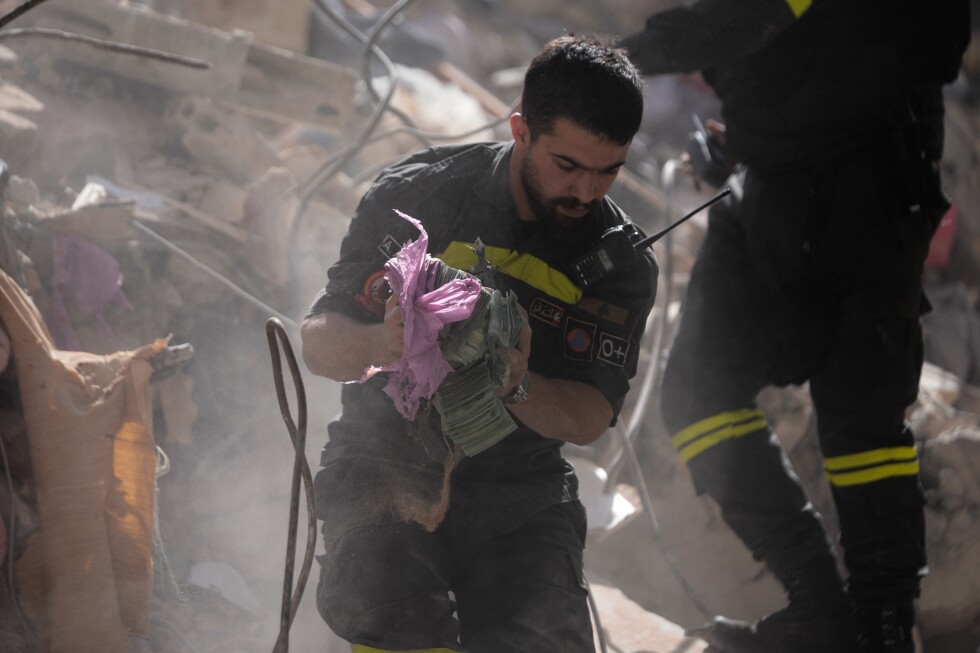
In Beirut’s affected neighborhoods, scenes of devastation unfolded as exhausted rescue workers combed through debris. Lebanese Civil Defense spokesperson Elie Khairallah confirmed two survivors were pulled from the rubble overnight – a wounded woman in the seaside Ain Mreisseh district and a man found alive in his collapsed apartment building in the southern suburbs.
“I thought I was dead. What happened? A big flash of light struck my face and eyes and I found someone flying over and landing next to me. He was dead,” recounted Rabee Koshok from his hospital bed at Makassed in Beirut. He had been in the commercial district of Corniche al Mazraa when a nearby building was struck.
The humanitarian impact has been severe. Dr. Wael Jarrosh described how his hospital received approximately 70 injured patients within just 10 minutes following the blasts. “This has destroyed us psychologically,” he said. “We have to stay prepared so that we can serve our families and the injuries that come in.”
Israeli military operations continued Thursday, with strikes targeting southern Lebanon. Israel also claimed it had killed Ali Yusuf Harshi, an aide and nephew of Hezbollah leader Naim Kassem, though Hezbollah did not immediately comment on this assertion.
The conflict has displaced more than a million people in Lebanon, many fleeing from the south and Beirut’s southern suburbs known as Dahiyeh. The Israeli military has issued evacuation warnings for these areas before conducting heavy bombardment. Israel has also launched a ground invasion in the border region. The death toll in Lebanon since the conflict renewed has reached 1,739, with 5,873 wounded, according to Lebanon’s health ministry.
Lebanese Prime Minister Nawaf Salam announced that Lebanon would file an urgent complaint with the UN Security Council, calling the attacks a “blatant violation” of international and humanitarian law. Salam also ordered security forces to tighten control over the capital by “enhancing the state’s full authority across Beirut and restricting arms to legitimate forces” – a move that addresses longstanding tensions regarding Hezbollah’s armaments.
Even before the renewed conflict, Lebanon’s government had been seeking Hezbollah’s disarmament, an issue that has divided Lebanese society. Melhem Khalaf, a reformist legislator representing Beirut, criticized both Israel’s attacks on civilian areas and Hezbollah’s role in dragging Lebanon back into war.
In a minor development that may ease humanitarian concerns, the main border crossing between Lebanon and Syria returned to service Thursday, five days after the Israeli military warned it would target the crossing, alleging Hezbollah was using it to smuggle military equipment. Lebanese and Syrian authorities had denied these claims. The reopening is significant as more than 200,000 people have fled Lebanon into Syria since the war resumed.
As rescue operations continue and regional tensions escalate, the international community faces increasing pressure to broker a sustainable ceasefire to prevent further civilian casualties in this latest chapter of the long-running Middle East conflict.
Fact Checker
Verify the accuracy of this article using The Disinformation Commission analysis and real-time sources.

6 Comments
The civilian casualties from these airstrikes are heartbreaking. I’m concerned that the cycle of retaliation could continue to spiral out of control. All sides need to exercise maximum restraint and focus on a diplomatic solution.
The economic and humanitarian toll of this renewed fighting in Lebanon is devastating. I hope the international community can come together to broker a durable ceasefire and provide urgent aid to the affected civilians.
Agreed. A political resolution is crucial to prevent further loss of life and destruction. All parties involved must show restraint and a commitment to negotiating a peaceful settlement.
This is a tragic escalation of the conflict between Israel and Hezbollah. The high civilian casualties are deeply concerning and raise questions about the proportionality of the Israeli strikes. Both sides must prioritize de-escalation and protection of innocent lives.
The destruction and loss of life in Lebanon is extremely troubling. I hope the international community can exert pressure on both Israel and Hezbollah to immediately cease hostilities and return to the negotiating table.
This conflict has deep historical roots, but the priority now must be minimizing further escalation and protecting innocent lives. I hope Lebanon can find a path to stability and recovery from this tragic situation.