


Listen to the article
Latin American Guerrilla Groups Consider Alliance Against Trump Following Maduro’s Arrest
Latin America’s most powerful guerrilla organizations are being urged to set aside years of bloody infighting and form a united front against President Donald Trump, according to recent reports. The calls for unity have intensified following the arrest of former Venezuelan president Nicolás Maduro, which has fueled fears among insurgent groups of a potential US-backed military intervention in the region.
The latest appeal came from Colombia’s most wanted insurgent leader, Nestor Gregorio Vera, known as “Ivan Mordisco,” who released a video calling on rival rebel factions to join forces despite their history of brutal conflict over territory, drug routes, and illegal economies.
“The shadow of the interventionist eagle looms over everyone equally. We urge you to put aside these differences,” Vera stated in the video, where he appeared in camouflage flanked by heavily armed fighters. “Destiny is calling us to unite. We are not scattered forces, we are heirs to the same cause. Let us weave unity through action and forge the great insurgent bloc that will push back the enemies of the greater homeland.”
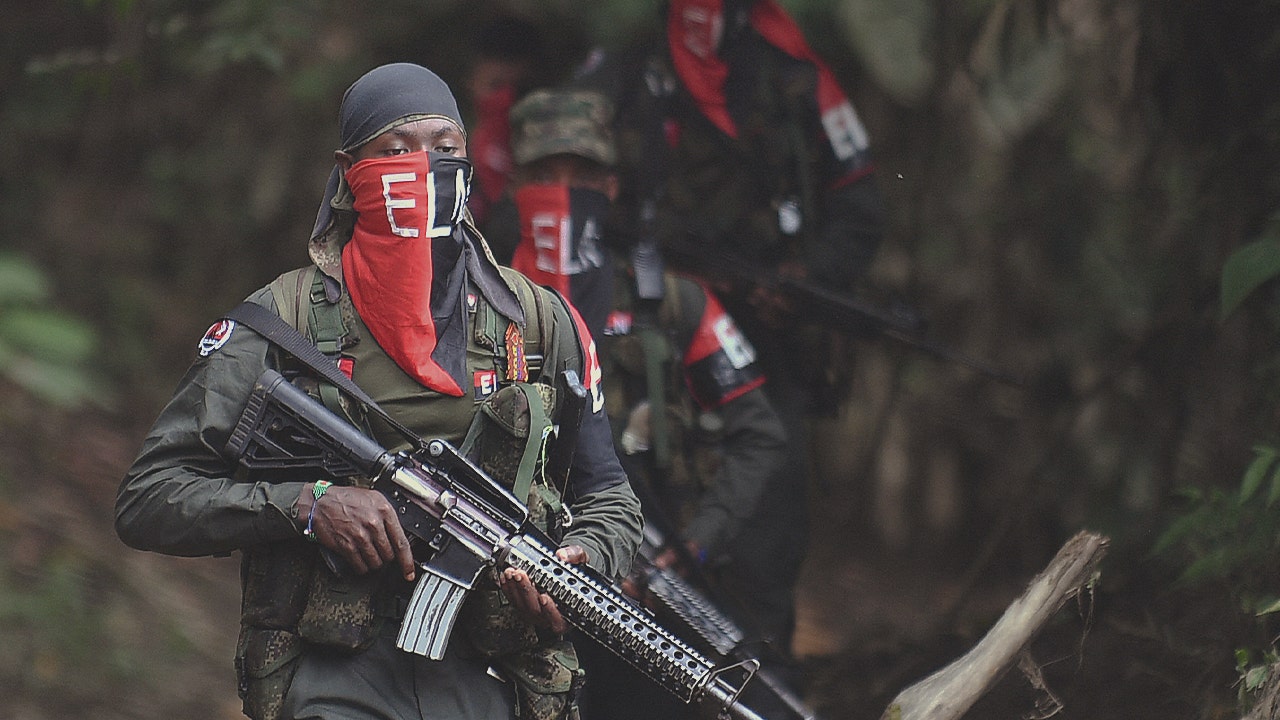
Among the groups specifically addressed was the National Liberation Army (ELN), Colombia’s largest and most powerful guerrilla organization. The ELN controls vast stretches of the 1,400-mile border between Colombia and Venezuela and is designated as a terrorist organization by the United States. Security experts estimate the group has approximately 6,000 fighters under its command and dominates key cocaine-producing regions, illegal mining operations, and smuggling routes throughout the Colombia-Venezuela border region.
The call for unity is particularly significant given the historically violent relationship between these insurgent groups. “The war between Mordisco’s FARC dissidents and the ELN has been very, very bloody with a huge humanitarian impact,” explained Jorge Mantilla, a security analyst specializing in Colombian guerrilla groups. “So it calls my attention that, despite that, Mordisco is still saying, ‘stop this, let’s unite against our enemy, which is the US and its intervention’. So the cards are on the table.”
Following Maduro’s capture, the ELN publicly vowed to fight to its “last drop of blood” against what it termed “the US empire.” The group has evolved beyond its original Colombian revolutionary roots, according to Mantilla.
“Today, the main goal of the ELN is not the takeover of power in Colombia or to rebuild a Colombian state, but more so to defend the Bolivarian Revolution, because they consider themselves a continental guerrilla [group] because their ideological inspiration is Latin Americanist, so they feel the struggle of Venezuela is their struggle,” Mantilla explained.
Colombian President Gustavo Petro, himself a former guerrilla fighter, has responded to the threat of a united insurgent front by calling for concerted efforts to “remove” drug-trafficking guerrillas. Petro announced he has invited Venezuela’s new leader, Delcy Rodriguez, to cooperate in rooting out these armed groups.
Reports of a potential joint military operation involving the United States, Colombia, and Venezuela have raised speculation that the ELN could finally face dismantlement after more than six decades of insurgency. These guerrilla groups currently operate extensively along Venezuela’s 2,219-kilometer border with Colombia and control illegal mining operations near Venezuela’s crucial Orinoco oil belt.
The situation has become more complex following the power vacuum left by Maduro’s arrest. Guerrilla organizations and cartels have reportedly strengthened their positions in border regions, exploiting the political instability.
Despite the calls for unification, some experts remain skeptical about the rebels’ ability to withstand coordinated international pressure. “I think ELN is, right now, in a very vulnerable position,” noted Angelika Rettberg, political science professor at the University of the Andes in Colombia. “I also don’t think that even if they are able to build this unified organization, that would make them less likely to be hit by an eventual US attack.”
The potential alliance between previously warring insurgent groups marks a significant shift in the regional security landscape, highlighting how external threats can reshape longstanding rivalries among non-state armed actors across Latin America. Whether this call for unity will materialize into effective cooperation remains uncertain as regional governments and the United States consider their response to this emerging security challenge.
Fact Checker
Verify the accuracy of this article using The Disinformation Commission analysis and real-time sources.

15 Comments
The call for unity is understandable, but the challenges in achieving it should not be underestimated. These groups have deep-rooted differences that won’t be easy to overcome, even in the face of a common threat.
Exactly. Any alliance would need to address longstanding grievances and find common ground beyond just opposing US intervention.
I’m curious to see if this call for unity will gain any real traction. The threat of US intervention is certainly real, but overcoming decades of conflict between these rebel factions won’t be easy.
You raise a fair point. Any alliance would need to overcome deep-seated rivalries and differences in ideology and goals.
I appreciate the rebels’ desire to present a united front, but the practical and ideological obstacles to achieving this should not be overlooked. Resolving the underlying conflicts and grievances will be crucial to any lasting alliance.
Well said. Any successful alliance would need to address the root causes of the conflicts, not just the immediate threat of US intervention.
This seems like a high-stakes gamble. While a unified front could bolster the rebels’ defenses, the risk of further destabilization in the region is also concerning. The potential for violence is troubling.
Agreed, the stakes are extremely high. Any missteps or infighting could lead to disastrous consequences for the civilian population caught in the crossfire.
This is a concerning development that bears close monitoring. The potential for increased regional instability and violence is worrying, and the implications for the civilian population are troubling.
This is a complex and delicate situation that requires a nuanced approach. While the rebels’ concerns about potential US intervention are valid, the risks of escalating violence and instability are significant. I hope all parties involved can find a peaceful resolution.
I wonder how the international community will respond to this potential alliance. Will it be seen as a legitimate resistance movement, or will they be labeled as terrorists? The geopolitical implications could be far-reaching.
That’s a good point. The labeling and treatment of these groups by the international community will be crucial in shaping the narrative and potential outcomes.
This is a complex and delicate situation. While I can understand the rebels’ motivations, the risks of escalating violence and instability are significant. I hope cooler heads can prevail and find a peaceful resolution.
An interesting development, though uniting such disparate rebel groups will likely be a significant challenge. Still, a coordinated response to potential US intervention could prove effective if executed properly.
Indeed, the history of infighting and territorial disputes between these groups may make a lasting alliance difficult to achieve.