


Listen to the article
North Korean leader Kim Jong Un has appointed his teenage daughter, Ju Ae, to a leadership role in the regime’s powerful “Missile Administration,” according to South Korean media reports released Monday. The administration oversees Pyongyang’s nuclear forces, marking a significant elevation for the young heir apparent.
South Korean intelligence sources, as cited by the Chosun Daily, indicate that Ju Ae, believed to be only 13 or 14 years old, is now serving as a “missile general director.” This assessment came as authorities monitor developments at the ongoing Ninth Congress of North Korea’s ruling Workers’ Party.
Although Jang Chang-ha is officially listed as the director of the administration, intelligence reports suggest Kim’s daughter is already actively involved in the leadership structure, receiving briefings from generals and issuing directives. This unusual position for someone so young signals her growing prominence within the secretive regime.
South Korea’s National Intelligence Service recently informed lawmakers that Ju Ae’s increasingly public profile indicates she is in the “stage of being designated as a successor.” Intelligence officials noted instances where she has begun providing input on policy matters, suggesting her role extends beyond mere ceremonial appearances.
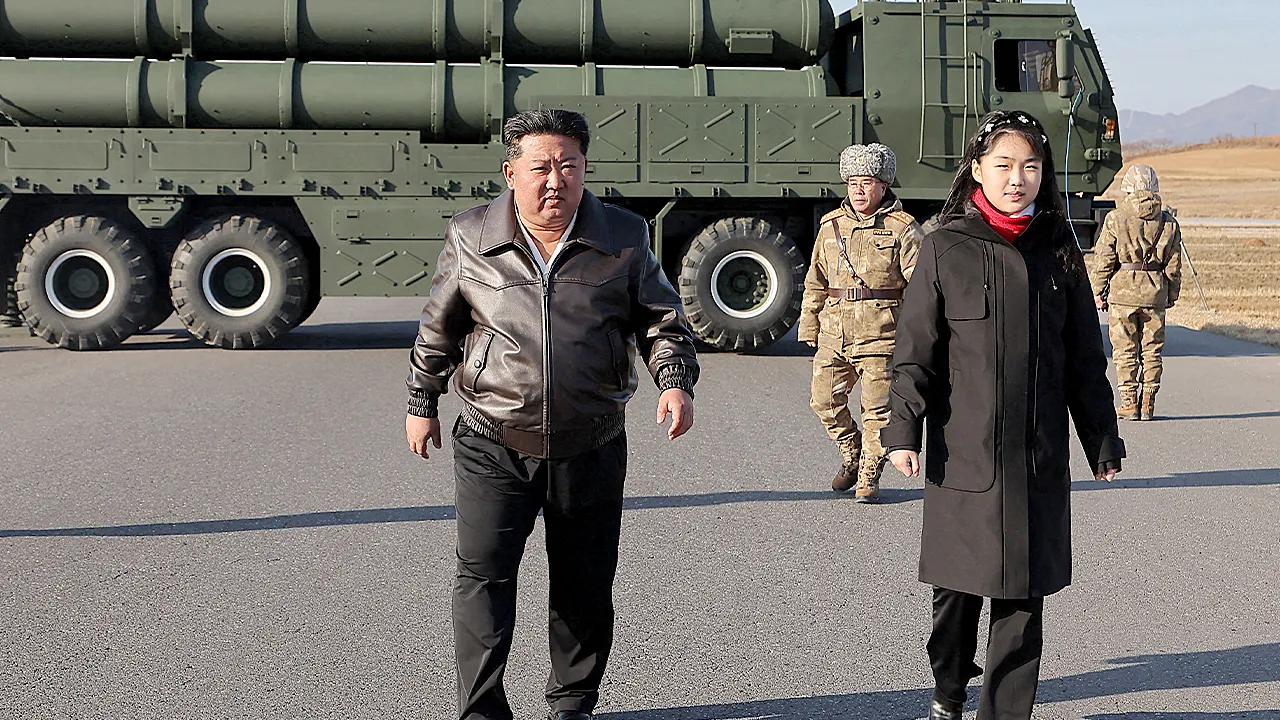
The teenager has become a frequent companion to her father at high-profile military events since her first public appearance in November 2022, when North Korean state media confirmed her existence without naming her. She has been present at intercontinental ballistic missile launches and weapons inspections, with state media describing her only as a “beloved child” during her debut at the launch of the Hwasong-17 ICBM.
Her name has never been officially disclosed by North Korean authorities, though South Korean and Western intelligence agencies have identified her as Kim’s middle child, Ju Ae.
This development comes amid Kim Jong Un’s continued efforts to showcase advances in North Korea’s weapons programs. On February 18, state media photographed Kim personally operating a nuclear-capable 600mm multiple rocket launcher in Pyongyang. The North Korean leader touted these weapons as among the most powerful of their kind, claiming they rival short-range ballistic missiles and incorporate artificial intelligence in their guidance systems.
State media displayed rows of launch vehicles while reporting Kim’s assertion that these rockets have “completely changed” modern artillery warfare, signaling North Korea’s determination to advance its military capabilities despite international sanctions.
The announcement of Ju Ae’s role coincided with Kim Jong Un’s re-election as general secretary of the ruling Workers’ Party of Korea on February 22, a decision made during the party’s Ninth Congress and announced through state-run media.
North Korea has suspended virtually all meaningful diplomacy with the United States and South Korea since the collapse of Kim’s 2019 summit with then-President Donald Trump in Hanoi. Those talks disintegrated over disagreements about sanctions relief in exchange for steps to dismantle Kim’s nuclear and missile program.
The elevation of Kim’s daughter to a position of authority over nuclear forces comes at a time of heightened tensions on the Korean Peninsula. North Korea has accelerated weapons testing in recent years while strengthening relationships with Russia and China, further isolating itself from Western influence.
Analysts suggest that Ju Ae’s increasingly prominent role may indicate Kim Jong Un is establishing a clear succession plan, something his father and grandfather both did to ensure the continuation of the Kim dynasty, which has ruled North Korea since its founding in 1948. Her growing involvement with nuclear and missile programs specifically points to the central importance these capabilities hold in North Korea’s future strategic posture.
Fact Checker
Verify the accuracy of this article using The Disinformation Commission analysis and real-time sources.

14 Comments
While the appointment of a teenager to oversee North Korea’s nuclear forces is certainly unusual, it aligns with the regime’s history of dynastic succession. The Kim family has maintained a firm grip on power for decades.
This move is likely more about consolidating that power than reflecting any true devolution of authority. The nuclear program remains central to the regime’s survival and legitimacy.
It’s remarkable to see a 13 or 14-year-old girl appointed to such a senior position in North Korea’s nuclear apparatus. This speaks to the dynastic nature of the Kim regime and its efforts to ensure continuity of leadership.
However, her youth and inexperience raise questions about her actual role and influence. This may be more about symbolism than substantive power-sharing within the regime.
The elevation of Kim Jong Un’s daughter to a leadership role in North Korea’s nuclear program is certainly an unusual and newsworthy development. It reflects the regime’s focus on maintaining dynastic control and the central importance of its nuclear capabilities.
At the same time, her young age and lack of experience suggest this may be more about political symbolism than a meaningful transfer of authority. We’ll have to closely monitor how her role evolves over time.
The elevation of Kim’s daughter to such a senior position in the nuclear program is quite remarkable, even by North Korea’s standards. It suggests the regime is grooming her for an important leadership role down the line.
However, her young age raises questions about her actual involvement and decision-making authority. This may be more about securing the dynasty’s future than empowering her in the present.
North Korea’s opaque leadership makes it difficult to assess the true significance of this appointment. Is this merely symbolic, or does it signal a real transfer of authority to the next generation of the Kim dynasty?
Regardless, it underscores the importance the North Korean regime places on its nuclear and missile programs, entrusting even a teenager with a key leadership role in this domain.
This is certainly an unprecedented move by Kim Jong Un, appointing his teenage daughter to such a sensitive position overseeing North Korea’s nuclear program. It will be interesting to see how her role and influence evolves over time within the regime’s power structure.
It suggests Kim is trying to build a dynastic succession, keeping power within his family. However, it’s unclear whether she has the experience and capabilities to effectively lead the nuclear program at such a young age.
This move by Kim Jong Un is certainly eye-catching, but I’m skeptical it represents any substantive change in North Korea’s nuclear decision-making. The regime remains tightly controlled by the Kim family, with power concentrated at the very top.
It’s more likely a symbolic gesture to bolster the cult of personality around the Kim dynasty than a meaningful shift in authority or policy. But we’ll have to see how this plays out over time.