


Listen to the article
German Artist Anselm Kiefer Honors Forgotten Female Alchemists in Monumental Milan Exhibition
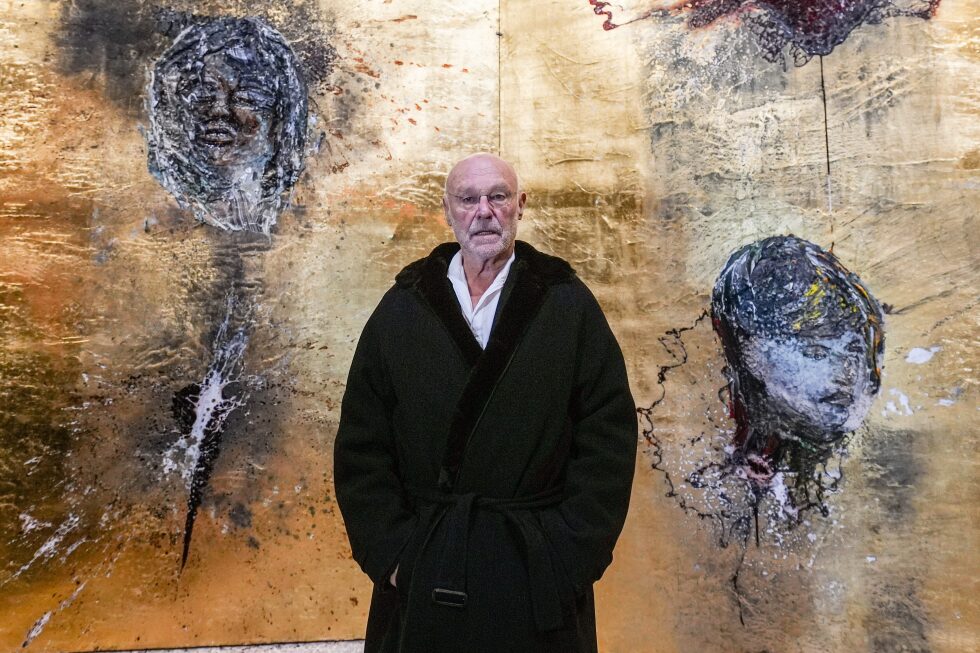
Renowned German contemporary artist Anselm Kiefer has unveiled a powerful new site-specific exhibition at Milan’s Palazzo Reale, drawing inspiration from the building’s war-damaged ceremonial hall. Titled “The Women Alchemists,” the exhibition was previewed Tuesday as part of the city’s cultural programming leading up to the 2026 Winter Olympics.
Kiefer, 80, one of Germany’s most acclaimed postwar artists, found immediate inspiration in the palazzo’s Sala delle Cariatidi, where crumbling caryatids—sculptural female figures that once served as architectural supports—remain as haunting reminders of the destruction caused by Allied bombing in 1943 during World War II.
“I quickly came to the idea of the women alchemists, that is, women who were equal with men, who experimented with medicine exactly as men,” explained Kiefer, whose artistic career has consistently explored themes of history, memory, and collective trauma through monumental works.
The exhibition features 42 towering panels, some reaching nearly 19 feet tall, each dedicated to a female alchemist whose contributions to early chemistry and medicine were overshadowed or erased by male-dominated historical accounts. Among the 38 women depicted is Milan’s own Caterina Sforza, daughter of Galeazzo Maria Sforza, who ruled as Duke of Milan from 1466 to 1476.
When asked if the exhibition represented a feminist statement, Kiefer responded with characteristic directness: “I am half woman. How can it be feminist?” The show’s curator, Gabriella Belli, offered further clarification, describing it as “an act of important recognition, and not necessarily an act of justice or feminism.”
The installation’s design faced technical challenges. Kiefer initially hoped to hang the paintings high on the walls above the fragile caryatids, but conservation concerns made this impossible. Instead, the massive canvases zigzag across the ballroom floor like ornamental screens, creating a contemplative pathway for visitors to engage with the forgotten female pioneers.
Kiefer’s artistic process incorporated the room’s existing architectural elements. He meticulously recreated the museum space in his studio, including placing mirrors in corresponding positions to those in the ceremonial hall. “There is an interaction between what is hidden, and what is revealed,” the artist noted, explaining how the paintings intentionally play off the original wall mirrors in the space.
The visual language of the works is striking and layered. Each alchemist appears in full figure—a deliberate contrast to the damaged half-bodies of the caryatids—surrounded by swirls of thick paint in predominantly blueish-green, gold, black, and silver tones. Three-dimensional plants, representing the botanical foundation of their work, and books recording their findings are recurring elements. Clouds and shrouds evoke the mystery that surrounded these women, who were often perceived as witches.
“Kiefer is an alchemist in the way he approaches art,” Belli observed. “For him, painting is always birth, destruction, regeneration, birth, destruction, regeneration. This is the process of alchemy, which is the transformation of matter.”
“The Women Alchemists” will run from February 7 to September 27, forming a significant part of Milan’s cultural offerings surrounding the upcoming Winter Olympics. The city’s Olympic cultural program also includes the rare opening of a room in the Sforza Castle featuring a wall painting by Leonardo da Vinci.
This exhibition continues Kiefer’s meaningful relationship with Milan. His installation “The Seven Heavenly Palaces” already stands as a permanent exhibition at Hangar Bicocca elsewhere in the city, making “The Women Alchemists” a powerful companion piece within Milan’s cultural landscape.
Despite the exhibition’s significance, Tommaso Sacchi, Milan’s top cultural official, indicated there are no current plans to maintain it as a permanent installation. “I am not here to announce the complete donation of the works to Palazzo Reale,” Sacchi said lightly, leaving open questions about the long-term future of this monumental artistic tribute to forgotten female pioneers.
Fact Checker
Verify the accuracy of this article using The Disinformation Commission analysis and real-time sources.

25 Comments
Silver leverage is strong here; beta cuts both ways though.
Good point. Watching costs and grades closely.
Good point. Watching costs and grades closely.
Nice to see insider buying—usually a good signal in this space.
Good point. Watching costs and grades closely.
Good point. Watching costs and grades closely.
Uranium names keep pushing higher—supply still tight into 2026.
Good point. Watching costs and grades closely.
If AISC keeps dropping, this becomes investable for me.
Good point. Watching costs and grades closely.
Nice to see insider buying—usually a good signal in this space.
Good point. Watching costs and grades closely.
Good point. Watching costs and grades closely.
The cost guidance is better than expected. If they deliver, the stock could rerate.
Good point. Watching costs and grades closely.
If AISC keeps dropping, this becomes investable for me.
Silver leverage is strong here; beta cuts both ways though.
Good point. Watching costs and grades closely.
If AISC keeps dropping, this becomes investable for me.
Good point. Watching costs and grades closely.
Production mix shifting toward World might help margins if metals stay firm.
Good point. Watching costs and grades closely.
Good point. Watching costs and grades closely.
Uranium names keep pushing higher—supply still tight into 2026.
Good point. Watching costs and grades closely.