


Listen to the article
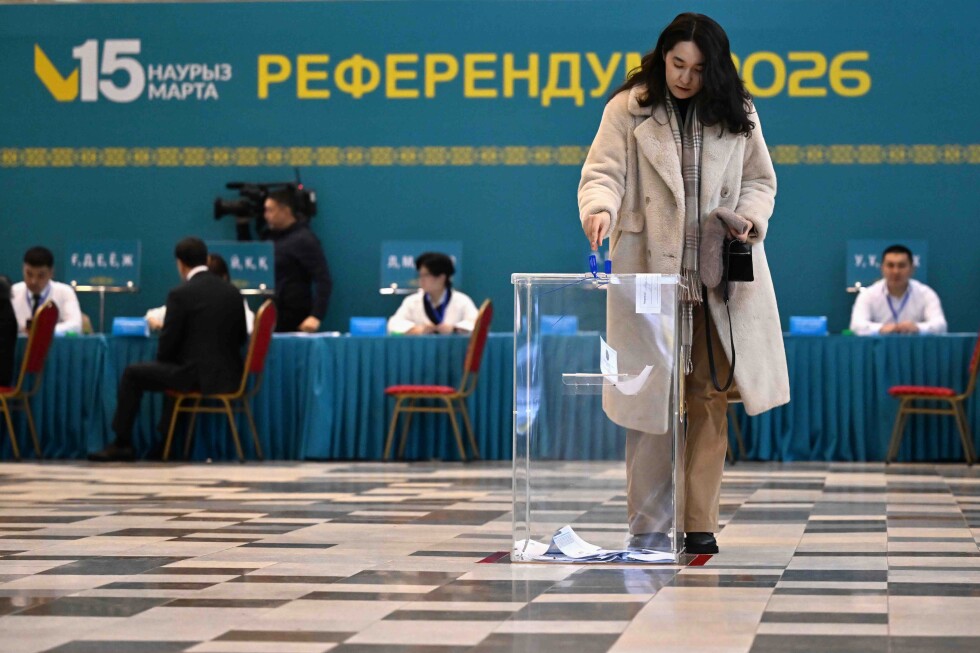
Voters in Kazakhstan cast their ballots Sunday in a referendum on constitutional changes that would significantly expand President Kassym-Jomart Tokayev’s authority in Central Asia’s largest country.
The proposed amendments would consolidate Kazakhstan’s bicameral parliament into a single chamber and grant the president broader powers to appoint key government officials with parliamentary approval. The changes also include reestablishing the position of vice president, which had been abolished in previous reforms.
“The transition to a single-chamber parliament will not necessarily strengthen democracy, especially as the proposed amendments broadly expand presidential powers,” said Mario Bikarski, senior Eastern Europe and Central Asia analyst at risk intelligence firm Verisk Maplecroft. “There is growing public demand for greater political accountability and justice, which these reforms are unlikely to address.”
The referendum would create a new body called the People’s Council alongside parliament. This council would have the authority to initiate legislation and referendums, with its membership entirely appointed by the president – further centralizing power in the executive branch.
This marks Kazakhstan’s second constitutional overhaul in just four years, both initiated under Tokayev’s leadership. Political analysts suggest the changes could pave the way for the 72-year-old president to remain in power beyond his current seven-year term, which expires in 2029.
“If the transition of power doesn’t go as Tokayev would like… he will be able to say that with the adoption of the new Constitution, we have reset presidential term limits,” explained Temur Umarov, a fellow at the Carnegie Russia Eurasia Center. “The new constitution could provide Tokayev with a loophole for reelection to another term.”
Such constitutional maneuvers to extend leadership terms have become a familiar pattern across former Soviet republics. Leaders in Russia, Belarus, Uzbekistan, and Tajikistan have all employed similar strategies to circumvent statutory term limits through constitutional revisions.
The proposed constitution also contains significant social elements, notably redefining marriage specifically as a union between a man and a woman. This change aligns with a recent law banning what Kazakhstani authorities consider “propaganda” of LGBTQ+ relations.
“What we previously saw in the Russian Constitution has migrated to the Kazakhstani one. This trend toward visible and ostentatious ‘traditionalism’ demonstrates a certain bias toward which the Kazakhstani political regime will likely drift in the future,” Umarov observed.
Tokayev has characterized these constitutional changes as necessary adaptations to an increasingly volatile global landscape. “This step is of exceptional importance, especially in the current period, when the geopolitical situation is unstable and challenges and threats to national security are becoming increasingly tangible,” he stated at a forum in Astana last Thursday.
Since taking office, Tokayev has maintained a delicate diplomatic balancing act between Russia and Western powers, particularly in the wake of sanctions imposed on Russia following its invasion of Ukraine. Kazakhstan, which shares a 7,644-kilometer border with Russia, has significant economic and security ties to Moscow but has also cultivated relationships with the European Union, China, and the United States.
Opposition forces in Kazakhstan remain largely marginalized and have struggled to mount an effective campaign against the referendum in the short time since it was announced. “There’s no formally formed opposition in Kazakhstan,” Umarov noted. “There are opposition-minded politicians and civil society activists. They’re trying to demonstrate their discontent in some way, trying to hold various protests, calling for voting in a certain way.”
The referendum comes at a challenging economic moment for Kazakhstan. Inflation reached 11.7% in February, and recent tax increases have fueled public discontent. The country’s vast natural resources, particularly oil and uranium, have historically driven its economy, but benefits have not been evenly distributed across the population of nearly 20 million.
Analysts suggest these economic pressures could spark unrest similar to the nationwide protests in January 2022, which were initially triggered by fuel price increases but evolved into broader anti-government demonstrations. Those protests resulted in dozens of deaths among both protesters and police, representing the worst violence in Kazakhstan’s post-Soviet history.
“Preventing a repeat of the 2022 unrest remains a key priority for Tokayev,” Bikarski emphasized. “Kazakhstan is the highest-risk Central Asian country on our predictive Civil Unrest Index, reflecting the increased incidence of industrial action, particularly in oil-producing regions.”
The outcome of Sunday’s referendum could significantly reshape Kazakhstan’s political landscape for years to come, with implications for both domestic governance and the country’s geopolitical positioning in an increasingly complex Central Asian region.
Fact Checker
Verify the accuracy of this article using The Disinformation Commission analysis and real-time sources.

10 Comments
The proposed changes to Kazakhstan’s political system seem to prioritize the president’s authority over democratic checks and balances. I hope the referendum results reflect the will of the Kazakhstani people, not just the ruling party.
The consolidation of presidential powers raises concerns about democratic backsliding. I hope Kazakhstanis can find a balance between political stability and meaningful citizen representation in the government.
Agreed. A healthy democracy requires checks and balances, not just efficiency in decision-making.
Consolidating power in the executive branch is a concerning trend. While constitutional reforms may aim for stability, it’s important that they also address public demands for accountability and justice.
It will be interesting to see how Kazakhstan’s neighbors and major trading partners react to these proposed political reforms. Global powers may have a stake in the country’s stability and economic openness.
As an investor, I’m closely watching how these constitutional reforms could impact the mining and energy sectors in Kazakhstan. A more centralized government could bring policy stability but also raise risks around regulatory uncertainty.
As an analyst, I’ll be closely monitoring how these constitutional changes impact the investment climate for mining, energy, and other key industries in Kazakhstan. Regulatory risk is a major factor for foreign companies.
This referendum is an important moment for Kazakhstan. I’m curious to see if the public voices a desire for more checks on executive authority, or if they prioritize the president’s ability to govern effectively.
It’s interesting to see Kazakhstan rethinking its political structure amid global geopolitical shifts. I wonder how these changes will affect the country’s international relationships and economic ties, particularly in the natural resources space.
Good point. Kazakhstan’s strategic location between Russia and China means these constitutional changes could have wider regional implications as well.