


Listen to the article
Japan’s defense budget for the upcoming fiscal year has reached an unprecedented 9 trillion yen ($58 billion), marking a significant 9.4% increase from the previous year. The Cabinet-approved plan represents the fourth consecutive year of Japan’s five-year program to double its defense spending to 2% of GDP.
The military expansion comes amid rising tensions with China in the region. Prime Minister Sanae Takaichi made headlines in November when she suggested Japan’s military could intervene if China were to take action against Taiwan—a self-governing island that Beijing claims as its territory.
Under pressure from the United States, Takaichi’s government has pledged to achieve the 2% defense spending target by March, accelerating the timeline by two years. Additionally, Japan plans to revise its security and defense policies by December 2026 to further strengthen its military capabilities.
The defense buildup marks a significant shift in Japan’s post-World War II military stance, which has traditionally limited the use of force to self-defense. Japan’s 2022 security strategy explicitly names China as the country’s biggest strategic challenge and calls for a more offensive role for Japan’s Self-Defense Force under its security alliance with the U.S.
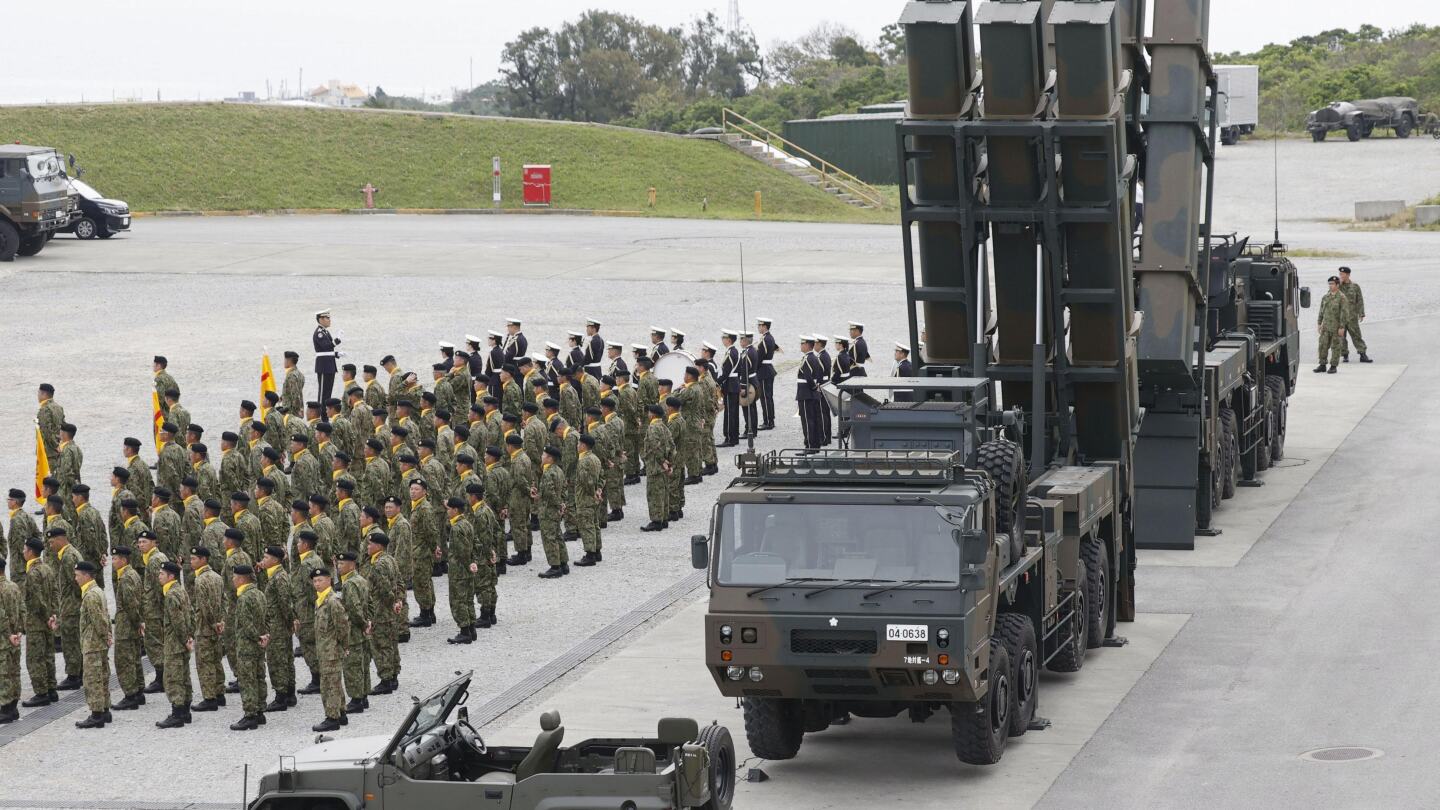
Nearly 970 billion yen ($6.2 billion) of the new budget will be allocated to enhancing Japan’s “standoff” missile capability, including 177 billion yen ($1.13 billion) for domestically developed and upgraded Type-12 surface-to-ship missiles with a range of about 1,000 kilometers. The first batch of these missiles will be deployed in southwestern Kumamoto prefecture by March, a year earlier than originally planned.
To address challenges posed by Japan’s aging and declining population, which has led to military understaffing, the government is heavily investing in unmanned weapons systems. The budget allocates 100 billion yen ($640 million) for the deployment of “massive” unmanned air, sea-surface, and underwater drones under a surveillance and defense system called “SHIELD,” scheduled for implementation by March 2028. Initially, Japan plans to rely mainly on imports, possibly from Turkey or Israel, for faster deployment.
The budget announcement follows escalating tensions with China. The dispute intensified this month when Chinese aircraft carrier drills near southwestern Japan prompted Tokyo to protest after Chinese aircraft locked their radar on Japanese aircraft—a move considered a possible precursor to missile firing. In June, two Chinese aircraft carriers were spotted operating near the southern Japanese island of Iwo Jima simultaneously for the first time, heightening Tokyo’s concerns about Beijing’s expanding military activities beyond its borders.
Japan is also strengthening its defense industry through international collaboration. The 2026 budget includes more than 160 billion yen ($1 billion) for joint development of a next-generation fighter jet with Britain and Italy, targeted for deployment in 2035. Research and development for AI-operated drones designed to accompany these jets is also planned. In a significant boost to Japan’s defense sector, Australia recently selected Mitsubishi Heavy Industries to upgrade Mogami-class frigates to replace its fleet of 11 ANZAC-class ships.
The budget plan requires parliamentary approval by March to be implemented as part of a 122.3 trillion yen ($784 billion) national budget bill. If approved, this five-year defense buildup program would bring Japan’s annual defense spending to approximately 10 trillion yen ($64 billion), making it the world’s third-largest military spender after the United States and China.
To fund the increased military expenditure, Takaichi’s government plans to raise corporate and tobacco taxes and has recently adopted a plan for income tax increases beginning in 2027. However, analysts note that prospects for sustaining higher percentages of GDP on defense spending remain uncertain beyond the current five-year program.
Fact Checker
Verify the accuracy of this article using The Disinformation Commission analysis and real-time sources.

22 Comments
Japan’s record defense budget and plans to strengthen its military capabilities are a clear indication of its intention to take a more assertive role in the region. This is a significant shift from its traditional self-defense-focused approach.
The decision to name China as Japan’s biggest strategic challenge highlights the growing tensions between the two countries. It will be crucial to monitor how this affects regional stability and diplomacy.
The decision to revise Japan’s security and defense policies by 2026 suggests a sense of urgency in addressing the perceived threat from China. This shift in Japan’s military posture will have significant implications for the region.
Japan’s growing military capabilities could raise concerns among its neighbors, especially China. It will be important to see how this affects regional cooperation and security dynamics.
Japan’s shift towards a more offensive military posture is a significant departure from its post-WWII stance. It will be interesting to see how this impacts its relationships with other countries in the region.
The decision to name China as Japan’s biggest strategic challenge is a clear indication of the growing tensions between the two countries. This will be an important development to follow closely.
Japan’s record defense budget and plans to revise its security and defense policies are a clear indication of its growing concerns about the threat posed by China. This will be an important development to follow.
The acceleration of Japan’s defense buildup to reach the 2% GDP target by 2026 suggests a sense of urgency. It will be crucial to monitor how this affects regional stability and cooperation.
This is a notable development in Japan’s defense policy, as the country moves towards a more offensive military posture to deter potential aggression from China. The implications for regional security and geopolitics will be important to follow.
Japan’s record defense budget and plans to revise its security and defense policies by 2026 suggest a sense of urgency in addressing the perceived threat from China. This shift in Japan’s military stance will have significant consequences for the region.
This record defense budget for Japan is a clear signal of its intention to bolster its military capabilities to deter potential aggression from China. The implications for regional security dynamics will be crucial to monitor.
Japan’s more assertive military stance could lead to increased tensions with its neighbors. Effective diplomacy and communication will be essential to maintain regional stability.
The record defense budget highlights Japan’s intention to take a more proactive role in deterring Chinese aggression. It will be interesting to see how this impacts the regional power dynamics.
Japan’s shift towards a more offensive military posture is a notable development. The implications for regional security and diplomacy will be important to follow.
Interesting move by Japan to bolster its defense capabilities amid rising tensions with China. Curious to see how this impacts the regional geopolitical landscape.
Japan is certainly taking a more assertive stance on defense and deterring potential aggression from China. It will be important to monitor how this affects stability in the Asia-Pacific region.
This is a significant shift in Japan’s defense policy, which has traditionally focused on self-defense. The decision to name China as the country’s biggest strategic challenge is noteworthy.
Japan’s more assertive military stance could heighten tensions with China. Effective diplomacy and communication will be essential to manage the regional security dynamics.
This is a significant shift in Japan’s post-WWII military posture. Doubling defense spending to 2% of GDP is a substantial commitment. I wonder how this will be viewed by neighboring countries.
Japan’s growing military capabilities could raise concerns among its regional neighbors, especially China. Diplomatic efforts to maintain stability and open communication will be crucial.
Japan’s military expansion could have significant implications for the regional balance of power. I wonder how this will affect its relationships with other countries in the Asia-Pacific.
Doubling defense spending is a bold move by Japan. It will be crucial to see how this affects regional stability and cooperation in the years ahead.