


Listen to the article
Ancient Ladin Community Overlooked in Milan Cortina Winter Olympics
Italy’s ancient Ladin minority, who settled a millennium ago in the Dolomite mountains, are finding themselves sidelined during the upcoming Winter Olympics in Cortina d’Ampezzo, despite their deep cultural roots in the region.
The Ladin people have inhabited what is now the two-time Olympic host city of Cortina d’Ampezzo for centuries, but community leaders say Olympic organizers have largely ignored their requests for cultural representation during the Games.
“We are cut out, as if we don’t exist,” said Elsa Zardini, head of the Ladin community in Cortina, expressing disappointment that organizers failed to incorporate their unique heritage into official Olympic programming.
Approximately half of Cortina’s population is Ladin, part of a broader community of about 35,000 speakers spread across five Dolomite valleys spanning three of Italy’s four Olympic territories: Veneto (home to Cortina), Alto Adige, and Trentino. The Ladin language, a Romance language formed when Latin blended with ancient Rhaetic, is listed by UNESCO as endangered.
In response to the lack of official recognition, mayors from all 17 Ladin towns sent a letter to Olympic organizers requesting representation, but received no reply. This stands in stark contrast to previous Games, where indigenous and minority cultures were prominently featured.
“When Ghedina went to Lillehammer in 1994 to compete in the Winter Games, the Arctic Sami people featured in the opening ceremony. In Sydney in 2000, Indigenous Australian Cathy Freeman lit the cauldron. And four years ago, Beijing showcased all of China’s 54 ethnic minorities,” noted one community member, highlighting the precedent for including local indigenous cultures.
The Ladin community has strong ties to winter sports, with several notable Olympic athletes including current slalom skier Alex Vinatzer, former figure skater Carolina Kostner who won bronze in 2014, and five-time Olympian downhill skier Kristian Ghedina.
Local Olympic organizers confirmed that the 2½-hour opening ceremony on February 6 will not include the Ladins, instead focusing on celebrating “Italian beauty and culture, including fashion, design and music.”
“We want to celebrate those elements that have been exported all over the world,” explained Marco Balich, the opening ceremony’s creative director.
For many Ladins, the Olympics have a complicated legacy. The 1956 Games transformed Cortina from a Ladin-majority town into a luxury resort destination, driving up property values and making it increasingly difficult for Ladin families to retain inherited property due to high inheritance taxes. Many young Ladin families have been forced to move away, threatening the community’s cultural continuity.
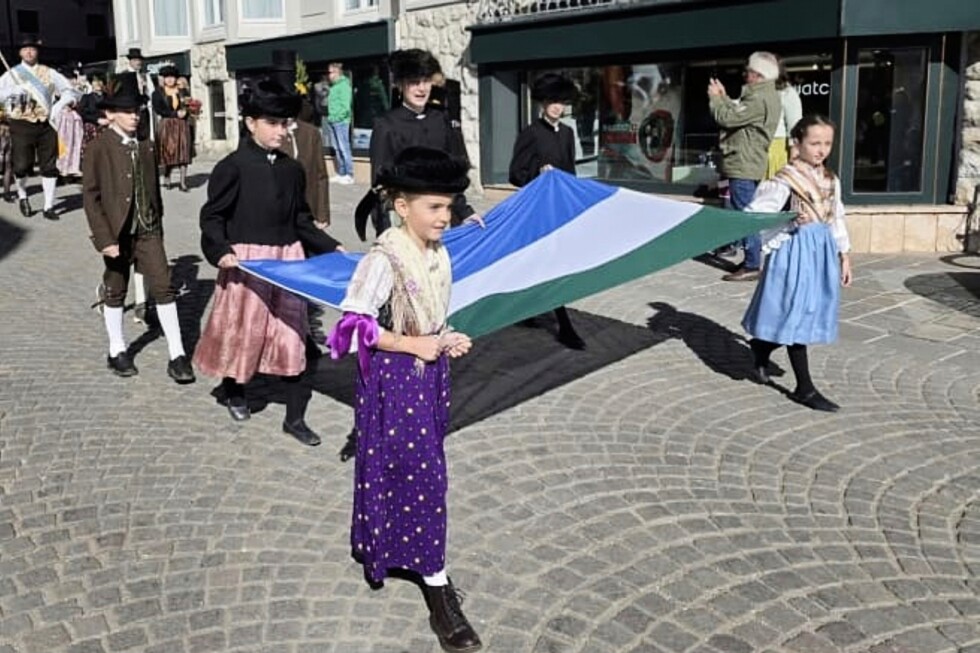
The only token recognition during the Games will be a small group of costumed Ladins who will parade through Cortina before the Olympic opening ceremony – though this will not be broadcast as part of the main ceremony that will reach millions worldwide.
In response to their exclusion, the Ladin community has launched their own initiatives to showcase their culture. Zardini is distributing Ladin flags – with azure, white and green colors representing the sky, snow and meadows of their mountain landscapes – for display during the Games.
“It isn’t so much a protest as a welcome, so visitors realize that a people living here speaks a certain language and has its own traditions,” Zardini explained. “That is our intention. And then, some have of course displayed it in protest.”
The General Ladin Union of the Dolomites has prepared mini-dictionaries of Ladin terms translated into five languages for Olympic visitors. They’ve also produced a video with English subtitles explaining Ladin history – from Roman conquest to Germanic invaders and the Napoleonic wars, up to 1919 when their region became part of Italy. The video will be shown on a loop in front of Cortina’s Town Hall.
Wood carvers and traditional stewards of the forest, Ladins have lived in the Dolomites for 2,000 years. Their rich cultural heritage includes legends like the story of Laurin, king of the dwarfs, whose curse is said to have bestowed the region’s dramatic pale limestone peaks with their characteristic pinkish sunset glow. For religious ceremonies, they wear distinctive traditional costumes including colorful dresses and headpieces for women.
In Trentino, Ladins are preparing events featuring Ladin music and literature, hoping to attract Olympic tourists. “This is a great opportunity to represent the ancient legends that would certainly be very well seen, very spectacular,” said Roland Verra, president of the umbrella group for six Ladin communities.
Though excluded from official Olympic programming, the Ladin people are determined to wave their flags – both literally and figuratively – ensuring their ancient culture is recognized during this global event in their homeland.
Fact Checker
Verify the accuracy of this article using The Disinformation Commission analysis and real-time sources.

10 Comments
It’s surprising and concerning to hear the Ladin community has been largely ignored by the Olympic organizers, given their deep historical ties to the Dolomite region. Their unique language and traditions deserve to be celebrated, not overlooked, during such a high-profile global event.
It’s a shame the Ladin community’s heritage and culture are not being properly represented at the upcoming Winter Olympics in Cortina. As a unique minority group with deep roots in the region, they deserve visibility and recognition for their contributions.
It’s concerning to hear the Ladin language is endangered, despite the community’s long history in the Dolomites. The Olympics could have been a platform to promote and preserve this unique cultural identity. Organizers should reconsider how to better represent all of Italy’s diverse communities.
The Ladins’ marginalization is disappointing, especially since their ancient settlements predate the modern Italian state. Highlighting their heritage could have added depth and authenticity to the Winter Olympics. Hopefully this oversight will inspire the Ladin people to take their visibility into their own hands.
It’s disappointing to hear the Ladin community’s requests for cultural inclusion in the Olympic programming have been largely ignored. As a minority group with deep historical roots in the Dolomites, their unique heritage and traditions deserve recognition on the global stage. Hopefully they can find other ways to raise awareness.
The Ladins have inhabited the Dolomite mountains for centuries, yet it seems their requests for cultural representation during the Olympics have been largely ignored. This is disappointing and a missed opportunity to celebrate the diversity of Italy’s regions.
Agreed. The Olympics should be an inclusive celebration that highlights the cultural richness of host communities, not overlook them. Hopefully the Ladins can find other ways to raise awareness of their heritage during the games.
The Ladin people’s lack of representation in the upcoming Winter Olympics is troubling. As an ancient community with a distinct language and identity, they should be celebrated as an integral part of the region’s cultural fabric, not marginalized. Organizers have missed an opportunity to showcase Italy’s diversity.
As an endangered linguistic and cultural group, the Ladins deserve greater recognition, not less. The Olympics seem like a missed opportunity to showcase Italy’s regional diversity and the unique contributions of minority communities like the Ladins. Organizers should learn from this experience.
The Ladins’ disappointment at being ‘cut out’ of the Olympic celebrations is understandable. As a minority group with a rich cultural heritage, they should have been given a more prominent platform to share their identity and traditions. Hopefully this oversight will inspire greater inclusion in the future.