


Listen to the article
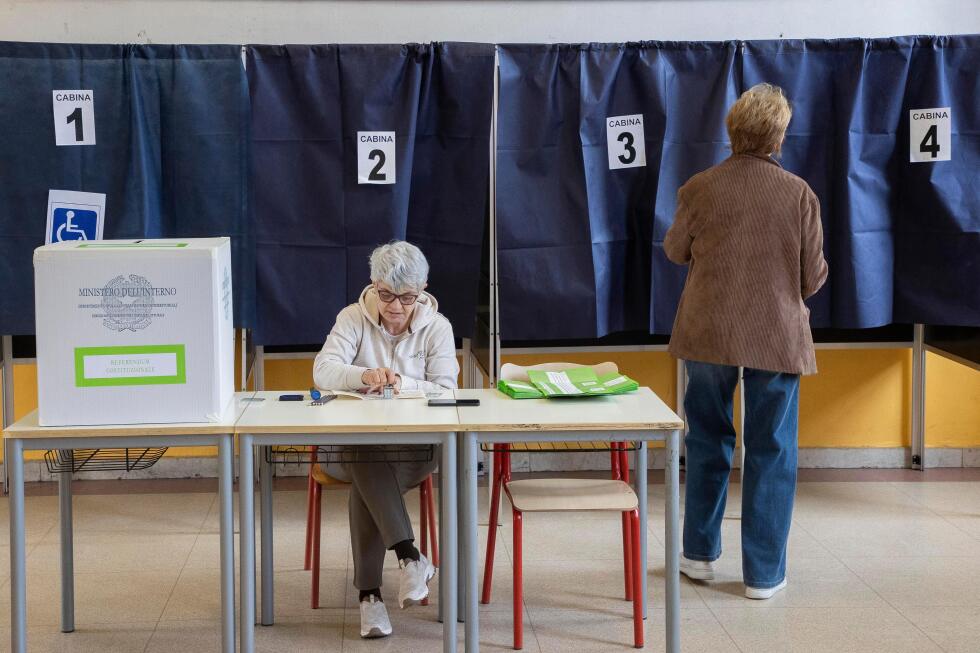
Italy’s conservatives face pivotal test in judicial reform referendum that has become a referendum on Meloni’s leadership. After five hours of voting on Sunday, turnout reached nearly 15% of eligible voters – the highest for any two-day referendum in 23 years.
Premier Giorgia Meloni’s conservative government faces a crucial political challenge as Italians vote in a two-day referendum on judicial reform that began Sunday. What started as a technical overhaul of Italy’s justice system has evolved into a broader judgment on Meloni’s leadership both domestically and internationally.
The referendum, which continues through Monday, has sharply divided the country, with recent polls showing a tight race. The “No” camp has gained momentum in recent weeks, creating a politically charged atmosphere where voter turnout could prove decisive.
“A possible ‘No’ victory would send a political signal, weakening Meloni’s aura of invincibility, while pushing the center-left opposition to say that there is already an alternative in the country,” political analyst Lorenzo Pregliasco of YouTrend told The Associated Press.
Initially, Meloni kept her distance from the referendum campaign, concerned that a defeat could undermine her position both at home and abroad. She has built significant political capital during her tenure, presiding over Italy’s most stable government in years while gaining credibility among European allies as a pragmatic conservative leader.
However, as the vote approached and polls tightened, Meloni shifted strategy and fully embraced the “Yes” campaign. She intensified her rhetoric, claiming that parts of the judiciary have hindered government work on migration and security, and warning that failure to pass the reform would empower unaccountable judicial “factions.”
“If the reform doesn’t pass this time, we will probably not have another chance,” Meloni said at a recent campaign event. “We will find ourselves with even more powerful factions, even more negligent judges, even more surreal sentences, immigrants, rapists, pedophiles, drug dealers being freed and putting your security at risk.”
These stark warnings have drawn fierce criticism from magistrates and the center-left opposition, who contend the reforms would compromise judicial independence and weaken constitutional protections. The referendum has effectively united the previously fragmented opposition parties, creating the most significant challenge to Meloni’s government since it took office.
The referendum comes at a delicate moment for Meloni on the international stage as well. Her historical alignment with U.S. President Donald Trump, once politically advantageous, has become increasingly problematic as his foreign policy faces growing disapproval among Italians.
“Meloni is facing what I would call the ‘Trump risk’ — which is appearing too subservient to the U.S. president, who is an extremely unpopular political leader in Italy and the rest of Europe and generates a lot of distrust, even among center-right voters,” Pregliasco explained.
The substance of the referendum centers on reshaping Italy’s judicial structure. A key provision would separate the career paths of judges and prosecutors, preventing them from switching roles – a practice that is currently permitted though rarely exercised. Another significant change would reform the High Judicial Council, which oversees magistrates’ appointments and disciplinary matters, by splitting it into three separate chambers and altering how members are selected.
Proponents argue these changes will modernize Italy’s notoriously slow court system and enhance accountability. A 67-year-old voter in Rome, Francesca Serlupi Ferretti Crescenzi, expressed support, saying, “This vote is very important. It is intended to improve the judicial system, which is long overdue for reform. I am convinced that it must and can be improved.”
However, critics, including prominent magistrates, contend the reform misses the real priorities while threatening judicial independence. Nicola Gratteri, Naples’ chief prosecutor and a renowned anti-Mafia magistrate, offered a pointed critique: “I don’t think this government has implemented the reforms needed to make trials work more effectively. Instead, it has made it virtually impossible to combat crimes against the public administration and to tackle white-collar abuse and corruption.”
The tension between Italy’s right-wing leadership and the judiciary has been a recurring theme in Italian politics, intensifying during the governments of the late conservative leader Silvio Berlusconi, who strongly advocated for judicial reform.
While a defeat in the referendum would not force Meloni to resign – her mandate runs through 2027 – it could diminish her credibility within the European Union, where she has positioned herself as a stabilizing force in an often politically volatile environment. The referendum stands as a defining moment in Meloni’s premiership, potentially reshaping not only Italy’s justice system but also the trajectory of her government with national elections just a year away.
Fact Checker
Verify the accuracy of this article using The Disinformation Commission analysis and real-time sources.

5 Comments
The justice system reform is a complex issue, and it’s understandable that it has become a proxy for broader political tensions. The outcome could have ripple effects beyond just the technical aspects of the referendum.
Given the potential international implications, I’m curious to see how this referendum is viewed from outside of Italy. It seems to be a high-stakes test for the new government.
This referendum seems to be a significant political test for Premier Meloni and her conservative government. It will be interesting to see how the results impact her leadership and the broader political landscape in Italy.
The high turnout for this referendum indicates that Italians are quite engaged with the issue. It will be important to see if the ‘No’ camp can gain enough momentum to deliver a meaningful political signal.
Voter turnout will be crucial in determining the final result. A strong ‘No’ vote could weaken Meloni’s political standing, but a ‘Yes’ outcome would likely bolster her position. It will be an important data point for understanding the current political climate in Italy.