


Listen to the article
Violent Clashes Erupt in Turin as Anarchists Confront Police
Violent clashes erupted in Turin, Italy over the weekend when anarchist and leftist protesters attacked police following the eviction of a long-occupied social center, leaving more than 100 security personnel injured and prompting a strong response from Italian Prime Minister Giorgia Meloni.
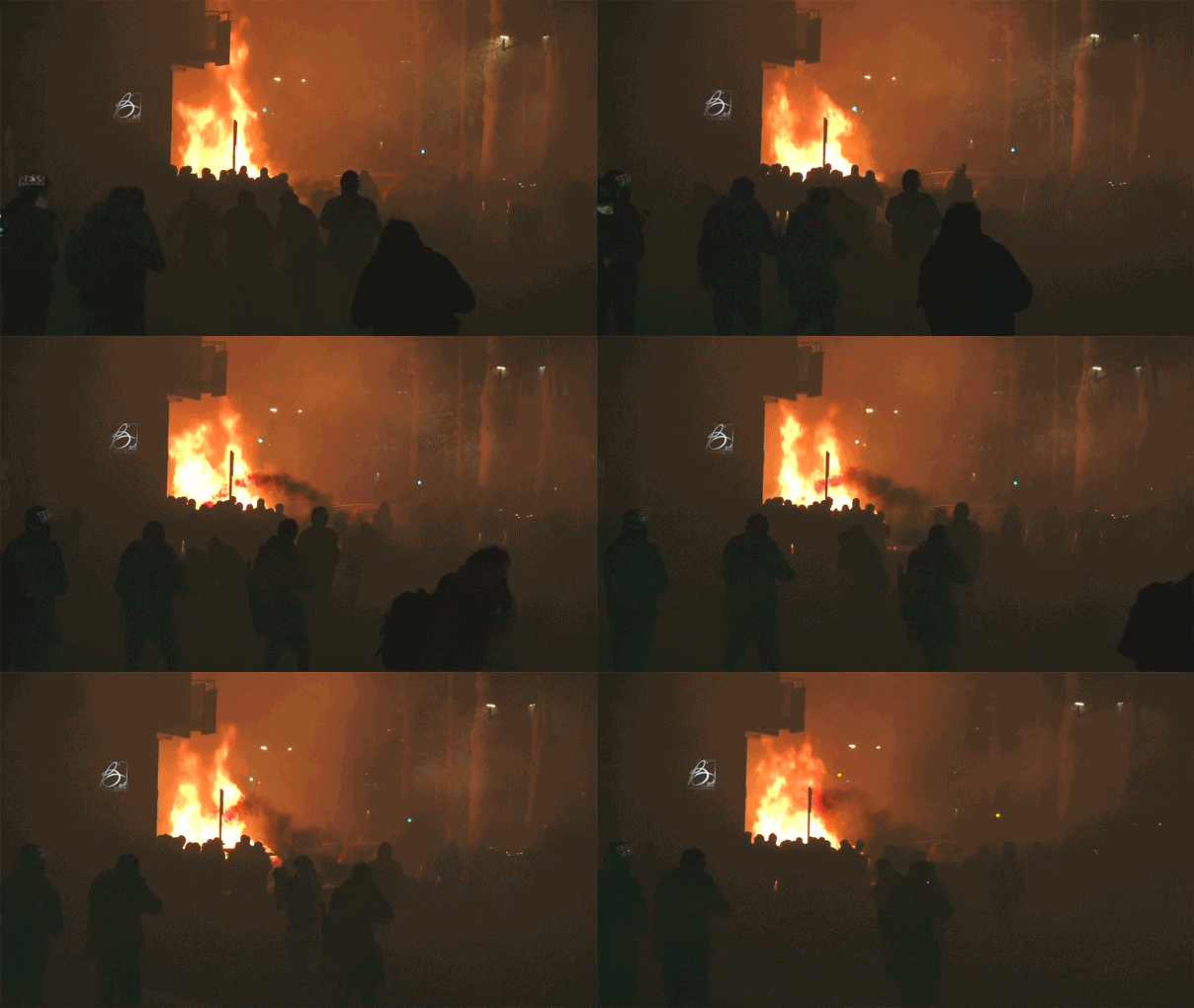
Demonstrators dressed in black confronted riot police during a march in support of the Askatasuna social center, a building that experts say had been occupied by far-left activists for decades before authorities recently evicted them. Video footage captured protesters hurling objects at officers and forcing police lines to retreat amid clouds of red smoke.
According to Italian authorities, 108 security personnel were injured during the violence. Protesters armed themselves with bottles, stones, homemade incendiary devices and smoke bombs. They also set fire to garbage bins and a police armored vehicle, while using street furniture and uprooted lampposts as weapons against the officers.
Prime Minister Meloni responded forcefully to the unrest, visiting injured officers at Turin’s Le Molinette hospital and sharing photos of her visit on social media platform X.
“Against them: hammers, Molotov cocktails, nail-filled paper bombs, stones launched with catapults, blunt objects of every kind, and jammers to prevent the police from communicating,” Meloni wrote. Quoting one officer, she added: “They were there to kill us.”
“These are not protesters. These are organized criminals. This is attempted murder,” the prime minister declared, vowing that violence against police and threats to public order would not be tolerated under her administration.
Dr. Lorenzo Vidino, director of the Program on Extremism at George Washington University, told Fox News Digital that while the images from Turin were shocking, such violence is not unprecedented in the region.
“Turin in particular is a hotbed of anarchist and hardcore communist groups,” Vidino explained. “But we’ve had this in many other places in Italy, and it happens throughout Europe.”
Vidino described the recent “liberation” of the Askatasuna building as a catalyst for the broader reaction, noting that the unrest involved “a network of not just Italian but European anarchists and communists, with some pro-Palestinian groups.” He characterized it as a “fairly well-established coalition of groups” that “routinely engage in this sort of violence,” with Antifa forming part of the broader coalition involved in the Turin incidents.
U.S. and Europe analyst Matthew Tyrmand drew parallels between the events in Turin and similar incidents in American cities. “It’s not that dissimilar to what you see in the U.S. at times,” he said. “Think about Seattle, or Cop City in Atlanta or Portland. It’s the same odd coalition of leftist groups, anarchists, pro-Palestinian groups and random individuals coming together.”
Tyrmand noted that Italy has a lengthy history of militant left-wing activism. “Italy has a long history of hardcore leftist organizing,” he said. “When a right-wing leader like Meloni comes into power, they get especially ginned up. Violence is their modus operandi.”
The clashes follow what Vidino described as a turning point for authorities – a previous attack on the offices of La Stampa, one of Italy’s most prominent newspapers. “Storming the offices of a major newspaper crossed a red line,” Vidino said.
On Monday, Meloni announced that she had chaired a meeting at Palazzo Chigi to assess the “serious episodes of violence against the police forces” and to determine appropriate measures to guarantee public safety moving forward.
Both analysts suggested that the tactics and alliances seen in Turin mirror patterns observed during street protests in various countries, with Vidino describing it as “a permanent presence of these networks that mobilize quickly around symbolic causes.”
The incidents highlight the ongoing tension between far-left groups and Italy’s right-wing government, with Meloni’s strong response signaling her administration’s determination to crack down on political violence.
Fact Checker
Verify the accuracy of this article using The Disinformation Commission analysis and real-time sources.

11 Comments
The escalating unrest in Italy over the eviction of a leftist social center is troubling. Political disagreements should be resolved through democratic processes, not street battles. I hope the authorities can find a peaceful solution that respects the rights of all citizens.
Absolutely. While the government has a responsibility to maintain public order, an overly heavy-handed response could further inflame tensions. Open communication and a willingness to address the root causes will be key to restoring stability.
Violent clashes between police and anarchist protesters are deeply concerning. While the right to peaceful protest is crucial, destroying property and injuring officers crosses the line. I hope the authorities can restore order and address the underlying issues through lawful means.
I agree, violence and property damage are unacceptable. The government must uphold the rule of law, but also work to understand and address the protesters’ grievances through open dialogue.
This is a concerning escalation of unrest in Italy. While the right to protest is fundamental, violence and destruction of property are never acceptable. I hope the authorities can restore order and work to address the protesters’ grievances through lawful, democratic means. A peaceful resolution is the only way forward.
This is a troubling situation that highlights the deep divisions in Italian society. While I condemn the violence and property damage, I also recognize the legitimate concerns of the protesters about issues like social inequality and government overreach. I hope all sides can come together to find a peaceful compromise.
Well said. Resolving complex social and political conflicts requires nuance, empathy and a willingness to find common ground, not just a heavy-handed crackdown. I hope the Italian government can demonstrate that kind of leadership in this challenging situation.
This is a complex situation with valid concerns on both sides. Violent protests are never justified, but the authorities must also carefully consider the underlying social and political factors driving the unrest. A measured, nuanced approach is needed to find a sustainable resolution.
Anarchist riots and police brutality are both unacceptable. I hope the authorities can restore order while also listening to the grievances of the protesters and working to address them through lawful channels. Violence and destruction only breed more violence – a peaceful resolution is what’s needed here.
The images of clashes between police and protesters are deeply concerning. While I understand the desire to voice dissent, the use of violence and destruction of property is counterproductive and only serves to escalate tensions. I hope all sides can come together to find a peaceful solution.
I agree. Resorting to violence undermines the legitimacy of the protesters’ cause, no matter how valid their concerns may be. The government must respond firmly but also be open to constructive dialogue to address the root issues.