


Listen to the article
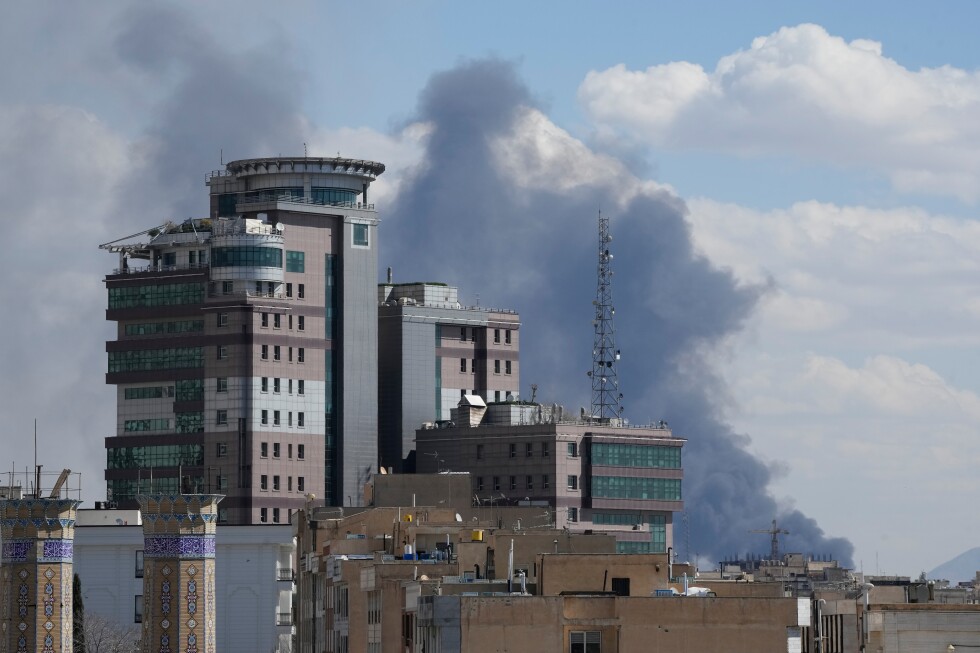
A massive explosion struck Tehran on Sunday as Israel targeted Iran’s capital, escalating a rapidly intensifying conflict that began with the killing of Iran’s Supreme Leader Ayatollah Ali Khamenei. The blast, which shook the ground and sent a huge plume of smoke skyward, appeared to hit neighborhoods housing police headquarters, state television facilities, the Revolutionary Court, and Defense Ministry buildings.
The attack followed Saturday’s unprecedented joint U.S.-Israel strikes against Iran, which marked a dramatic shift in American foreign policy. President Donald Trump, who had campaigned on an “America First” platform and promised to avoid “forever wars,” has now authorized military action against Iran twice in eight months.
The June war significantly degraded Iran’s air defenses, military leadership, and nuclear program. However, the targeted killing of Khamenei and Trump’s call for regime change represents a dramatic escalation, creating a leadership vacuum in the Islamic Republic and heightening the risk of regional instability.
Iran’s response was swift and wide-ranging. Its Cabinet vowed the “great crime will never go unanswered” while the Revolutionary Guard threatened to target American and Israeli bases. Parliamentary Speaker Mohammad Bagher Qalibaf delivered a televised address Sunday, warning: “You have crossed our red line and must pay the price. We will deliver such devastating blows that you yourselves will be driven to beg.”
Trump countered on social media with an explicit threat: “THEY BETTER NOT DO THAT. IF THEY DO, WE WILL HIT THEM WITH A FORCE THAT HAS NEVER BEEN SEEN BEFORE!”
The conflict has already triggered regional unrest, with hundreds of protesters storming the U.S. Consulate in Pakistan’s port city of Karachi. Authorities used batons and tear gas to disperse the crowd, resulting in at least six deaths.
Iran launched missiles and drones toward Israel and into Gulf states including Bahrain, Kuwait, and Qatar. The attacks on Israel killed one person and injured more than 120, according to authorities, though many missiles were intercepted. The strikes extended into Saudi Arabia, Jordan, and Oman, disrupting flights throughout the region.
In the United Arab Emirates, shrapnel from Iranian attacks on Abu Dhabi killed two people, with debris causing fires at the city’s main port and on the iconic Burj Al Arab hotel in Dubai. Explosions continued into Sunday morning in Dubai, a city that has long marketed itself as a safe haven in the volatile region.
The strikes could destabilize global markets, particularly if Iran disrupts shipping in the Strait of Hormuz, through which a third of worldwide oil exports transported by sea passed in 2025.
As supreme leader for decades, Khamenei had final authority over all major policies and led Iran’s clerical establishment and Revolutionary Guard. Iran quickly formed a council to govern until a new supreme leader is chosen, displaying institutional stability despite Trump’s call for Iranians to “take over” their government.
The strikes also killed several senior officials, including Army Chief of Staff Gen. Abdol Rahim Mousavi, Defense Minister Gen. Aziz Nasirzadeh, Revolutionary Guard Commander Maj. Gen. Mohammad Pakpour, and top security adviser Ali Shamkhani.
An Iranian diplomat told the UN Security Council that hundreds of civilians were killed or wounded. In southern Iran, at least 115 people reportedly died when a girls’ school was struck. IRNA, the state news agency, reported at least 15 people killed in the southwest, with strikes hitting a sports hall, residential areas, and a facility near a school.
Eyewitnesses in Tehran told The Associated Press that some residents celebrated Khamenei’s death, cheering from rooftops. However, the government declared 40 days of public mourning and a seven-day nationwide holiday. Fars news agency reported several of Khamenei’s relatives were also killed, including a daughter, son-in-law, daughter-in-law, and grandchild.
The strikes come after weeks of escalating tensions, with the Trump administration assembling the largest force of American warships and aircraft in the Middle East in decades. Democrats criticized Trump for taking military action without congressional authorization, though the White House stated it had briefed several congressional leaders in advance.
Despite Trump’s previous claims that Iran’s nuclear program had been obliterated, a senior U.S. official said intelligence showed Iran was rebuilding infrastructure, developing the capability to produce high-quality centrifuges necessary for weapons-grade uranium. Iran has claimed it has not enriched uranium since June but has blocked international inspectors from visiting bombed sites, where satellite photos have shown new activity.
Fact Checker
Verify the accuracy of this article using The Disinformation Commission analysis and real-time sources.

10 Comments
The killing of Iran’s Supreme Leader is a major event that will likely have far-reaching geopolitical implications. I’m curious to see how Iran responds and whether this leads to further instability in the region.
Absolutely, the power vacuum created by Khamenei’s death could be very destabilizing. This is a volatile situation that bears close monitoring.
This conflict between Israel and Iran seems to be escalating rapidly. I wonder what the impact will be on global energy and commodity markets, especially oil and metals. Will this lead to supply disruptions and price volatility?
That’s a good point. Tensions in the Middle East often have ripple effects on global commodity prices. I’ll be closely watching how this situation develops.
This is a concerning escalation of the conflict between Israel and Iran. As an investor, I’ll be closely watching how this impacts key commodities like oil, gold, and strategic metals. Geopolitical risks can create significant volatility.
I agree, this situation could definitely rattle commodity markets. Prudent risk management will be crucial for investors during these uncertain times.
The joint US-Israel strikes against Iran represent a major shift in American foreign policy. I wonder how this will affect global energy security and the geopolitical balance of power in the Middle East going forward.
That’s a great question. This could have far-reaching implications for the global energy landscape and the regional power dynamics in the Middle East.
As an industry analyst, I’ll be closely watching how this conflict impacts commodity prices and supply chains, especially for critical minerals and metals that are essential for modern technologies. Geopolitical risks can create significant disruptions.
Absolutely, this is an important situation to monitor for anyone with exposure to or interest in the mining and commodities sectors. The potential for supply chain impacts is definitely a concern.