


Listen to the article
US Leadership Reshapes Middle East in 2025, Analysts Say
For years, Washington has spoken about reducing its Middle East footprint, yet 2025 proved the opposite: American force — not retreat — reshaped the region, according to analysts who spoke with Fox News Digital.
“2025 underscored what Middle East watchers have long known, and U.S. policymakers never seemed to want to admit: that strength is the currency of the realm and there is no substitute for U.S. leadership,” said Blaise Misztal, vice president for policy at the Jewish Institute for National Security of America (JINSA).
Israeli political analyst Nadav Eyal concurred, noting a distinct shift in American involvement. “What we have seen in 2025 is an increased role of the United States, rather than a withdrawal,” Eyal said. “It delivered a hostage deal and a ceasefire in Gaza. It brought a certain level of stability in Syria. We see increased cooperation with Saudi Arabia, Qatar and the UAE.”
“The idea that the U.S. is out of the Middle East is just out the window,” he added.
Gaza Ceasefire: A Diplomatic Breakthrough
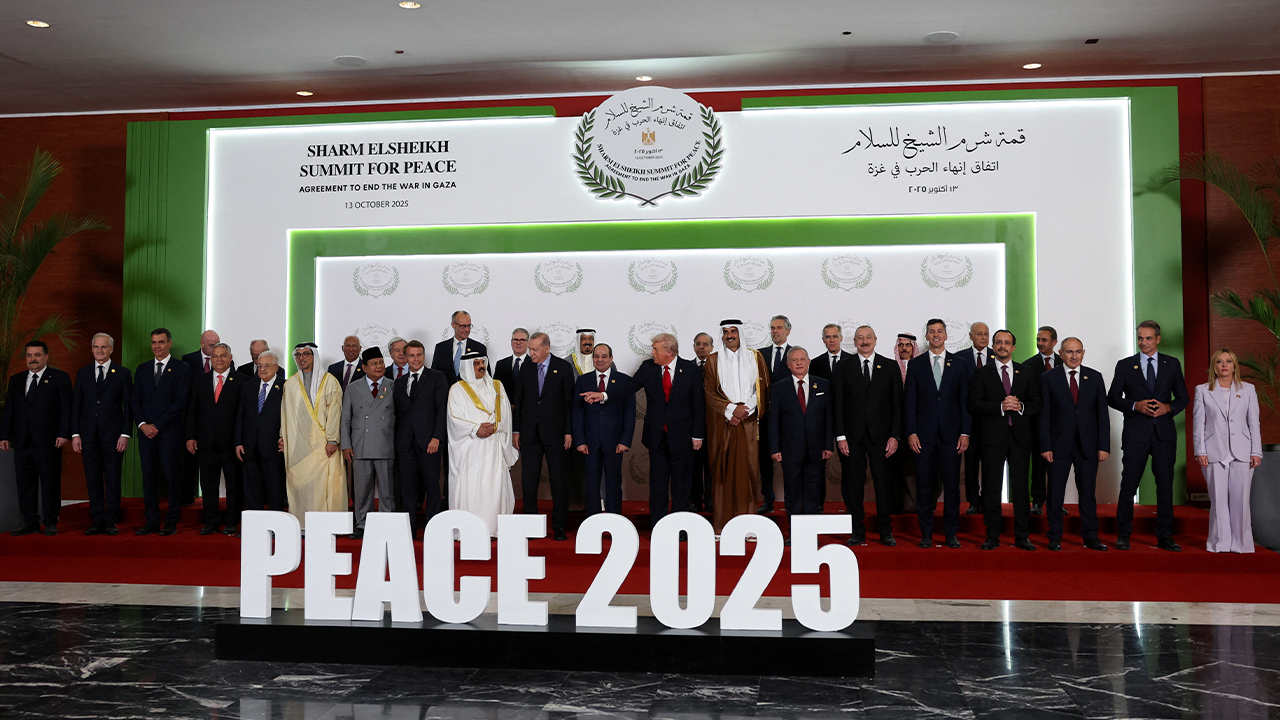
The Trump administration’s most notable achievement came with brokering a ceasefire that ended the two-year war in Gaza and secured the return of all living Israeli hostages except for the remains of Ran Gvili, which still remains in Hamas’ possession.
President Donald Trump personally traveled to both Israel, where he addressed the Knesset, and Cairo to finalize the agreement. The complex deal included an exchange of Palestinian prisoners held by Israel for hostages captured by Hamas during the October 2023 attacks.
“There is absolutely no doubt that without President Trump’s intervention, this could have lasted much longer, or maybe not have ended at all, or ended in tragedy,” Eyal said, adding that the administration fundamentally expanded what had been considered possible in terms of negotiations with Hamas.
According to Eyal, the breakthrough came from a combination of Israeli military pressure enabled by the White House, American diplomatic insistence, and coordination with regional powers like Qatar and Turkey.
Misztal emphasized that diplomacy alone did not produce results. “The relative calm that the region is now enjoying, after two years of war, is not the result of diplomacy, which failed on its own to stop Iran’s nuclear advance or convince Hamas to return Israeli hostages,” he said. “It is the result of Israeli and U.S. willingness to use force, and do so together in pursuit of common objectives.”
“Operations Rising Lion and Midnight Hammer, coupled with the Israeli strike in Doha, unlocked the path to peace,” Misztal added.
The ceasefire remains fragile but intact, with the United States now deeply involved in shaping Gaza’s postwar reconstruction and governance.
Regional Power Shifts
The Middle East’s geopolitical landscape underwent dramatic transformation in 2025, building on momentum from late 2024 when Israel’s defeat of Hezbollah was followed by the collapse of the Assad regime in Syria.
Operation Rising Lion, known as the “12-day war,” demonstrated Israel’s air superiority, with Israeli aircraft striking Iranian military infrastructure and eliminating senior commanders of Iran’s Revolutionary Guard Corps (IRGC). The campaign highlighted unprecedented U.S.-Israel coordination, culminating in American strikes that severely damaged Iran’s nuclear program and curtailed Tehran’s ability to support proxy groups across the region.
Eyal described Iran as facing a period of profound uncertainty. “Iran will, without doubt, try to rebuild its influence after its proxy system was shattered,” he said. “It was defeated in war with Israel and lost most of its nuclear program.”
The analyst posed two critical questions about Iran’s future: “Can Iran rebuild its alliances, its prestige and its sources of power, like the nuclear program or air defenses, and stabilize itself again as a regional power? The deeper question is what happens to the regime.”
He characterized Iran as increasingly unstable, with a devastated economy and growing public discontent. “It seems like almost everything is ripe for a substantial change in Iran,” Eyal said. “Whether the Islamic Republic can survive without significant reform, or whether there will be a coup or counterrevolution, will take us well into 2026.”
Hamas: Weakened But Still Present
The past year forced a reckoning about Hamas’ future in the region. “In 2025, Israelis, and to a certain extent countries in the Middle East, woke up from a fantasy that Hamas would cease to exist completely as a functioning body,” Eyal said.
“Everybody understands there will be some sort of presence of Hamas, and unfortunately, they will hold some sort of armed power,” he added. “The question is, to what level can you reduce it?”
Despite this sobering assessment, Eyal stressed the scale of Hamas’ losses. “In 2025 they suffered tremendous defeats and were wiped out as a functioning military body,” he said. “This is the year in which it happened.”
“Even after losing half of Gaza, with Gaza devastated, and the hostages returned, they are still functioning as a military organization,” he noted. “That means they are incredibly resistant or flexible.”
Looking Ahead: Challenges for 2026
Misztal warned that the current calm will not persist without sustained American engagement. “The sands of the Middle East are always shifting,” he said. “Today’s calm will not last without consistent effort applied to uphold it.”
He cautioned that 2026 could see renewed challenges from multiple fronts. “Adversaries will seek to reassert themselves and find new advantages,” Misztal said. “Iran will test the boundaries of U.S. and Israeli patience and ISIS or other Sunni extremists may seek a spectacular attack to mark their comeback.”
“These will all be tests for the U.S. appetite to continue applying the ‘peace through strength’ approach,” he concluded. “If Washington takes its eyes off the region, the progress of the last year might quickly be lost.”
Fact Checker
Verify the accuracy of this article using The Disinformation Commission analysis and real-time sources.

13 Comments
This news highlights the continued importance of energy security and geopolitics in the Middle East, which can have significant impacts on commodity markets like mining and uranium. Careful monitoring of the situation is warranted.
Interesting to see the US continue its active role in the Middle East despite claims of withdrawal. Maintaining stability and diplomacy in the region remains crucial for global security and energy markets.
You’re right, the US presence and influence in the Middle East is still significant. It will be important to see how this evolves going forward.
The notion of a US withdrawal from the Middle East seems premature. American leadership and involvement, while complex, remains essential for maintaining stability and navigating the region’s delicate balance of power.
That’s a fair assessment. The US role in the Middle East is evolving, but it’s clear they still wield significant influence and seek to shape regional dynamics.
This news highlights the continued volatility and geopolitical tensions in the Middle East, which can have significant implications for the mining and energy sectors. Careful monitoring of these developments will be important for industry participants.
Agreed. The Middle East’s strategic importance, especially in critical minerals and energy, means the region will remain a key focus for global powers like the US.
The hostage release and ceasefire deal are positive developments, though the underlying tensions and conflicts in the region remain challenging. Careful diplomacy and a nuanced approach are needed.
Agreed. Deescalating conflicts through dialogue is critical, but the geopolitical dynamics in the Middle East are complex and fragile.
The release of Israeli hostages and the ceasefire deal are positive steps, but the broader tensions and conflicts in the region persist. Continued diplomatic efforts and a measured approach will be crucial going forward.
The notion of a US withdrawal from the Middle East seems overstated. This news suggests the US remains actively engaged in the region, using diplomacy and strategic influence to navigate complex challenges. Maintaining stability in the Middle East is crucial for the global economy and commodity markets.
This news underscores the ongoing geopolitical complexities and energy security challenges in the Middle East, which can have ripple effects on global commodity markets. Careful monitoring and analysis of these developments will be important for industry stakeholders.
Absolutely. The Middle East’s strategic importance, especially in energy and minerals, means that global players like the US will likely maintain a strong presence in the region.