


Listen to the article
Israeli Military Reveals Hamas Tunnel Network in Rafah Amid Fragile Ceasefire
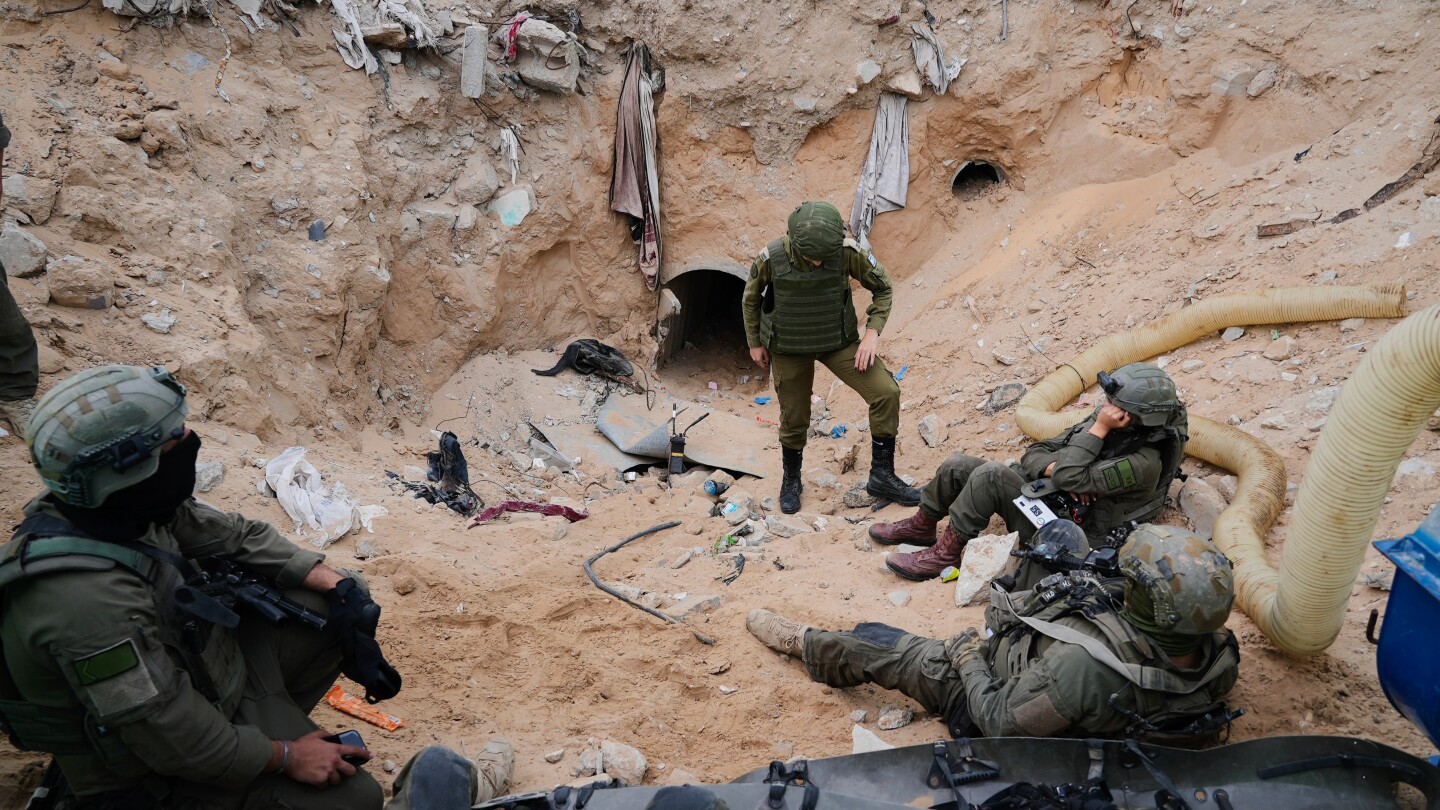
Israeli soldiers led international journalists through a sprawling Hamas tunnel beneath Rafah on Monday, offering a rare glimpse into Gaza’s underground network as the two-month ceasefire reaches a critical juncture. The military-escorted tour highlighted what Israel describes as one of Hamas’ most significant underground routes, used by top commanders and for weapons storage.
Soldiers guided journalists through a narrow entrance into a dark hallway with low ceilings, navigating around concrete debris, crushed plastic bottles and abandoned mattresses. The Israeli military claims the tunnel extends more than 7 kilometers (4 miles) and reaches depths of 25 meters (82 feet) below what was once a densely populated residential neighborhood.
“What we see right here is a perfect example of what Hamas did with all the money and the equipment that was brought into Gaza throughout the years,” said Lt. Col. Nadav Shoshani. “Hamas took it and built an incredible city underground for the purposes of terror and holding bodies of hostages.”
The military stated that the body of Hadar Goldin, a soldier killed in Gaza over a decade ago, had been held in this tunnel before being returned last month as part of the U.S.-brokered ceasefire agreement. Israel has accused Hamas of using such tunnels not only for military operations but also to hide hostages taken during the October 7, 2023 attack.
Above ground, Rafah presents a scene of near-total destruction. Once Gaza’s southernmost city and a refuge for Palestinians fleeing fighting elsewhere, it now consists primarily of rubble-lined roads and collapsed buildings. Journalists observed piles of mangled concrete, exposed wiring, and personal belongings scattered among the debris—foam mattresses, towels, and religious texts, remnants of civilian lives upended by the conflict.
Israel’s military operation in Rafah last year displaced nearly one million Palestinians. After gaining control of the area, satellite images show the military systematically demolished most remaining structures. The offensive also resulted in the closure of the vital Rafah crossing, Gaza’s only gateway to the outside world not controlled by Israel.
Israeli officials defended the Rafah operation as necessary to dismantle Hamas’ last major stronghold, describing it as key to achieving their war aim of eliminating the group’s military capabilities. Last week, Israel announced readiness to reopen the Rafah crossing, but only for outbound traffic—a position that has raised concerns among Egyptians and Palestinians who fear those leaving might not be permitted to return.
The war, triggered by Hamas’ October 2023 attack that killed 1,200 people in southern Israel and resulted in hundreds being taken hostage, has devastated Gaza. According to the Hamas-run Health Ministry, more than 70,000 Palestinians have been killed in Israel’s retaliatory campaign. The ministry, which does not distinguish between civilians and combatants, reports that approximately half of the casualties have been women and children.
The ceasefire is approaching the end of its first phase, which mandated the return of all hostages, living and dead, in exchange for Palestinians held in Israeli prisons. With just one more hostage’s remains still to be recovered, mediators warn the second phase will face greater challenges, including thorny issues such as Hamas disarmament and Israel’s withdrawal from the territory it currently controls—more than half of Gaza.
Since the ceasefire began, three Israeli soldiers have been killed in clashes with what Israeli and Egyptian officials claim are approximately 200 Hamas militants remaining underground in Israeli-held territory. Hamas has denied responsibility, stating that communication with any remaining units in Rafah has been cut off for months.
Both parties have accused each other of violating the ceasefire terms. Israel claims Hamas has intentionally delayed hostage returns, while Palestinian health officials report that over 370 Palestinians have been killed in continued Israeli strikes since the truce took effect.
Israeli Prime Minister Benjamin Netanyahu is scheduled to travel to Washington this month to discuss next steps with U.S. President Donald Trump, as the delicate ceasefire faces its most challenging phase yet.
Fact Checker
Verify the accuracy of this article using The Disinformation Commission analysis and real-time sources.

24 Comments
Exploration results look promising, but permitting will be the key risk.
Good point. Watching costs and grades closely.
I like the balance sheet here—less leverage than peers.
I like the balance sheet here—less leverage than peers.
Good point. Watching costs and grades closely.
Production mix shifting toward World might help margins if metals stay firm.
Exploration results look promising, but permitting will be the key risk.
Good point. Watching costs and grades closely.
The cost guidance is better than expected. If they deliver, the stock could rerate.
Good point. Watching costs and grades closely.
The cost guidance is better than expected. If they deliver, the stock could rerate.
Good point. Watching costs and grades closely.
Nice to see insider buying—usually a good signal in this space.
Good point. Watching costs and grades closely.
Good point. Watching costs and grades closely.
Uranium names keep pushing higher—supply still tight into 2026.
Good point. Watching costs and grades closely.
Good point. Watching costs and grades closely.
If AISC keeps dropping, this becomes investable for me.
Good point. Watching costs and grades closely.
Silver leverage is strong here; beta cuts both ways though.
Good point. Watching costs and grades closely.
Good point. Watching costs and grades closely.
Interesting update on Israeli army takes journalists into a tunnel in a Gaza city it seized and largely flattened. Curious how the grades will trend next quarter.