


Listen to the article
Iraqi Calligrapher Completes Monumental Handwritten Quran After Six-Year Journey
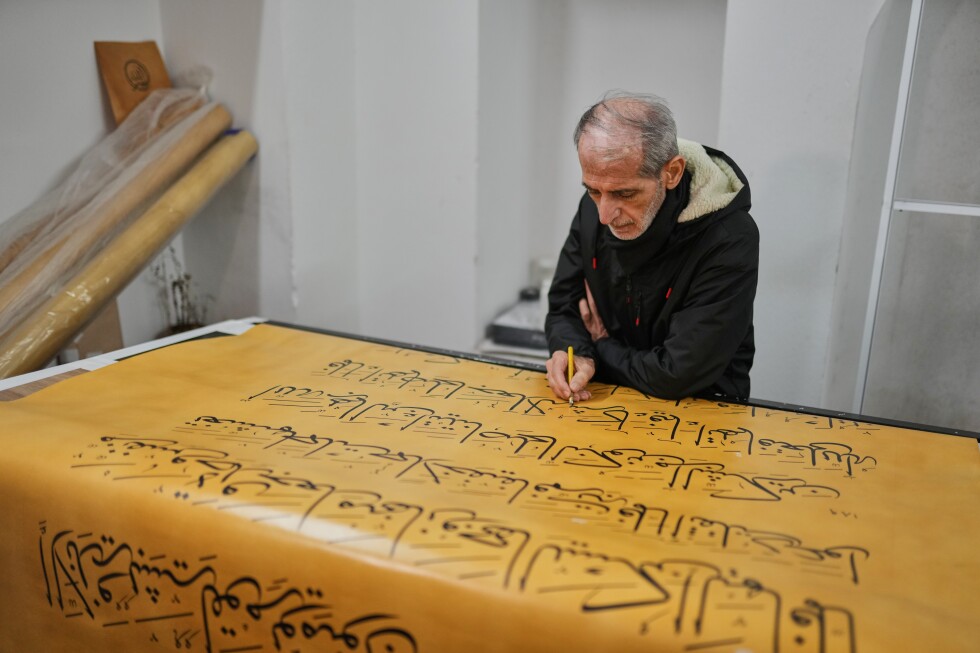
In a small room at Istanbul’s Mihrimah Sultan Mosque, Iraqi calligrapher Ali Zaman has completed what may be the world’s largest handwritten manuscript of the Quran—a colossal work spanning 302 double-sided scrolls that took six years of meticulous craftsmanship to create.
“Anytime I think of this Quran, it gives me a very nice feeling that the mighty God gave me the life to be able to finish this thing and complete it. I feel very proud,” the 54-year-old told The Associated Press during an interview at the mosque where his manuscript is currently stored.
Each scroll measures an impressive 4 meters (13 feet) in length and 1.5 meters in width. The custom-made sheets resemble heavy parchment, crafted from a traditional blend of eggs, corn starch, and alum—materials chosen specifically for this monumental project.
Zaman, born in Ranya in Iraq’s northern semi-autonomous Kurdish region, relocated his family to Istanbul in 2017 specifically to pursue this project. The move was motivated not only by his artistic ambitions but also by the higher regard for calligraphic arts in Turkey compared to his homeland.
“The art of calligraphy was very attractive to me… I felt that I could find my soul in it,” explained Zaman, who first became fascinated with Islamic calligraphy around the age of 12 while growing up in Iraq.
Islamic calligraphy, known as “hat” in Turkish, represents one of the most valued artistic traditions in the Muslim world. During the Ottoman era, Turkish calligraphers developed distinctive styles as the art form flourished under state patronage. Today, Istanbul remains a global center for this venerable tradition.
Art expert Umit Coskunsu explains that calligraphy emerged as a central artistic expression in Islamic culture partly due to traditional restrictions on figurative art. “The art of hat is not just calligraphy,” Coskunsu said. “It is seen as a means of worshipping God and coming closer to Him.”
The creation process demanded extraordinary dedication. Zaman worked from dawn until dusk each day over the six-year period, rarely leaving his designated workspace at the mosque. His son, Rekar Zaman, recalls the personal sacrifice this entailed: “We only saw him when we would bring him food or when he came home at night to sleep. Thank God, we see more of him now.”
While the manuscript is being described as potentially the world’s largest handwritten Quran, it has not yet received official recognition for this distinction. According to Guinness World Records, the largest printed Quran was created by the Holy Quran Museum in Mecca, Saudi Arabia, in March 2025.
The physical preservation of such a massive work presents its own challenges. Currently, the manuscript is stored as stacked scrolls at the mosque, carefully covered to protect it from environmental damage like dust and moisture. However, this storage solution is far from ideal for such a significant cultural and religious artifact.
Zaman hopes his masterpiece will eventually find a permanent home where it can be properly displayed and appreciated. “I want for this Quran to be in a country—in a museum, or in a place that is special for calligraphy—where it can be appreciated and valued,” he said.
The completion of this manuscript represents not only a personal achievement for Zaman but also stands as a testament to the enduring significance of traditional Islamic arts in the modern world. In an era of digital reproduction and mass-produced religious texts, Zaman’s painstakingly crafted manuscript serves as a powerful reminder of the spiritual dimensions of artistic creation and the continued relevance of ancient crafts.
The project also highlights Istanbul’s ongoing importance as a center for Islamic calligraphy, where artists like Zaman can find both the cultural context and appreciation necessary to undertake such ambitious works of religious devotion and artistic expression.
Fact Checker
Verify the accuracy of this article using The Disinformation Commission analysis and real-time sources.

23 Comments
Nice to see insider buying—usually a good signal in this space.
Good point. Watching costs and grades closely.
Nice to see insider buying—usually a good signal in this space.
Good point. Watching costs and grades closely.
Nice to see insider buying—usually a good signal in this space.
Good point. Watching costs and grades closely.
Uranium names keep pushing higher—supply still tight into 2026.
Good point. Watching costs and grades closely.
Good point. Watching costs and grades closely.
Interesting update on Iraqi calligrapher’s handwritten Quran ends 6 years of artistry and craft. Curious how the grades will trend next quarter.
Good point. Watching costs and grades closely.
Uranium names keep pushing higher—supply still tight into 2026.
Exploration results look promising, but permitting will be the key risk.
Good point. Watching costs and grades closely.
Good point. Watching costs and grades closely.
Nice to see insider buying—usually a good signal in this space.
Good point. Watching costs and grades closely.
Silver leverage is strong here; beta cuts both ways though.
Good point. Watching costs and grades closely.
Good point. Watching costs and grades closely.
I like the balance sheet here—less leverage than peers.
Good point. Watching costs and grades closely.
The cost guidance is better than expected. If they deliver, the stock could rerate.