


Listen to the article
Iran’s Supreme Leader Warns US Attack Would Trigger “Regional War” Amid Rising Tensions
Iran’s supreme leader Ayatollah Ali Khamenei issued a stark warning Sunday that any military action by the United States against Iran would escalate into a “regional war” across the Middle East, significantly raising tensions as President Trump continues to threaten military strikes against the Islamic Republic.
Speaking from his compound in Tehran during celebrations marking the 1979 Islamic Revolution, the 86-year-old Khamenei delivered his most direct threat yet as the USS Abraham Lincoln carrier strike group maintains its position in the Arabian Sea. The deployment came following Iran’s bloody crackdown on nationwide protests that began in December.
“The Americans must be aware that if they wage a war this time, it will be a regional war,” Khamenei told supporters. “We are not the instigators, we are not going to be unfair to anyone, we don’t plan to attack any country. But if anyone shows greed and wants to attack or harass, the Iranian nation will deal a heavy blow to them.”
When asked about Khamenei’s warning, President Trump responded that the U.S. has “the biggest, most powerful ships in the world over there, very close, a couple of days, and hopefully we’ll make a deal. If we don’t make a deal, then we’ll find out whether or not he was right.”
The escalating rhetoric comes as Iran planned live-fire military drills in the strategic Strait of Hormuz—a vital shipping route through which approximately one-fifth of global oil supplies pass. The U.S. military’s Central Command had previously warned Iran against threatening American assets or disrupting commercial traffic during these exercises.
In a significant shift, Khamenei characterized the recent nationwide protests as “a coup,” hardening the government’s position on demonstrators. “The recent sedition was similar to a coup. Of course, the coup was suppressed,” he said. “Their goal was to destroy sensitive and effective centers involved in running the country.”
The protests, which began December 28 over the collapse of Iran’s rial currency, quickly evolved into direct challenges to Khamenei’s rule. According to the U.S.-based Human Rights Activists News Agency, over 49,500 people have been detained in the government crackdown, with at least 6,713 killed—most of them protesters. Iran’s government disputes these figures, claiming a much lower death toll of 3,117. Independent verification remains impossible due to Iran’s internet restrictions.
The death toll, even by Iran’s official count, exceeds that of any other period of unrest in Iran in decades and recalls the chaos surrounding the 1979 revolution. The scale of the crackdown has drawn international condemnation, with President Trump establishing the potential mass execution of detainees as a “red line” that could trigger U.S. military action.
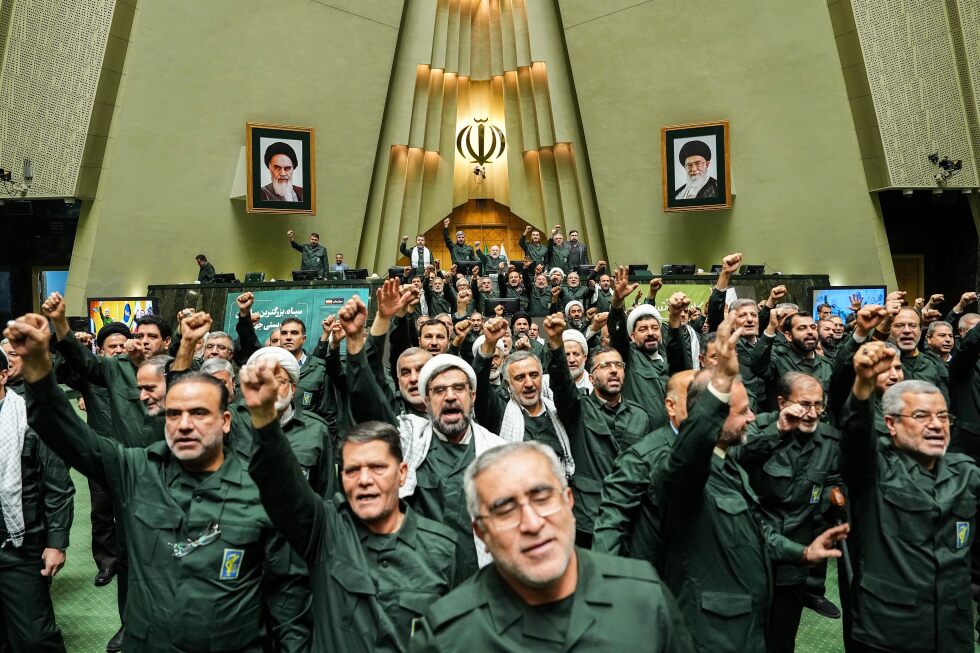
In a related development, Iranian Parliament Speaker Mohammad Bagher Qalibaf announced that Iran now considers all European Union militaries to be terrorist groups. This move comes in response to the EU designating Iran’s Revolutionary Guard as a terrorist organization for its role in suppressing protests.
“By seeking to strike at the Guard, which itself has been the greatest barrier to the spread of terrorism to Europe, Europeans have in fact shot themselves in the foot,” said Qalibaf, a former Guard commander who spoke while wearing a Guard uniform in solidarity.
The Revolutionary Guard, which controls Iran’s ballistic missile arsenal and holds vast economic interests throughout the country, answers only to Khamenei. The reciprocal terrorist designations, while largely symbolic, represent a further deterioration in Iran’s relations with Western powers.
President Trump has indicated two specific triggers for potential military action: the killing of peaceful protesters and mass executions of detainees. He has also increasingly discussed Iran’s nuclear program, which was the subject of negotiations before Israel launched a 12-day war with Iran in June. During that conflict, the U.S. bombed three Iranian nuclear sites, and satellite imagery suggests Iran may now be attempting to obscure activities at two of those locations.
Despite the confrontational rhetoric, Trump suggested diplomatic channels remain open. “They are talking to us. Seriously talking to us,” he told reporters Saturday night, while declining to elaborate on his plans regarding potential military action.
As the standoff continues, the possibility of direct military conflict between the United States and Iran looms larger, with profound implications for regional stability and global energy markets.
Fact Checker
Verify the accuracy of this article using The Disinformation Commission analysis and real-time sources.

11 Comments
Production mix shifting toward World might help margins if metals stay firm.
Production mix shifting toward World might help margins if metals stay firm.
I like the balance sheet here—less leverage than peers.
I like the balance sheet here—less leverage than peers.
Good point. Watching costs and grades closely.
If AISC keeps dropping, this becomes investable for me.
Good point. Watching costs and grades closely.
Uranium names keep pushing higher—supply still tight into 2026.
The cost guidance is better than expected. If they deliver, the stock could rerate.
Good point. Watching costs and grades closely.
Production mix shifting toward World might help margins if metals stay firm.