


Listen to the article
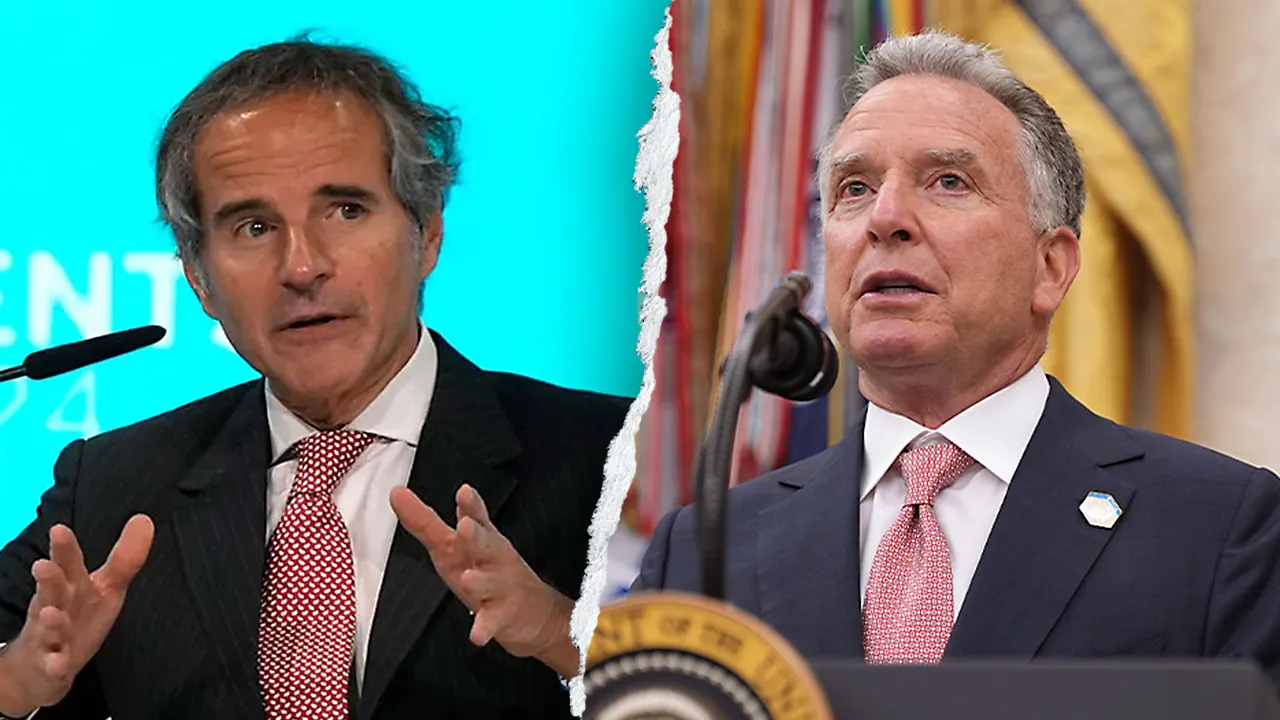
In a diplomatic standoff over nuclear ambitions, the International Atomic Energy Agency (IAEA) Director General Rafael Grossi has come under scrutiny after claiming “there has been no evidence of Iran building a nuclear bomb” despite alarming revelations from U.S. Special Envoy Steve Witkoff about Iran’s nuclear capabilities.
Witkoff recently disclosed to Fox News details of his negotiations with Iranian officials, revealing that the regime openly boasted about possessing enough enriched uranium to produce multiple nuclear weapons. According to Witkoff, Iranian negotiators stated they had an “inalienable right” to enrich uranium and were proud of evading international oversight.
“They have 10,000, roughly, kilograms of fissionable material that’s broken up into roughly 460 kilograms of 60% enriched uranium, another 1,000 kilograms 20% enriched uranium,” Witkoff explained. “The 60% material can be brought to 90% – that’s weapon grade — in roughly one week, maybe 10 days at the outside.”
Perhaps most concerning was Witkoff’s claim that Iranian officials “said with no shame that they controlled 460 kilograms of 60% and they’re aware that that could make 11 nuclear bombs, and that was the beginning of this negotiating stance.”
The revelations come amid a joint U.S.-Israel military campaign against Iran that has targeted several nuclear facilities. The IAEA, meanwhile, has not responded to inquiries about how it could properly assess Iran’s nuclear weapons development without full access to the country’s facilities.
Grossi, who is currently campaigning to become the next United Nations Secretary-General, did acknowledge in his statement that Iran maintains “a large stockpile of near-weapons grade enriched uranium” and has denied inspectors complete access to its program. He admitted the IAEA “will not be in a position to provide assurance that Iran’s nuclear programme is exclusively peaceful” without cooperation from Tehran.
Richard Goldberg, a senior advisor to the Foundation for the Defense of Democracies and former Trump administration official, criticized the international community’s response to Iran’s nuclear program. “The IAEA board last year found Iran to be in breach of the NPT. To this day, Grossi has confirmed that the IAEA cannot verify the Iranian nuclear program is peaceful,” Goldberg said.
Unlike previous concerns about weapons programs in other countries, Goldberg emphasized that Iran’s nuclear development has largely occurred “in plain sight,” with additional weaponization work progressing at undeclared sites.
Independent analysis from the Institute for Science and International Security (ISIS) supports Witkoff’s assessment. Spencer Faragasso, a senior fellow at ISIS, confirmed that prior to recent military actions, Iran possessed about 440.9 kilograms of 60% enriched uranium—enough material to produce approximately 11 weapons within a month if further enriched to 90%.
However, Faragasso noted uncertainties about Iran’s current capabilities following U.S. and Israeli strikes. “Being able to enrich the uranium up to weapon grade is actually a tall order,” he said, explaining that it would require a new enrichment site and components that “Iran would either need to recover from its destroyed facilities” or “illicitly import them from abroad.”
Satellite imagery has revealed activity at previously damaged Iranian nuclear sites, with experts now tracking an Israeli strike on a previously unknown facility at Min-Zadayi. According to the Israel Defense Forces, the site was “used by a group of nuclear scientists who operated to develop a key component for nuclear weapons.”
U.S. Secretary of State Marco Rubio reinforced the administration’s position, stating: “This terroristic, radical, cleric-led regime cannot be ever allowed to have nuclear weapons… Under President Trump that will never, ever happen.”
The situation highlights ongoing tensions between international monitoring efforts and Iran’s nuclear ambitions, as well as disagreements about the current state of Iran’s nuclear program following recent military operations.
Fact Checker
Verify the accuracy of this article using The Disinformation Commission analysis and real-time sources.

5 Comments
This is a concerning revelation about Iran’s nuclear ambitions. If the IAEA is unaware of the scale of Iran’s enrichment program, it raises serious questions about the effectiveness of international oversight.
Iran’s boasting about their nuclear capabilities and their ‘inalienable right’ to enrich uranium is deeply troubling. The international community must take decisive action to address this clear violation of nuclear nonproliferation norms.
This report highlights the challenges of verifying nuclear programs, especially when countries like Iran appear to be actively obstructing inspections. The international community needs to find ways to strengthen safeguards and improve transparency.
The discrepancy between the IAEA’s assessment and the US envoy’s claims is worrying. Transparency and accurate monitoring of nuclear programs are crucial to maintaining global security. I hope the IAEA investigates this matter further.
Uranium enrichment levels that could be weaponized in a matter of days are alarming. Iran’s defiant attitude and disregard for international oversight underscores the urgency of this issue. Diplomatic efforts must be redoubled to ensure compliance.