


Listen to the article
Benny Sabti’s childhood experience of receiving Adolf Hitler’s “Mein Kampf” as a school prize in Iran exemplifies the country’s decades-long campaign of ideological indoctrination, according to experts who have studied the Islamic Republic’s methods of control.
“For being an excellent student, I received a Persian translation of Mein Kampf by Adolf Hitler,” recalls Sabti, now an Iran expert at Israel’s Institute for National Security Studies (INSS). “They translated Hitler’s book into Persian and distributed it to students.”
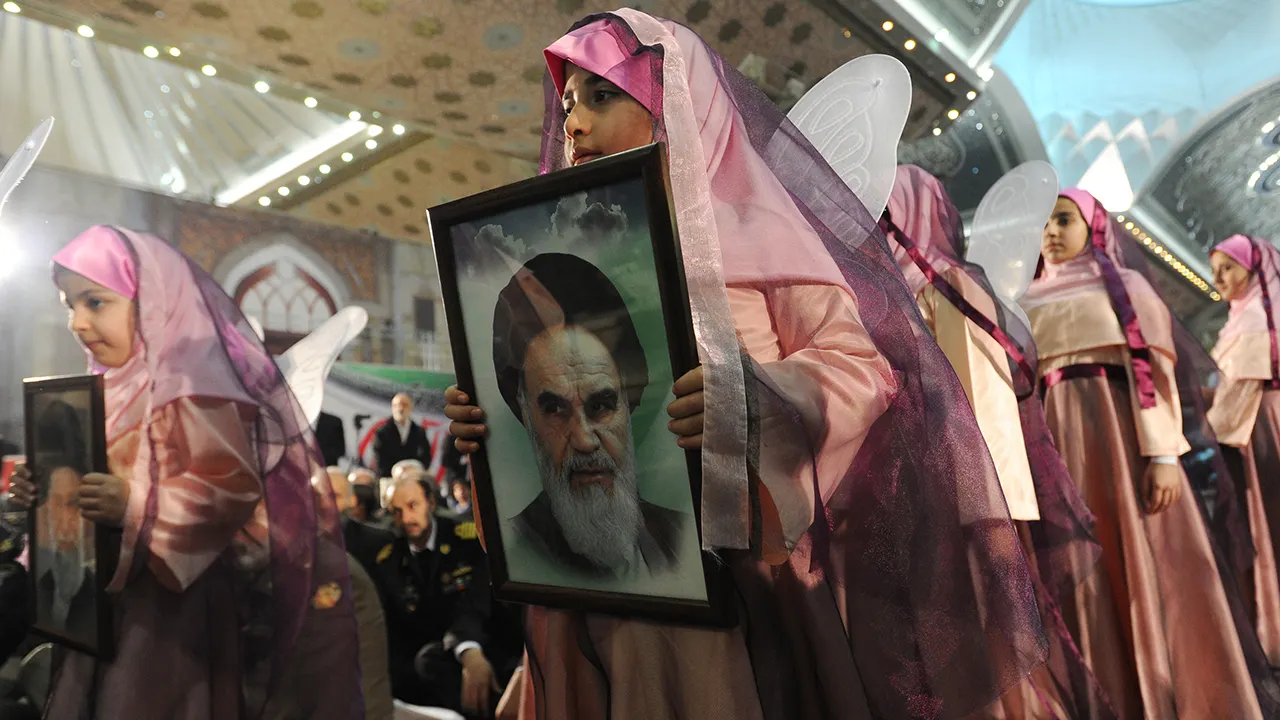
This childhood memory illuminates a broader pattern of how Iran’s clerical leadership has systematically shaped the worldview of generations of Iranians through comprehensive indoctrination across all facets of society, from educational institutions to religious spaces.
The Islamic Republic, founded on the doctrine of velayat-e faqih, or “guardianship of the Islamic jurist,” places ultimate political and religious authority in the hands of the country’s supreme leader. But critics contend that religious principles often serve as a veneer for political control.
“Faith for them is their tool,” explains Banafsheh Zand, an Iranian-American journalist. “It’s not the end all to be all. It’s a tool that they can hide behind so that they can carry out all their criminalities.”
According to Zand, the system functions less as a purely religious project and more as a mechanism of political control. “It’s more like a mafia. They use faith in order to keep people down,” she says.
The regime has built an intricate system that reinforces ideological compliance through both incentives and intimidation. Programs associated with the Basij, a paramilitary force affiliated with the Islamic Revolutionary Guard Corps (IRGC), provide economic benefits such as jobs, housing, and education to families who demonstrate loyalty to the regime.
“If you are poor and you join the Basij, they give you benefits,” Zand explains. “But you have to go along with whatever it is that they offer you.”
The indoctrination extends far beyond formal institutions. Sabti describes how the Islamic Republic established a vast network designed to impose ideology on everyday life. “In banks, offices, public spaces and even in the bazaars, regime representatives walk between shops telling people it is time to pray and checking who is not attending,” he says.
Religious institutions themselves are tightly integrated into the political apparatus. Friday prayer leaders often deliver sermons that echo government messaging, while a network of 16 propaganda bodies works to spread the regime’s interpretation of Islam and the ideals of the Islamic Revolution.
The government has also dedicated resources to exporting this ideology abroad. “There is a university dedicated to converting Sunnis to Shiism,” Sabti notes. “They bring people from Africa and South America to Iran, convert them to Shiism and send them back to export the Shiite Islamic revolution.”
Within Iran, schools serve as primary vehicles for ideological training. “Schools are heavily indoctrinated,” Sabti explains. “In civil studies books, Islam was promoted as superior to all other ideologies.”
Religious messaging permeates virtually all academic subjects. “You cannot separate any school subject from Islam,” Sabti says. “Not history, not geography. Everything is mixed with ideology. The only thing missing was adding it to mathematics.”
However, the credibility of the system has been increasingly undermined by the perceived hypocrisy of Iran’s ruling elite. “You can see it in the second generation,” Sabti observes. “Their children live abroad while the elites live in palaces in Iran and in other countries. It is hypocrisy.”
Despite the regime’s extensive ideological apparatus, both Sabti and Zand believe many Iranians never fully internalized the worldview the government attempted to impose. “Over the years, the indoctrination has stopped working,” Sabti asserts. “Most of the public does not truly believe it.”
Instead, the Islamic Republic maintains control through what Sabti describes as “money, weapons and propaganda.” Many Iranians comply outwardly simply to avoid punishment, creating a society where, as Zand puts it, “Everybody is afraid of the police. Everybody is afraid of their neighbors.”
Despite decades of ideological pressure, Iran’s cultural identity has proven resilient. According to Zand, beneath the surface of enforced compliance, many Iranians have maintained their connection to the country’s pre-revolutionary cultural heritage, suggesting that the regime’s ideological project has achieved compliance without winning genuine conviction.
This gap between official ideology and private belief represents one of the fundamental tensions in contemporary Iranian society, as the regime continues to deploy its extensive apparatus of control while facing an increasingly skeptical population.
Fact Checker
Verify the accuracy of this article using The Disinformation Commission analysis and real-time sources.

7 Comments
The revelations about Iran’s propaganda system built on ideology, intimidation, and patronage raise important questions about the regime’s true motives and the extent of its indoctrination efforts. This warrants further investigation and close monitoring.
I’m curious to learn more about the specific tactics and reach of Iran’s propaganda system. How does the regime leverage educational institutions, religious spaces, and other channels to shape the worldviews of the Iranian people? This seems like a concerning trend that warrants further investigation.
This report on Iran’s propaganda efforts is a sobering reminder of the lengths authoritarian regimes will go to indoctrinate their citizens and maintain power. The systematic distribution of Mein Kampf is a particularly chilling example of the regime’s tactics.
The Islamic Republic’s reliance on the ‘guardianship of the Islamic jurist’ doctrine to centralize political and religious authority is clearly a means of consolidating control, rather than upholding true religious principles. This provides important context for understanding Iran’s propaganda machinery.
Fascinating look at Iran’s extensive propaganda system built on ideology, intimidation, and patronage. The distribution of Mein Kampf to students as a ‘prize’ is a chilling example of how the regime has indoctrinated generations through the education system and other institutions.
This article highlights the concerning reality that religious principles in Iran often serve as a veneer for political control, with the regime using ‘faith as a tool’ to maintain power. It’s troubling to see such systematic ideological indoctrination taking place.
Appreciating the insight this article provides into how Iran’s clerical leadership has systematically shaped the ideology and worldview of its people. The use of religious principles as a ‘veneer for political control’ is a troubling dynamic that deserves close scrutiny.