


Listen to the article
Iranian President Declares “Total War” with US, Israel, and Europe
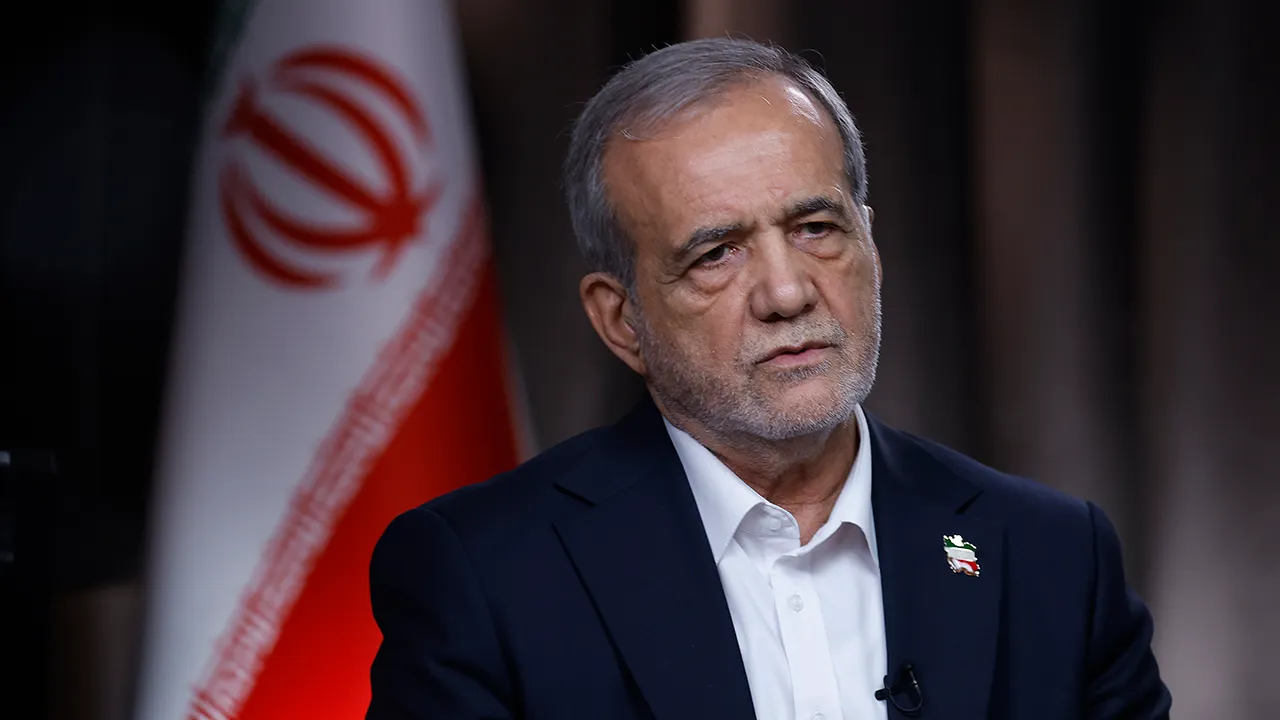
Iranian President Masoud Pezeshkian has escalated his rhetoric against Western powers, claiming his country is engaged in what he describes as a “total war” with the United States, Israel, and Europe. In an interview published Saturday by Iranian state media, Pezeshkian accused these nations of attempting to bring Iran “to its knees.”
“In my opinion, we are at total war with the United States, Israel and Europe,” Pezeshkian stated. “They want to bring our country to its knees.”
The Iranian leader argued that the current geopolitical conflict is more complex than the Iran-Iraq war of the 1980s, noting that his country now faces pressure “from every angle.” He elaborated on the multifaceted nature of this perceived conflict, saying, “If one understands it well, this war is far more complex and difficult than that war. In the war with Iraq, the situation was clear, they fired missiles, and we knew where to hit.”
“Here, they are besieging us from every aspect,” Pezeshkian continued. “They are creating problems for us in terms of livelihood, culturally, politically, and security-wise.”
Despite acknowledging these pressures, the Iranian president claimed that the country’s military emerged stronger following its June conflict with Israel. “Our beloved military forces are doing their jobs with strength and now, in terms of equipment and manpower, despite all the problems we have, they are stronger than when they attacked,” he asserted, warning that any future attacks would “naturally face a more decisive response.”
The timing of Pezeshkian’s inflammatory comments is significant, as they come just days before Israeli Prime Minister Benjamin Netanyahu’s scheduled meeting with President Donald Trump at Mar-a-Lago. The two leaders are expected to discuss regional security concerns, with Iran’s nuclear program likely to feature prominently on the agenda.
Tensions between Iran and Western powers, particularly the United States and Israel, have remained high following a brief but intense conflict in June. The violence resulted in approximately 1,100 deaths in Iran, including senior military commanders and nuclear scientists, while Iranian missile attacks killed 28 people in Israel.
The conflict marked a significant escalation in the ongoing shadow war between Iran and Israel. On June 22, President Trump announced that U.S. forces had launched attacks on Iranian nuclear sites, including facilities at Fordow, Natanz, and Isfahan.
“Our objective was the destruction of Iran’s nuclear enrichment capacity and a stop to the nuclear threat posed by the world’s number one state sponsor of terror,” Trump stated at the time. “Tonight, I can report to the world that the strikes were a spectacular military success. Iran’s key nuclear enrichment facilities have been completely and totally obliterated.”
A U.S.-brokered ceasefire between Iran and Israel took effect on June 24, but Pezeshkian’s recent comments suggest that diplomatic relations remain severely strained.
The Iranian president’s characterization of the situation as a “total war” represents a concerning development in Middle East tensions. His remarks align with Iran’s long-standing antagonistic position toward the United States and Israel but mark an unusually direct accusation against European powers as well.
Regional security analysts note that Iran’s increasingly confrontational stance comes as the country continues to face severe economic sanctions and growing international isolation. The Islamic Republic has responded by strengthening its ties with Russia and China, creating an alternative power bloc that challenges Western influence in the region.
For now, the uneasy ceasefire between Iran and Israel holds, but Pezeshkian’s rhetoric suggests that the fundamental tensions driving the conflict remain unresolved. The upcoming meeting between Trump and Netanyahu may prove crucial in determining the next phase of this complex and volatile regional struggle.
Fact Checker
Verify the accuracy of this article using The Disinformation Commission analysis and real-time sources.

11 Comments
This is a concerning escalation of rhetoric from the Iranian president. While tensions are high, a ‘total war’ stance will only serve to further inflame the situation. I hope cooler heads can prevail and diplomacy can be used to de-escalate the conflict.
The Iranian president’s comments about facing pressure ‘from every angle’ suggest a multilayered conflict that goes beyond just US-Iran tensions. Addressing the full scope of issues will be crucial to finding a sustainable path forward.
The Iranian president’s framing of this as a ‘total war’ is concerning rhetoric that could backfire and provoke further escalation. Hopefully this is more posturing than a true reflection of Iran’s strategic intentions.
While the Iranian leader’s language is inflammatory, it’s important to try to understand the underlying drivers of the conflict from their perspective. Demonizing the other side rarely leads to productive solutions in geopolitical disputes.
While the rhetoric from the Iranian president is concerning, it’s important to avoid knee-jerk reactions. Carefully analyzing the underlying drivers and potential off-ramps for de-escalation should be the priority at this stage.
The complex web of geopolitical tensions and domestic pressures makes this a highly volatile situation. De-escalation through diplomacy should be the priority, rather than ramping up confrontational rhetoric on either side.
I agree, a diplomatic solution should be the focus. Further sabre-rattling and threats will only serve to harden positions on all sides and make a peaceful resolution more elusive.
The Iranian leader’s comments about facing pressure ‘from every angle’ suggest a complex geopolitical landscape. It’s important to understand all sides of the conflict to work towards a peaceful resolution, rather than further antagonism.
You raise a good point. Simplifying this as a binary ‘us vs. them’ conflict risks overlooking nuanced factors and potential diplomatic off-ramps. Constructive dialogue will be key to finding a way forward.
This appears to be a worrying escalation in the already tense relationship between Iran and Western powers. Cooler heads must prevail to prevent this from spiraling into an even more dangerous confrontation.
I agree, the stakes are extremely high. All sides need to exercise caution and restraint to avoid further destabilization. Constructive dialogue, not inflammatory rhetoric, is the only path forward.