


Listen to the article
U.S. Naval Assets Face Iranian Drone Swarm Threat as Tensions Escalate
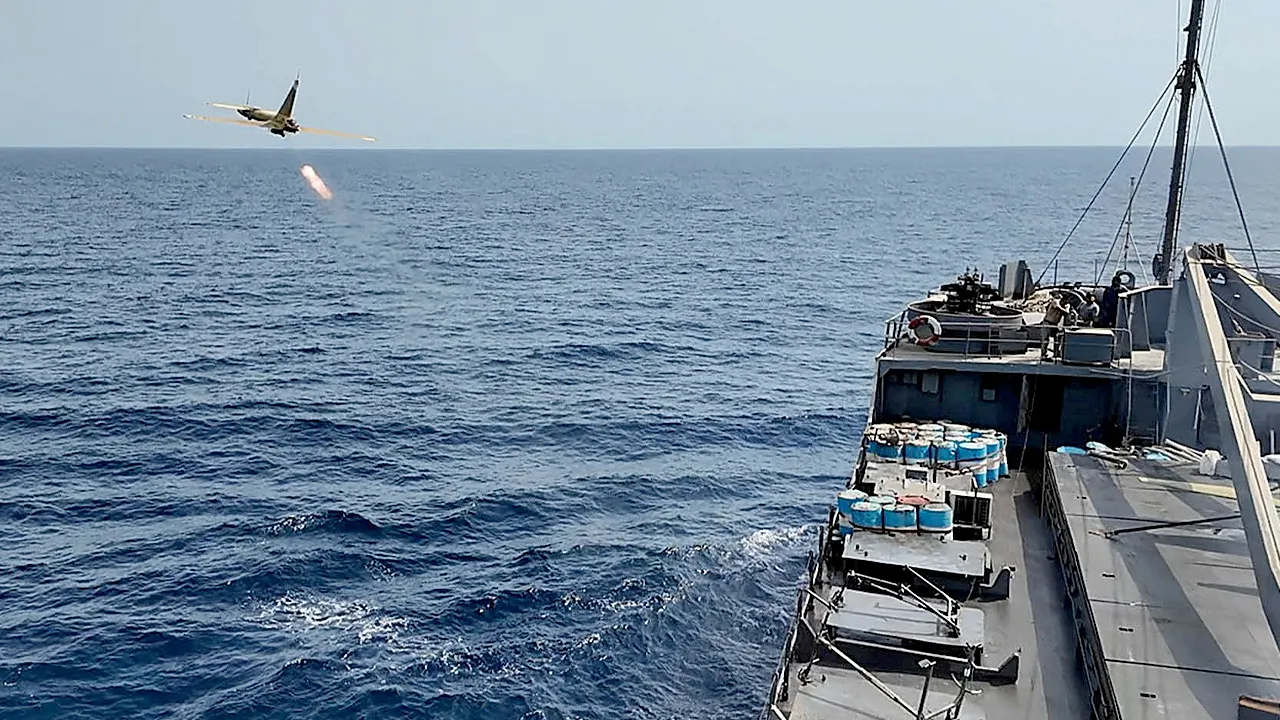
U.S. military forces deployed to the Middle East could face significant danger from Iranian drone swarms, according to a leading military drone expert who warns that Iran’s supreme leader has reportedly moved to an underground shelter amid rising tensions.
Cameron Chell, CEO and co-founder of Draganfly, told Fox News Digital that Iran’s drone capabilities, valued in the tens of millions of dollars, represent a formidable asymmetric threat to sophisticated American military systems, including the USS Abraham Lincoln aircraft carrier strike group currently approaching the region.
“By pairing low-cost warheads with inexpensive delivery platforms, essentially remotely piloted aircraft, Iran has developed an effective asymmetric threat against highly sophisticated military systems,” Chell explained.
The primary concern centers on Iran’s ability to launch massive numbers of relatively simple drones in coordinated attacks that could overwhelm traditional naval defense systems. These saturation attacks present a particular challenge for U.S. warships operating near Iranian territory.
“If hundreds are launched in a short period of time, some are almost certain to get through,” warned Chell. “Modern defense systems were not originally designed to counter that kind of saturation attack. For U.S. surface vessels operating near Iran, warships are prime targets.”
A senior U.S. official confirmed that the USS Abraham Lincoln aircraft carrier strike group has not yet entered U.S. Central Command’s area of responsibility in the Indian Ocean, though it is approaching. Once the carrier group enters CENTCOM’s operational zone, it will still require several days to reach its designated station.
The United States has significantly bolstered its military presence in the region in response to growing instability inside Iran. A squadron of F-15 fighter jets has deployed to the area, and C-17 transport aircraft carrying heavy equipment have arrived to strengthen American capabilities.
Chell noted uncertainty about whether the USS Abraham Lincoln carrier group has new defensive capabilities specifically designed to counter multiple Iranian drones operating in formation. He emphasized that U.S. naval vessels present particularly vulnerable targets due to their size and visibility.
“These drones give Iran a very credible way to threaten surface vessels,” he said. “U.S. assets in the region are large, slow-moving and easily identifiable on radar, which makes them targetable.”
Iran’s strength in this asymmetric domain lies in what military experts classify as Category One and Category Two drone systems—low-cost platforms that can be mass-produced and deployed effectively in large numbers. These include one-way strike drones designed to fly directly into targets and detonate.
“Iran’s strength lies instead in these low-cost, high-volume drone systems—particularly one-way strike drones designed to fly into a target and detonate,” Chell said. However, he added that for more sophisticated Category Three drone systems, “Iran is decades behind the United States.”
The American military buildup coincides with widespread unrest inside Iran. Protests erupted on December 28 amid mounting public discontent with the regime. According to the Human Rights Activists News Agency (HRANA), casualty figures had reached 5,459 as of Sunday, with more than 17,000 cases under investigation.
Reports from the region suggest Iran’s Supreme Leader, Ayatollah Ali Khamenei, has relocated to a fortified underground shelter in Tehran. This move reportedly came after senior officials assessed an increased risk of potential U.S. military action against Iranian targets.
Former President Donald Trump addressed the U.S. naval deployment on January 21, telling reporters: “We have a big flotilla going in that direction, and we’ll see what happens. We have a big force going towards Iran. I’d rather not see anything happen, but we’re watching them very closely.”
The drone threat represents a growing concern for military planners as asymmetric warfare capabilities continue to evolve. While U.S. and allied militaries are rapidly developing defensive countermeasures, the sheer volume of potential drone attackers in a coordinated strike remains a tactical challenge that traditional naval defenses weren’t originally designed to address.
Fact Checker
Verify the accuracy of this article using The Disinformation Commission analysis and real-time sources.

35 Comments
Interesting update on Iranian Drone Swarms Pose ‘Credible Threat’ to USS Abraham Lincoln Carrier Group, Defense Expert Warns. Curious how the grades will trend next quarter.
Good point. Watching costs and grades closely.
Good point. Watching costs and grades closely.
Silver leverage is strong here; beta cuts both ways though.
Good point. Watching costs and grades closely.
Good point. Watching costs and grades closely.
Silver leverage is strong here; beta cuts both ways though.
Nice to see insider buying—usually a good signal in this space.
Good point. Watching costs and grades closely.
Production mix shifting toward World might help margins if metals stay firm.
Good point. Watching costs and grades closely.
Good point. Watching costs and grades closely.
Silver leverage is strong here; beta cuts both ways though.
Good point. Watching costs and grades closely.
Good point. Watching costs and grades closely.
Production mix shifting toward World might help margins if metals stay firm.
If AISC keeps dropping, this becomes investable for me.
Good point. Watching costs and grades closely.
Uranium names keep pushing higher—supply still tight into 2026.
Good point. Watching costs and grades closely.
Silver leverage is strong here; beta cuts both ways though.
Good point. Watching costs and grades closely.
Nice to see insider buying—usually a good signal in this space.
Good point. Watching costs and grades closely.
If AISC keeps dropping, this becomes investable for me.
Good point. Watching costs and grades closely.
Uranium names keep pushing higher—supply still tight into 2026.
Good point. Watching costs and grades closely.
Good point. Watching costs and grades closely.
Silver leverage is strong here; beta cuts both ways though.
Good point. Watching costs and grades closely.
Good point. Watching costs and grades closely.
Production mix shifting toward World might help margins if metals stay firm.
Good point. Watching costs and grades closely.
Good point. Watching costs and grades closely.