


Listen to the article
Satellite Images Show Iranian Naval Base Ablaze Amid Rising Tensions
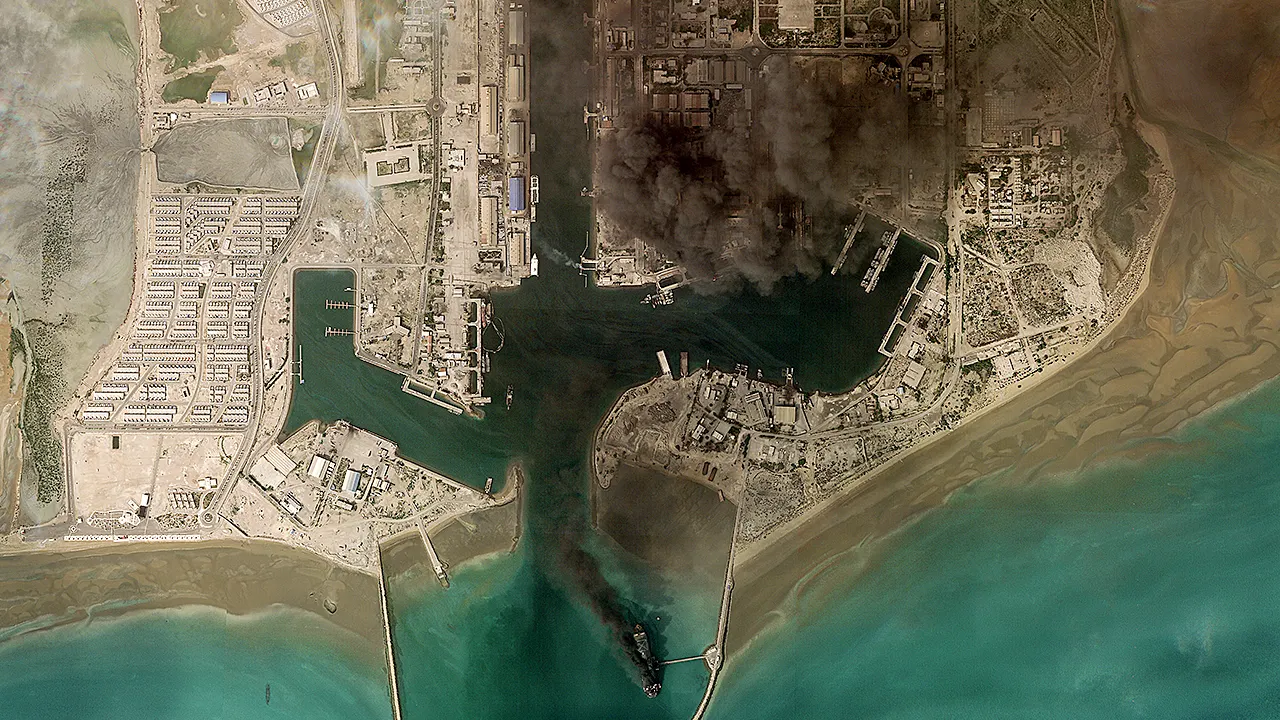
Satellite images released Monday reveal extensive fires and thick plumes of black smoke rising from Iran’s main naval headquarters at Bandar Abbas, with at least one vessel visibly engulfed in flames following recent strikes.
The images, provided by Planet Labs, emerge just days after coordinated U.S. and Israeli strikes on Iran as part of Operation Epic Fury. The situation has escalated to the point where President Donald Trump stated he would not rule out deploying U.S. troops into Iran if “necessary.”
The strategic port of Bandar Abbas, which serves as the capital of Hormozgan Province, occupies a critical position along the Strait of Hormuz and functions as the headquarters of the Iranian Navy. This vital waterway represents one of the world’s most significant maritime choke points, through which approximately 20% of global oil shipments pass daily.
“As of 10:56 a.m. GMT on March 2, 2026, the Port of Bandar Abbas is experiencing multiple active fires, including one aboard a berthed vessel, while maintaining a significant combined military and commercial presence at port facilities,” reported maritime intelligence firm Windward AI.
The firm identified three distinct fires in the vicinity – two at port infrastructure facilities and one involving a docked vessel. Despite the blazes, seventeen military vessels and five commercial ships reportedly remained at the port, suggesting “a heightened defensive posture rather than evacuation.”
Satellite imagery analyzed by BBC Verify identified a damaged vessel approximately 230 meters (750 feet) long, consistent with a Makran-class forward base ship operated by the Iranian Navy. The Makran, a converted tanker, serves as a mobile maritime base and helicopter carrier capable of deploying up to five helicopters and fast-attack boats.
The strikes on Bandar Abbas mark the third day of open conflict in the region. U.S. Central Command claimed it had sunk 11 Iranian vessels in the Gulf of Oman, stating on social media: “Two days ago, the Iranian regime had 11 ships in the Gulf of Oman, today they have ZERO.” President Trump has reinforced this position, stating that “annihilating” Iran’s naval forces is a core objective of Operation Epic Fury.
The escalation has severely disrupted commercial maritime traffic through the Strait of Hormuz, which has “effectively stalled,” according to Windward AI. Reports from the Times of Israel suggested Iran’s Revolutionary Guards (IRGC) had declared the strait closed, threatening to set fire to any vessel attempting passage – though Fox News National Security Correspondent Jennifer Griffin confirmed through CENTCOM that the strait was not officially closed.
The disruption has significant implications for global energy markets. The Strait of Hormuz serves as a critical transit route connecting the Persian Gulf to the Gulf of Oman, through which tankers carry oil from Saudi Arabia, Iran, the United Arab Emirates, Kuwait, and Iraq to markets worldwide.
Maritime security experts warn that active fires at Iran’s principal naval and commercial port introduce “additional operational uncertainty” and heighten the risk of secondary maritime disruption across the entire Gulf region. The potential for further escalation remains high as Iranian forces maintain a significant presence in the area despite the attacks.
Video footage shared by Iran International appeared to show an attack specifically targeting Iranian naval air facilities in Bandar Abbas, indicating precision strikes aimed at degrading Iran’s military capabilities in the region.
As tensions continue to rise, analysts are closely monitoring the situation for signs of further military action or potential diplomatic efforts to de-escalate the conflict.
Fact Checker
Verify the accuracy of this article using The Disinformation Commission analysis and real-time sources.

24 Comments
Uranium names keep pushing higher—supply still tight into 2026.
Good point. Watching costs and grades closely.
Exploration results look promising, but permitting will be the key risk.
Good point. Watching costs and grades closely.
Uranium names keep pushing higher—supply still tight into 2026.
Good point. Watching costs and grades closely.
Exploration results look promising, but permitting will be the key risk.
Good point. Watching costs and grades closely.
Good point. Watching costs and grades closely.
Production mix shifting toward World might help margins if metals stay firm.
Good point. Watching costs and grades closely.
Good point. Watching costs and grades closely.
Nice to see insider buying—usually a good signal in this space.
I like the balance sheet here—less leverage than peers.
Good point. Watching costs and grades closely.
Good point. Watching costs and grades closely.
Exploration results look promising, but permitting will be the key risk.
Production mix shifting toward World might help margins if metals stay firm.
Good point. Watching costs and grades closely.
I like the balance sheet here—less leverage than peers.
Exploration results look promising, but permitting will be the key risk.
I like the balance sheet here—less leverage than peers.
Silver leverage is strong here; beta cuts both ways though.
Good point. Watching costs and grades closely.