


Listen to the article
Iran Releases French Nationals After Three-Year Detention, Signaling Diplomatic Shift
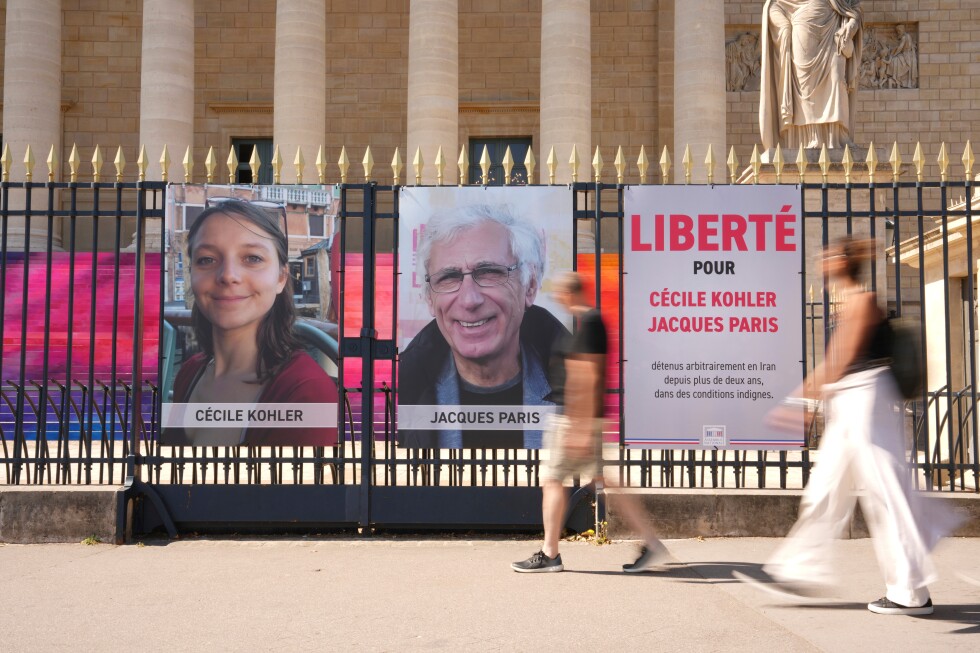
Iran has allowed two French citizens, Cécile Kohler and Jacques Paris, to leave the country after they spent three and a half years in detention, French President Emmanuel Macron announced Tuesday. The pair had been sheltering in French diplomatic premises since their release from prison last November.
“Cécile Kohler and Jacques Paris are free and on route toward French territory,” Macron wrote on social media platform X. French officials confirmed the former detainees are expected to arrive in France on Wednesday.
The decision to permit their departure comes at a sensitive geopolitical moment, highlighting Iran’s differentiated approach to international relations amid regional tensions. Analysts note that Tehran appears to be distinguishing between nations it considers allies and those it views as adversaries in the context of ongoing Middle East conflicts. France has maintained a notably independent stance, with Macron explicitly distancing his country from recent U.S.-Israeli military actions against Iran.
In his announcement, Macron acknowledged Oman’s crucial mediation role in securing the release. “It’s a relief for us all and obviously for their families,” he wrote.
The Élysée Palace clarified that the two French nationals departed Iran by road “without any special coordination with the U.S. and Israeli forces” operating in the region. This detail is particularly significant as their departure coincided with airstrikes targeting two bridges and a train station in Iran on Tuesday.
Iran’s state-run news agency IRNA reported that the release was part of an exchange agreement involving Iranian national Mahdieh Esfandiari, who was convicted in France on charges of inciting terrorism over comments regarding the Hamas-led attacks on Israel in October 2023. However, Macron’s office firmly denied any prisoner swap arrangement, emphasizing that judicial proceedings in France remain ongoing in Esfandiari’s case, which is currently under appeal.
The release follows a series of diplomatic communications between Paris and Tehran. Macron was the first Western leader to speak with Iran’s President Masoud Pezeshkian after recent escalations, engaging in three phone conversations since March 8. During these calls, Macron consistently pressed for the return of the French nationals.
Kohler and Paris were originally arrested in May 2022 while visiting Iran on what French officials described as a tourism trip. France has consistently denounced their detention as “unjustified and unfounded,” rejecting espionage allegations against the pair. While Iranian authorities released them from prison in November, they were not permitted to leave the country and remained under the protection of the French Embassy in Tehran.
French Foreign Minister Jean-Noël Barrot shared that he had spoken with Kohler and Paris, who expressed “emotion and joy at soon being reunited with their country and their loved ones.” Barrot also extended gratitude to France’s diplomatic staff in Tehran who protected them “under very difficult conditions.”
This case exemplifies a pattern that Western nations have long criticized – Iran’s alleged use of foreign prisoners as diplomatic leverage, a practice Tehran officially rejects. In September, Iran’s foreign minister had indicated that the two countries were nearing a prisoner exchange agreement involving Esfandiari.
That same month, France withdrew its case against Iran before the International Court of Justice, where it had accused Tehran of violating consular protection rights for Kohler and Paris. The French government had characterized Iran’s actions as “a hostage policy.”
The Paris court decision regarding Esfandiari in February resulted in a one-year prison sentence with an additional three-year suspended sentence, along with a permanent ban from French territory. She was released pending appeal, according to French authorities.
The resolution of this diplomatic standoff represents a potential thaw in Franco-Iranian relations at a time of heightened regional tensions, though broader issues between Western nations and Iran remain unresolved.
Fact Checker
Verify the accuracy of this article using The Disinformation Commission analysis and real-time sources.

8 Comments
Interesting diplomatic development between Iran and France. It seems Tehran is willing to make concessions to certain nations while maintaining a hard line against others. Curious to see how this plays out in the broader geopolitical context.
Agreed. Iran’s selective approach to international relations is likely a strategic calculation, balancing domestic pressures and regional dynamics.
It will be interesting to see if this prisoner release leads to any broader thaw in Iran’s relations with Western nations. The geopolitical landscape in the Middle East remains highly complex and volatile.
That’s a good question. Much will depend on Iran’s ability to balance competing domestic and external priorities in its foreign policy approach.
The release of these French detainees is a positive step, but the broader human rights situation in Iran remains concerning. Hopefully this leads to further progress on critical issues.
A fair point. Iran will need to demonstrate a sustained commitment to improving its human rights record to rebuild trust with the international community.
As a major player in the global energy and minerals markets, developments in Iran are closely watched. This prisoner release could signal a willingness to engage more constructively on economic and trade matters.
The release of these French nationals is a positive development, but significant challenges remain in Iran’s relationships with the international community. Rebuilding trust will require tangible progress on key issues.