


Listen to the article
Indonesia Landslide Claims 17 Lives, 42 Missing Including Elite Marines
A devastating landslide struck a mountainside village in Indonesia’s West Java province early Saturday, killing at least 17 people and leaving 42 others missing, including 19 members of the country’s elite marine force, officials confirmed Monday.
The predawn disaster tore through Pasir Langu village on the slopes of Mount Burangrang, swallowing a military training camp and approximately 34 houses. Among the confirmed dead are four marines, according to Navy Chief of Staff Admiral Muhammad Ali.
“Heavy rain over two nights triggered the slope failure that buried their training area,” Admiral Ali told reporters. The 23-member marine unit had been conducting specialized training for a long-duration assignment along the remote Indonesia–Papua New Guinea border when disaster struck.
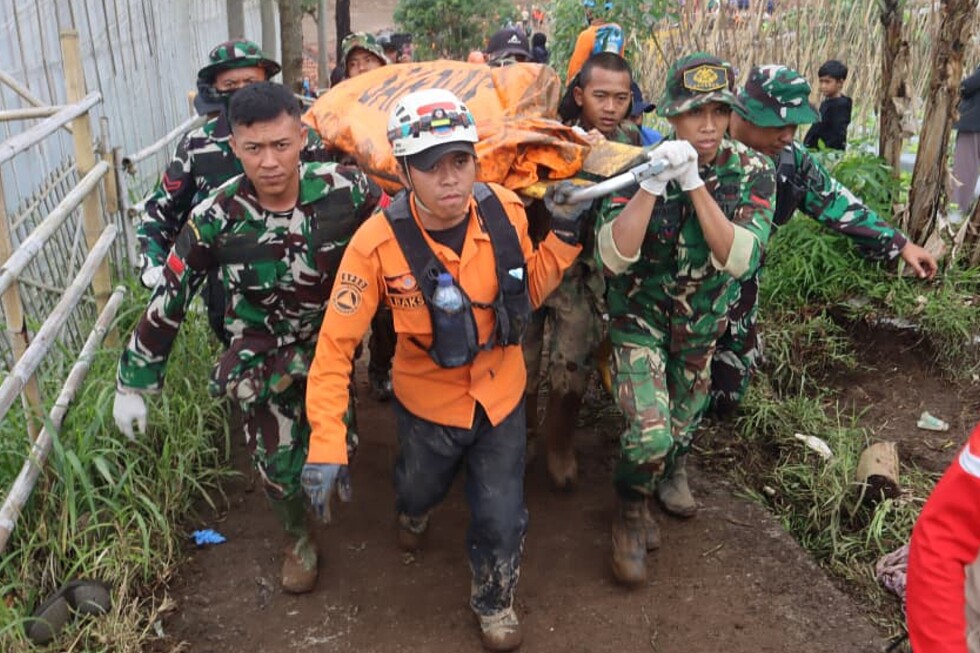
Rescue operations have intensified dramatically since Saturday, with personnel numbers swelling from an initial 500 to over 2,100. Teams are using everything from their bare hands to water pumps, drones and excavators in the desperate search for survivors, according to Abdul Muhari, spokesperson for Indonesia’s National Disaster Management Agency.
The challenging terrain has severely hampered rescue efforts. “Heavy machinery has struggled to reach the site, the access road is narrow and the ground remains unstable,” Admiral Ali explained. The remote location on the mountain slopes has complicated what is already a dangerous mission for rescue teams.
Ade Dian Permana, head of the local search and rescue office, highlighted the treacherous conditions facing rescuers. “The ground is still very unstable and mixed with water, which limits how far our teams can safely move,” he said. Operations have been suspended during nighttime hours due to poor visibility and the continued risk of further landslides.
The scale of the disaster is substantial, with the landslide path stretching more than 2 kilometers (1.2 miles). Yudhi Bramantyo, operation director of the National Search and Rescue Agency, reported that in some areas, rescuers are contending with mud accumulations reaching depths of up to 8 meters (26 feet). Teams are meticulously digging through tons of mud, rocks and uprooted trees in hopes of finding survivors.
This disaster highlights Indonesia’s persistent vulnerability to natural hazards, particularly during the annual monsoon season. The archipelago nation, comprising more than 17,000 islands, regularly faces flooding and landslides during the seasonal rains that typically occur from October to April. These environmental risks are magnified by Indonesia’s geography, with millions of citizens living in mountainous regions or near flood plains.
The military training exercise that placed the marines in harm’s way was part of Indonesia’s ongoing efforts to secure its remote land borders. The Indonesia-Papua New Guinea frontier represents one of the country’s most challenging border regions, characterized by dense jungle, mountainous terrain, and limited infrastructure.
For the affected communities in West Java, Indonesia’s most populous province, this disaster adds to a history of environmental challenges. The region’s combination of high population density, mountainous terrain, and intense seasonal rainfall creates conditions where landslides pose a recurring threat to villages situated on hillsides and mountain slopes.
As search operations continue, authorities face the dual challenges of deteriorating conditions at the disaster site and diminishing hopes for finding survivors as time passes. The significant military presence among the victims has added a national dimension to what would already be a devastating local tragedy.
Fact Checker
Verify the accuracy of this article using The Disinformation Commission analysis and real-time sources.

7 Comments
Landslides can be especially hazardous for remote military training camps and villages. I hope the rescue efforts are successful in finding any survivors. Geologists should investigate the slope failure to improve future prevention and mitigation efforts.
You’re right, understanding the root causes is crucial. Proper risk assessment and strengthening infrastructure in vulnerable areas could help save lives in the future.
This is a tragic incident. My heart goes out to the families of the missing marines and civilians. Natural disasters like landslides are devastating and highlight the need for robust disaster preparedness and response systems.
The loss of life is heartbreaking. I commend the first responders working tirelessly to search for the missing. Events like this emphasize the importance of mining and energy companies prioritizing worker safety and emergency preparedness.
Absolutely. Companies in high-risk industries must have robust safety protocols and emergency response plans in place to protect their employees and local communities.
While the loss of life is devastating, I hope the rescue efforts can still find survivors. Landslides are unpredictable natural disasters, but improved early warning systems and evacuation planning could potentially mitigate such tragedies in the future.
This is a sobering reminder of the risks and challenges facing those who work in remote locations, whether in the military or in mining/energy operations. My condolences to all affected by this tragic incident.