


Listen to the article
Israelis Take Shelter as Iran Fires Missiles in Retaliation for Joint US-Israel Attack
Residents across central Israel found themselves repeatedly rushing to bomb shelters throughout Saturday as Iran launched dozens of missiles in response to a major attack conducted earlier by the United States and Israel.
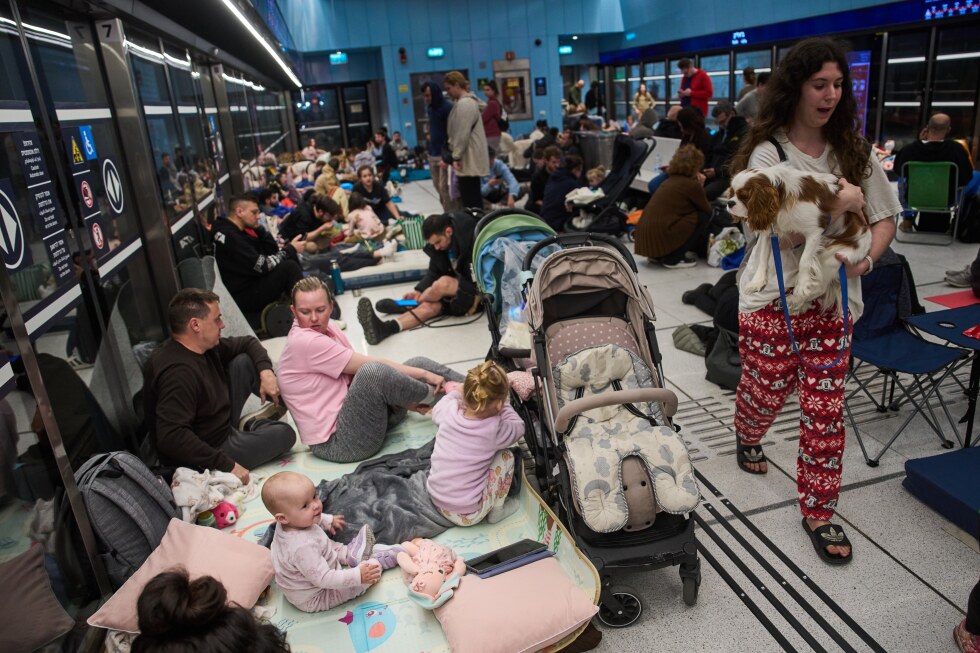
In Jaffa, a mixed Arab-Jewish neighborhood of Tel Aviv, more than 100 people sought protection in a public shelter beneath a park. The diverse group included Muslim families with young children, religious Jews from a nearby seminary, and numerous pets. Some residents brought mattresses and played cards to pass the time, while others shared snacks and scrolled through news updates on their phones as sirens wailed repeatedly across the neighborhood.
“Of course we expected it, even though we didn’t want it to happen,” said Idit Cohen, a local resident. She noted that despite the tension, the crisis brought the community together in unexpected ways. When her son received an emergency summons for military reserve duty, a religious Jewish man in the shelter volunteered to drive him to the base, setting aside Sabbath restrictions against driving on Saturdays.
“I want it to end as soon as possible, it’s a nightmare, people are more and more frustrated and tired,” Cohen added. “We see families with babies and young kids here, but there are elderly people that aren’t able to keep running here all day.”
As Muslim residents were forced to break their Ramadan fast in bomb shelters at sundown, the scene reflected the complex reality of life in Israel during times of conflict. For many Israelis, the routine has become distressingly familiar after fighting with multiple regional adversaries over the past two and a half years, including Hamas in Gaza, Hezbollah in Lebanon, Houthi rebels in Yemen, and a 12-day conflict with Iran last June.
Israel’s layered defense system of air-raid sirens, bomb shelters, and missile interceptors has significantly reduced casualties, but hasn’t eliminated them entirely. The country’s emergency service, Magen David Adom, reported that a woman in the Tel Aviv area died from injuries sustained in an Iranian strike. At least 90 people across Israel suffered light injuries, while one man was seriously injured.
The constant movement between normal life and shelter has taken a toll on families. Igor Libenson, a construction worker and father of two sons aged 4 and 7, described the exhaustion. “The kids aren’t scared, we were here also in June in the same situation,” he said, referring to previous conflicts that have become an unfortunate part of daily life.
Not all Israelis have equal access to protection, however. While newer buildings in Israel are required to have reinforced safe rooms designed to withstand rockets, Iran’s ballistic missiles pose a greater threat to these structures. Shelter access remains severely limited in poorer neighborhoods and towns, particularly in Arab areas and rural regions.
The situation is especially dire for Israel’s Bedouin minority, more than two-thirds of whom have no access to shelters, according to the Negev Coexistence Forum. During last year’s conflict, many Bedouin families resorted to building improvised shelters using buried steel containers, trucks, and construction debris.
Some Tel Aviv residents without home shelters have taken to sleeping in the city’s underground light rail stations and mall parking garages during periods of heightened tension.
The Iranian missile barrage began shortly after the joint Israeli-U.S. attack early Saturday. By nightfall, the Israeli military reported that dozens of missiles had been launched toward Israel, many of which were intercepted by defense systems.
“We look at this in the long term. We suffer today but we do hope that it will resolve the problems of tomorrow,” said Maya Tutian, who sought refuge in a northern Tel Aviv shelter. “The Iranian regime is not just a threat to us, people who live here in Tel Aviv, but for the entire world.”
In response to the attacks, Israeli authorities issued a nationwide warning and placed the country on high alert, canceling schools and restricting most public gatherings across Israel as the situation continues to develop.
Fact Checker
Verify the accuracy of this article using The Disinformation Commission analysis and real-time sources.

14 Comments
While the strategic and political motivations are complex, the human toll is heartbreaking. My thoughts are with the families taking shelter.
It’s admirable to see the community coming together in these frightening times. Small acts of kindness can provide comfort.
Tragic to see the cycle of violence continue. Hoping all in Israel can find safety and a path to lasting peace soon.
Agreed, the constant state of tension and fear must be exhausting for the people. Diplomacy and compromise are needed to break this cycle.
Missile strikes on civilian populations are never justified, regardless of the geopolitical circumstances. I hope diplomacy can resolve this conflict.
The ongoing tensions between Israel and Iran are deeply concerning. All parties must prioritize de-escalation and protecting human life.
The human cost of this conflict is devastating. I hope the international community can find a path to lasting peace in the region.
Agreed, the endless cycle of violence is tragic. Diplomacy and compromise are the only way to break this pattern.
The ongoing conflict in the Middle East is deeply concerning. I hope all sides can find the courage to pursue a peaceful resolution.
Agreed, the human toll is unacceptable. Diplomacy and compromise are essential to break this cycle of violence and suffering.
The geopolitical tensions in the Middle East seem unending. I hope the civilian populations don’t bear the brunt of these conflicts between states.
Innocent people should never be collateral damage. All sides need to prioritize de-escalation and protecting human life.
While the strategic context is complex, the suffering of the civilian population is heartbreaking. My sympathies are with the people of Israel.
Protecting innocent lives should be the top priority for all parties involved. Diplomacy and de-escalation are crucial at this juncture.