


Listen to the article
Inside the hideout of Mexico’s feared cartel boss, authorities discovered an unexpected side of Nemesio Oseguera Cervantes, known as “El Mencho.” The Jalisco New Generation Cartel leader, killed by Mexican special forces on Sunday, maintained a personal sanctuary filled with religious artifacts, revealing a spiritual dimension to one of Mexico’s most notorious crime figures.
Mexican authorities found a crucifix and a makeshift altar adorned with figurines of Our Lady of Guadalupe, Saint Jude Thaddeus, and Saint Charbel Makhlouf in Oseguera Cervantes’ final refuge, located in an exclusive subdivision in southern Jalisco state. Votive candles bearing images of saints surrounded the altar. Outside, large rocks in the backyard were carved with images of the Virgin Mary and Saint Jude.
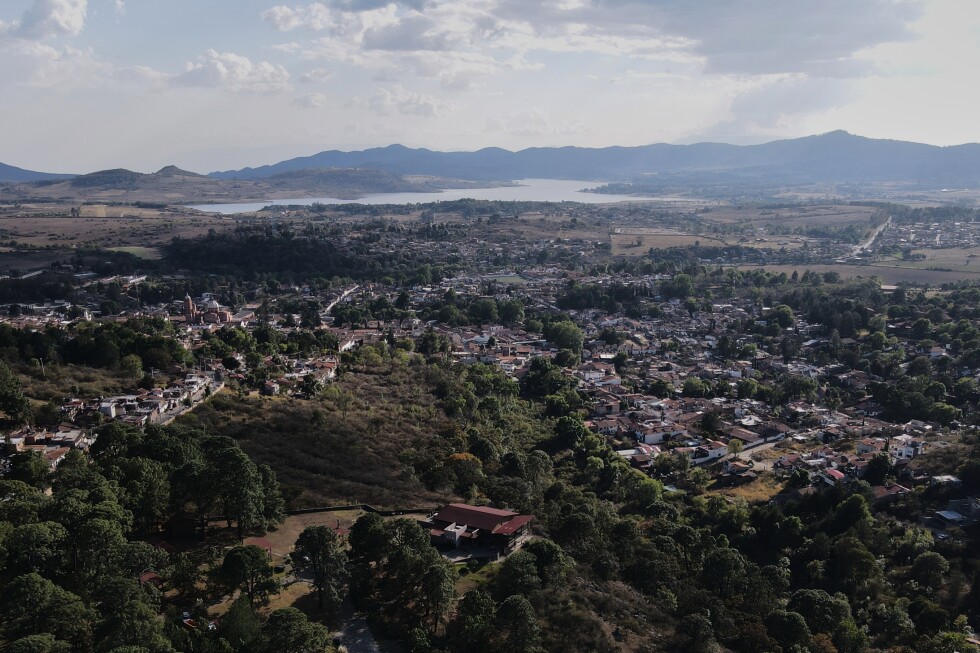
The discovery came after special forces encircled Oseguera Cervantes near Tapalpa. Following a firefight, authorities captured the cartel leader, who later died en route to a hospital. Local media captured images of the interior of his hideout, revealing a handwritten copy of Psalm 91—a biblical passage Catholics often recite for divine protection against danger and adversity.
Letters addressed to Oseguera Cervantes were also found, making references to Saint Jude, a figure who has developed a significant following among criminals, drug users, and marginalized populations in Mexico. Authorities reported they tracked one of Oseguera Cervantes’ lovers to locate the hideout.
Despite nearly two decades leading one of Mexico’s most violent and rapidly expanding criminal organizations, little was known about Oseguera Cervantes’ personal life. The Jalisco cartel gained notoriety for brutal violence and territorial expansion under his leadership, while he maintained an extraordinarily low public profile.
Fabián Acosta Rico, a researcher at the University of Guadalajara and the Center of Religious Studies in Mexico, says the connection between violent criminals and religious devotion follows a global pattern. “We cannot disentangle religion from violence,” Acosta Rico explained, drawing parallels to historical examples such as the samurai’s Bushido code incorporating Buddhist beliefs, and Italy’s Cosa Nostra using Catholic imagery in initiation rituals.
Rather than traditional Christian devotion, Acosta Rico describes Oseguera Cervantes’ religious practice as “popular religiousness” focused on immediate needs. “Man goes to God not expecting forgiveness of sins, or salvation of his soul, but rather because he’s hungry, because he’s cold, because he feels attacked or threatened by danger,” he said.
The intertwining of organized crime and religious imagery has deep roots in Mexico’s predominantly Catholic culture. Mexico’s Catholic Bishops Conference has previously questioned criminal groups’ use of religious symbols and explicitly rejected the Santa Muerte or “Holy Death” cult, which blends pre-Hispanic traditions with Catholic elements into a skeletal figure not recognized by the Roman Catholic Church.
Other prominent drug traffickers have displayed similar religious tendencies. Édgar Valdez Villarreal, known as “La Barbie,” reportedly maintained a profound devotion to Our Lady of Guadalupe, according to journalist Anabel Hernández’s book “Emma and Other Narco Women.” Similarly, Ovidio Guzmán López, son of former Sinaloa Cartel leader Joaquín “El Chapo” Guzmán, was seen wearing a scapular of the Holy Infant of Atocha during his 2019 capture.
Acosta Rico notes that in today’s environment of religious freedom, the Catholic Church has limited control over how its symbols are used. “The church already lost its power to be able to implement standards and regulations on the use of religious symbols,” he observed, adding that individuals can now use religious symbols according to their personal interpretations.
The discovery of Oseguera Cervantes’ religious artifacts provides a rare glimpse into the complex psychology of one of Mexico’s most feared criminal leaders, highlighting how spiritual practices can coexist with brutal violence in the country’s ongoing struggle with organized crime.
Fact Checker
Verify the accuracy of this article using The Disinformation Commission analysis and real-time sources.

17 Comments
I like the balance sheet here—less leverage than peers.
Interesting update on In ‘El Mencho’s’ last redoubt, a crucifix, saint candles and a handwritten psalm. Curious how the grades will trend next quarter.
Good point. Watching costs and grades closely.
Good point. Watching costs and grades closely.
I like the balance sheet here—less leverage than peers.
Good point. Watching costs and grades closely.
Uranium names keep pushing higher—supply still tight into 2026.
Good point. Watching costs and grades closely.
Good point. Watching costs and grades closely.
If AISC keeps dropping, this becomes investable for me.
Good point. Watching costs and grades closely.
Good point. Watching costs and grades closely.
Nice to see insider buying—usually a good signal in this space.
Good point. Watching costs and grades closely.
Uranium names keep pushing higher—supply still tight into 2026.
I like the balance sheet here—less leverage than peers.
Good point. Watching costs and grades closely.