


Listen to the article
Imprisoned Kurdish Leader Urges New Peace Legislation in Turkey’s Decades-Long Conflict
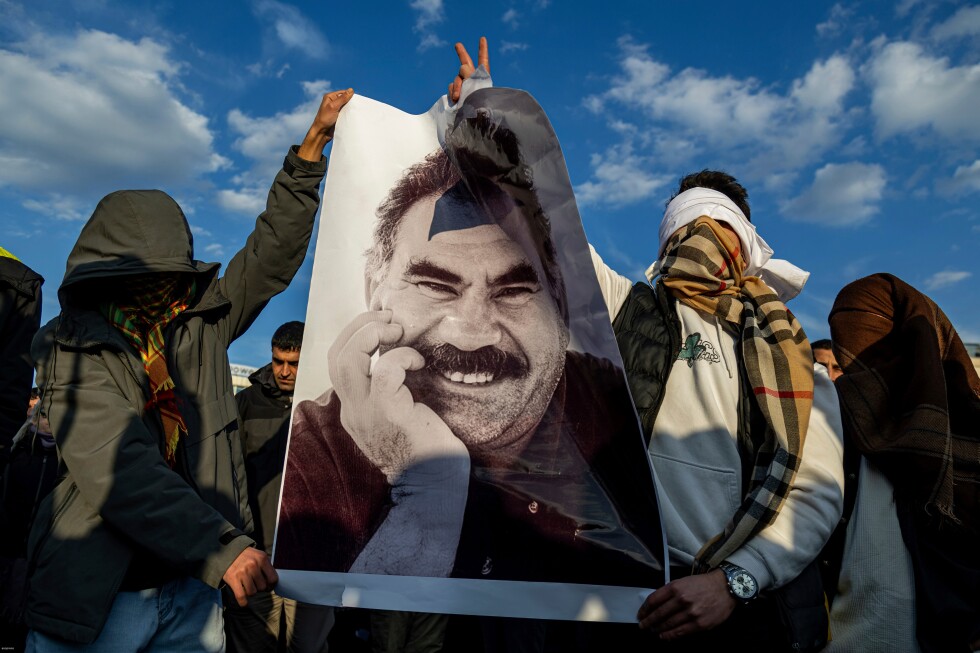
The imprisoned leader of the Kurdistan Workers’ Party (PKK), Abdullah Ocalan, called Friday for new legislation to advance peace negotiations with the Turkish government, marking a significant development in efforts to resolve the country’s decades-long Kurdish conflict.
Ocalan’s message, read in Turkey’s parliament by a senior member of the pro-Kurdish party, emphasized the need for legal frameworks to support the ongoing peace process. “The transition to democratic integration necessitates laws of peace,” Ocalan stated in the message delivered by legislator Pervin Buldan.
The appeal comes one year after Ocalan’s historic call for the PKK to disarm and dissolve itself, a watershed moment in a conflict that has claimed tens of thousands of lives since it began in 1984. The PKK, designated as a terrorist organization by Turkey, the United States, and the European Union, has waged an armed insurgency spanning Turkey, Iraq, and Syria.
“We aim to close the era of politics based on violence and to open a process based on a democratic society and the rule of law,” the message continued, calling on “all segments of society to create opportunities and take responsibility in this direction.”
Following Ocalan’s initial announcement in February 2025, the PKK responded positively in May, declaring its intention to disarm and disband. The group later conducted a symbolic disarmament ceremony in northern Iraq, where fighters burned dozens of weapons in a public display of commitment to the peace process. The PKK has also begun withdrawing its remaining fighters from Turkey to bases in northern Iraq, traditionally a safe haven during the insurgency.
This latest appeal follows recommendations from a multi-party parliamentary commission that recently outlined a series of reforms to support peace efforts. The commission’s proposals include measures to reintegrate PKK members who renounce violence, with the caveat that such legal steps should be tied to verification by state security institutions that the group has indeed surrendered its weapons.
The commission also recommended expanding freedom of expression, releasing elderly or ill prisoners, and ensuring that nonviolent acts are not prosecuted under Turkey’s anti-terrorism laws—a frequent criticism from international human rights organizations.
The Peoples’ Equality and Democracy Party (DEM), Turkey’s main pro-Kurdish political party, has backed Ocalan’s call for legislative action. “The state and the executive branch are obligated to move this process forward with the seriousness and determination that matches Mr. Ocalan’s pace for a solution,” said DEM party co-chairman Tuncer Bakirhan. “The responsibility now rests with the state and the executive branch.”
Despite being imprisoned since 1999 on treason charges, the 76-year-old Ocalan continues to wield significant influence over the PKK and its political movement. He remains confined on the island of Imrali off Istanbul’s coast, where his access to the outside world is heavily restricted.
The PKK initially sought an independent Kurdish state across parts of Turkey, Iraq, Syria, and Iran, where Kurdish populations live. However, its demands have evolved over the years toward autonomy and expanded cultural and political rights for Turkey’s estimated 15-20 million Kurds.
The ongoing peace process represents one of the most significant attempts to resolve Turkey’s longest-running conflict, which has heavily impacted the country’s southeastern regions and strained its relationships with neighboring countries. The economic cost of the conflict has been estimated in the hundreds of billions of dollars over four decades.
If successful, the peace initiative could transform Turkey’s domestic politics and regional standing, potentially opening new avenues for economic development in the predominantly Kurdish southeast and improving Turkey’s prospects for eventual European Union membership, which has been partially hindered by human rights concerns related to the conflict.
Fact Checker
Verify the accuracy of this article using The Disinformation Commission analysis and real-time sources.

6 Comments
This is a potentially significant development in the long-running Kurdish conflict in Turkey. Legal frameworks to support the peace process could help build confidence and momentum, if implemented in good faith by all sides.
Agreed. The devil will be in the details, but a genuine desire for peace on both sides is an important first step.
Encouraging to see the PKK leader call for new peace legislation. After decades of conflict, it’s time to find a sustainable political solution that respects all parties. Negotiation and compromise will be key to advancing this process.
After so much bloodshed, the call for a legal framework to support peace negotiations is encouraging. However, the details and implementation will be critical to determining whether this leads to meaningful progress or more disappointment.
New peace legislation could provide a path forward, but past failures make me cautiously optimistic. Sustained political will and good-faith efforts from all stakeholders will be required to achieve a lasting resolution.
The PKK’s decades-long armed insurgency has taken a heavy toll. Shifting to a democratic, non-violent approach is a wise and necessary move. Constructive dialogue and compromise will be essential to ending this long-standing dispute.