


Listen to the article
Illegal gold mining is spreading into new parts of Peru’s Amazon, advancing along remote rivers and into Indigenous territories as experts warn of a widening environmental and public health crises that could cause irreparable damage.
The surge marks a new phase for one of the Amazon’s most destructive industries, as operations move beyond long-established hot spots into previously untouched regions, environmentalists, researchers and Indigenous leaders told The Associated Press.
The expansion is accelerating deforestation, contaminating rivers with mercury and exposing remote communities to violence and organized crime, even as the government says it is stepping up enforcement.
Once largely concentrated in the southern Amazon region of Madre de Dios, illegal mining activity is now moving north into regions such as Loreto and Ucayali. Peru’s high commissioner for the fight against illegal mining, Rodolfo García Esquerre, acknowledged this troubling trend earlier this year, stating, “Unfortunately, we have illegal mining in all regions of Peru.”
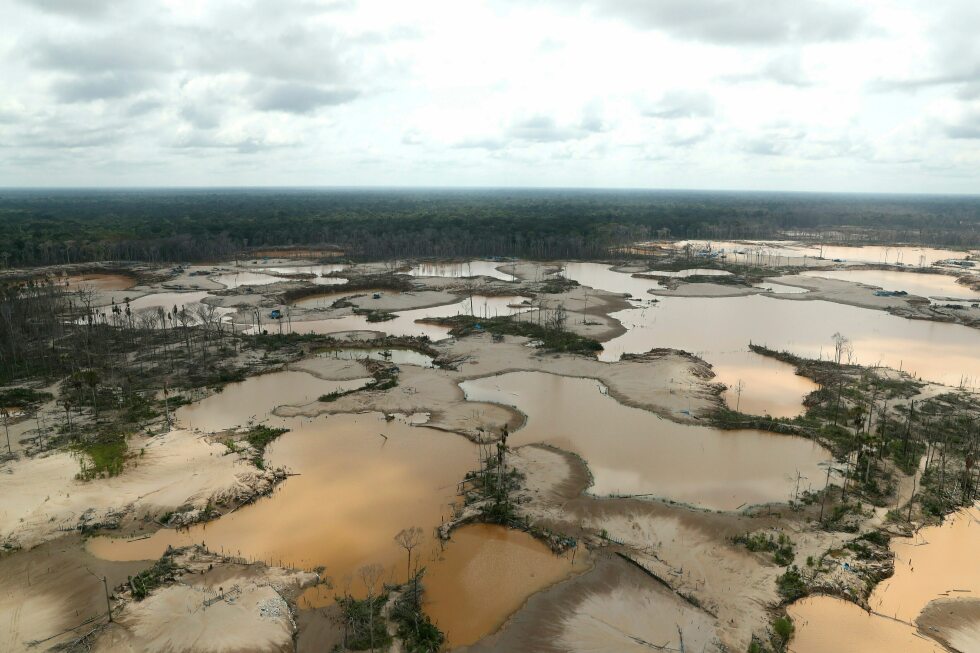
The mining operations employ destructive techniques that transform the landscape rapidly. Miners strip away forest with bulldozers, carve pits into flood plains and deploy floating dredges that suck up river sediment in search of gold. The process leaves behind pools of stagnant, mercury-laced water and eroded riverbanks, while camps and access roads spread deeper into previously untouched forest.
Peruvian environmental lawyer César Ipenza explained that the expansion has accelerated in recent years as gold prices surge. Gold has been trading at approximately $2,000 an ounce so far in 2026 — near historic highs and roughly double its price a decade ago, making it economically viable to operate in more remote regions.
“Illegal mining has increased considerably,” Ipenza said, pointing to new activity in Huanuco, Pasco, Loreto and along the Ecuador border.
Julia Urrunaga, Peru program director for the nonprofit Environmental Investigation Agency, confirmed that field reports show illegal mining appearing in new areas this year, particularly along river systems.
The environmental changes happen rapidly once illegal mining takes hold. “It happens pretty fast,” said Luis Fernández, a research professor and senior fellow of the Sabin Center for Environment and Sustainability at Wake Forest University. “You’ll see changes in weeks to months once the machinery comes in… sediment plumes in the rivers almost immediately.”
At the Panguana Biological Station in Peru’s central Amazon, a private conservation area protecting one of the region’s most biodiverse forests, the impacts are already visible. Fernando Malatesta, the station’s administrator, told the AP that the area has become a front line in the illegal mining boom.
“Where there were once intact forests… the rivers are now murky,” he said. “You used to see crystal-clear water, but not anymore.”
The situation has become increasingly dangerous for conservationists. Malatesta and his team were forced to leave the Panguana station after threats escalated in 2025 and early 2026. “They started threatening us… there were people with machetes,” he recalled, describing confrontations with miners and local residents.
Researchers point to the growing involvement of organized crime networks in these operations. “Transnational criminal groups are becoming more significant every day,” said Ipenza. Urrunaga added that illegal gold mining has become a key source of income for criminal networks and is “deeply linked to the political forces in the country right now.”
In late 2023, Peru’s government created a high-level multisector commission to combat illegal mining and oversee efforts to formalize small-scale miners. Officials say enforcement efforts are ongoing, with recent operations resulting in the seizure and destruction of equipment worth more than 60 million soles ($16 million) used in illegal mining activities.
However, environmental defenders argue that enforcement remains weak on the ground. When approached for comment, Peru’s high commissioner for the fight against illegal mining declined to respond.
Indigenous communities find themselves at the center of this crisis. “This is already being heard in other parts of the Amazon. It is spreading through Loreto and Ucayali,” said Julio Cusurichi, an Indigenous leader from Madre de Dios. He described how outside miners arrive quickly, cutting forests and polluting rivers, creating an atmosphere of fear. According to Cusurichi, more than 30 Indigenous leaders have been killed in recent years for defending their lands.
The environmental damage is closely tied to serious health risks for communities, particularly through mercury contamination. Miners use mercury to extract gold, which then pollutes rivers and contaminates the food and water consumed by Indigenous communities.
“Mercury becomes the delivery system for poison,” Fernández explained, describing how it builds up through food chains and affects children’s neurological development.
Claudia Vega, a scientist and mercury program coordinator at the Amazon Center for Scientific Innovation, warned that the expansion of mining into heavily fish-dependent Amazonian communities could have severe consequences. “Amazonian communities are already vulnerable… they eat fish every day,” she said. “If you put mining in that type of place… you are adding more risk.”
Vega cautioned that contamination could reach levels similar to the Minamata disaster in Japan, where mercury poisoning caused widespread neurological damage, including deformities and loss of vision and hearing.
Scientists warn that the continued expansion of mining, driven by rising gold prices and global demand, could have irreversible consequences for the Amazon, potentially pushing parts of the rainforest closer to an ecological tipping point where large areas shift into degraded savanna-like ecosystems.
“Every tree that falls, every river that is contaminated and every animal that disappears remind us that we are losing an irreplaceable treasure,” Malatesta said.
Fact Checker
Verify the accuracy of this article using The Disinformation Commission analysis and real-time sources.

10 Comments
Illegal mining is a huge problem across Peru, not just in the Amazon. The government needs to take a comprehensive, nationwide approach to combat this issue and hold companies and individuals accountable for the damage they’re causing.
Absolutely. A coordinated, multi-pronged strategy is needed to address the root causes and logistics of illegal mining. Stronger enforcement, tougher penalties, and alternative economic opportunities for affected communities should all be part of the solution.
This is a troubling example of the ongoing battle to protect the Amazon and its indigenous inhabitants. Illegal mining operations are devastating the landscape and exposing remote communities to violence. The Peruvian government must act swiftly to curb this crisis.
This is a complex and multifaceted issue, with both environmental and social justice implications. The Peruvian government must take a comprehensive approach, working closely with local communities and international partners to shut down illegal mining operations and provide alternative economic opportunities. The Amazon is a precious global resource that must be protected.
The rapid deforestation and mercury contamination caused by these illegal mining operations are deeply concerning. The impact on indigenous communities is also very worrying. This situation requires urgent action to protect the Amazon and its people.
I agree, the effects on the local environment and communities are devastating. The government must do more to crack down on these illegal activities and enforce environmental regulations.
It’s disheartening to see the Amazon facing yet another threat from destructive industries like illegal gold mining. The long-term impacts on the environment and local populations could be devastating. This is a complex issue that requires international cooperation to resolve.
The surge in illegal gold mining in Peru’s Amazon is extremely concerning. The rapid deforestation, mercury contamination, and exposure to organized crime are all serious issues that require urgent action. I hope the government can effectively enforce environmental regulations and protect vulnerable communities.
This is a troubling development, as illegal gold mining continues to devastate the Peruvian Amazon. The environmental and public health impacts are severe, and the spread into new regions is alarming. I hope the government can step up enforcement to curb this destructive industry.
Illegal mining is a persistent problem in many parts of the world, and the Peruvian Amazon is unfortunately the latest battleground. The scale of the destruction is alarming, and the impacts on local ecosystems and people are devastating. Stronger international cooperation and enforcement efforts are needed to combat this crisis.