


Listen to the article
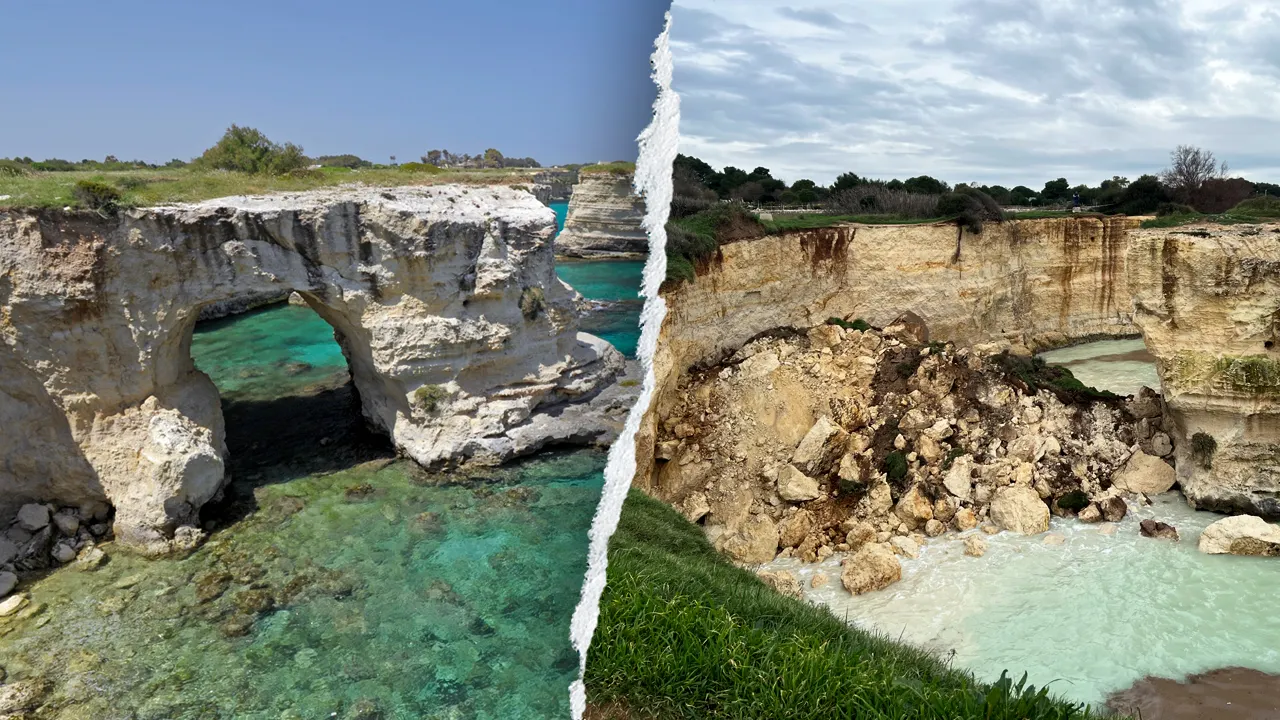
A popular Italian coastal landmark known as the “Lovers’ Arch” collapsed on Valentine’s Day, succumbing to a recent spell of severe weather that battered southern Italy’s Adriatic coastline. The natural rock formation, which had long served as a romantic backdrop for countless tourist photographs and marriage proposals, now lies in ruins.
“This is an unwanted Valentine’s Day gift,” lamented Maurizio Cisternino, mayor of nearby Melendugno, who described the collapse as a “very hard blow” for the region. The arch, part of the picturesque Sant’Andrea sea stacks, had been a significant tourist attraction and cultural symbol for the area.
“Nature has taken back what it created,” Cisternino added, reflecting on the inevitable forces that shaped and ultimately destroyed the formation.
Photographs from the site reveal only a pile of rubble where the majestic arch once stood, soaring gracefully over the azure waters below. The collapse followed days of punishing weather conditions, including heavy rainfall, powerful winds, and turbulent seas that pounded the coastline.
The destruction of the Lovers’ Arch highlights growing concerns about the stability of Italy’s coastal landscapes. Officials have issued warnings that other sections of the rocky coastline may be at risk, with visible cracks appearing along nearby cliffs. The situation has prompted calls for increased monitoring and potential restrictions in vulnerable areas to ensure public safety.
This incident is part of a broader pattern of weather-related damage affecting Italy’s southern coastline. The same storm systems have caused significant destruction along the Ionian Sea, with beach facilities suffering damage and small cliff collapses reported in coastal towns from Gallipoli to Ugento.
The timing of the collapse on February 14th struck many as particularly poignant, given the arch’s romantic associations and popularity as a setting for couples’ photographs and proposals. Local tourism officials are already discussing how the loss might impact visitor numbers to the region, which relies heavily on its natural attractions.
Environmental experts point to increasingly erratic weather patterns as a contributing factor to such natural structure failures. Rising sea levels and more frequent intense storms—often linked to climate change—are accelerating coastal erosion throughout the Mediterranean region.
The Lovers’ Arch joins a growing list of natural landmarks around the world that have succumbed to environmental pressures in recent years. Similar collapses have occurred at Malta’s Azure Window in 2017 and portions of Portugal’s Algarve coast.
For the local community, the loss represents more than just a physical change to the landscape. Many residents share personal memories associated with the arch, from childhood visits to wedding photographs, making its sudden absence particularly emotional.
Local authorities are now considering whether to implement additional protective measures for remaining geological formations in the area. Some conservation experts suggest that while natural processes cannot be halted entirely, certain interventions might help preserve similar structures for future generations.
As the community comes to terms with the loss of this iconic landmark, discussions have already begun about how to memorialize the Lovers’ Arch through photography exhibits and educational programs that would preserve its cultural significance even as its physical presence has vanished from Italy’s stunning Adriatic coastline.
Fact Checker
Verify the accuracy of this article using The Disinformation Commission analysis and real-time sources.

22 Comments
As a romantic spot, the collapse of the Lovers’ Arch on Valentine’s Day is quite symbolic. I hope the local community can find a way to memorialize the arch and its significance.
Yes, a fitting memorial could be a nice way to honor the arch and its role in the region’s culture and tourism.
This is a sad day for the people of Melendugno and the many visitors who enjoyed the Lovers’ Arch over the years. Natural wonders can be fragile, and we must cherish them while they last.
Well said. The collapse is a reminder of the delicate balance between nature and human activity along coastlines. Careful stewardship will be crucial going forward.
Sad to see this iconic landmark collapse, but nature can be unforgiving. I hope the local community can find a way to preserve or rebuild something meaningful in its place.
Agreed, the arch was a beloved symbol. It’s a reminder that even natural wonders can’t withstand the forces of nature indefinitely.
It’s a shame to see this iconic landmark disappear, but natural forces can be unpredictable and unforgiving. I wonder if there are opportunities to study the collapse and learn more about coastal geology and erosion.
That’s a good point. The collapse could provide valuable data for researchers studying coastal dynamics and preservation.
It’s always sad to see a beloved natural landmark like the Lovers’ Arch disappear. But nature can be unpredictable and unforgiving. I hope the local authorities can find a thoughtful way to honor its legacy.
That’s a good point. Preserving the memory and significance of the arch will be important for the community. A memorial or new structure could be a meaningful way to do that.
The Lovers’ Arch was a unique and beautiful natural formation. Its collapse is a loss for the local community and tourists alike. I hope they can find a way to commemorate its legacy.
Agreed, preserving the memory and significance of the arch will be important. A new monument or landmark could be a fitting way to honor its place in the region’s history.
The Lovers’ Arch was a beautiful and romantic spot. Its collapse on Valentine’s Day is quite poetic, if tragic. I wonder if there are plans to create a new landmark to honor the area’s history.
That’s a good point. Rebuilding or replacing the arch could be a way to celebrate the site’s significance for the community.
The Lovers’ Arch was a unique and beloved landmark. Its collapse is a loss for the local community and a reminder of the power of nature. I hope they can find a way to commemorate its legacy.
Absolutely. Perhaps a new monument or sculpture could be created to honor the arch and its significance for the region.
This is a shame, but unfortunately natural formations like the Lovers’ Arch can’t withstand the forces of nature forever. I wonder if there are any plans to create a new landmark or memorial in its place.
That’s a good question. Preserving the arch’s legacy through a new structure or public space could be a meaningful way to honor its history and cultural significance.
The collapse of the Lovers’ Arch is a loss for the local community and tourists alike. It was a unique and beautiful natural landmark. I hope they can find a way to commemorate its legacy in some form.
I agree, a fitting memorial or new landmark could be a way to keep the arch’s memory alive. It was clearly an important part of the region’s identity and culture.
This is unfortunate, but not entirely surprising given the severe weather conditions that have been impacting Italy’s coastline. Erosion and coastal instability are serious issues that need to be addressed.
You’re right, coastal erosion is a growing problem worldwide. Protecting these natural landmarks will require careful planning and investment by local authorities.