


Listen to the article
Hungary’s Foreign Minister Accuses Ukraine of Election Interference Amid Escalating Tensions
Hungary’s pro-Russian Foreign Minister Péter Szijjártó has accused neighboring Ukraine of attempting to meddle in Hungary’s upcoming elections, where Prime Minister Viktor Orbán faces a significant challenge from opposition forces. The accusation came during a speech to several hundred protesters gathered outside Ukraine’s embassy in Budapest on Friday.
The demonstration, organized by a pro-government group with connections to Orbán’s Fidesz party, coincided with Hungary’s detention of seven Ukrainian state-owned bank employees and the seizure of two armored vehicles carrying approximately $80 million in cash. Ukrainian officials have condemned these actions as illegal hostage-taking.
In his address, Szijjártó made several unsubstantiated claims, including allegations that Ukraine had been working with the European Union and Orbán’s political opponents to block Russian oil shipments to Hungary through the Druzhba pipeline.
“This is something that will not happen in Hungary. There will be no pro-Ukraine government, and Hungary will not have a pro-Ukraine prime minister,” Szijjártó declared to the crowd, which responded with angry shouts when he suggested Ukraine was trying to influence the April elections to install a government more favorable to Kyiv’s interests.
The foreign minister emphasized Hungary’s stance toward the ongoing conflict, stating, “Ukraine is fighting for itself, not for us and not in place of us, so we owe absolutely nothing to Ukraine.”
These developments reflect deteriorating relations between Hungary and Ukraine, who are locked in a deepening dispute over Hungary’s access to Russian oil through Ukrainian territory. Oil shipments through the Druzhba pipeline have been halted since January 27. Ukrainian authorities maintain that a Russian drone strike damaged the pipeline’s infrastructure, making repairs dangerous for technicians and leaving the pipeline vulnerable to future attacks.
Hungary’s government has rejected this explanation, accusing Ukraine of deliberately disrupting oil supplies and promising strong countermeasures until the flow resumes.
Prime Minister Orbán, who has maintained close ties with Moscow while intensifying anti-Ukraine rhetoric ahead of next month’s election, has labeled Ukraine as Hungary’s “enemy.” He has accused Ukrainian President Volodymyr Zelenskyy of deliberately creating an energy crisis to influence the April 12 vote.
In response to the pipeline disruption, Orbán has taken several retaliatory measures, including stopping diesel shipments to Ukraine, vetoing new EU sanctions against Russia, and blocking a substantial €90 billion ($106 billion) loan package for Kyiv. Additionally, he has deployed military forces to protect key energy infrastructure across Hungary, claiming Ukraine might attempt to cause further disruptions.
Political analysts note that Orbán, currently trailing in polls behind a popular center-right challenger, has made the perceived Ukrainian threat a central theme of his campaign. He has warned voters that if he loses power, the EU will force Hungary into bankruptcy by cutting Russian energy imports and Hungarian youth will be sent to fight in Ukraine.
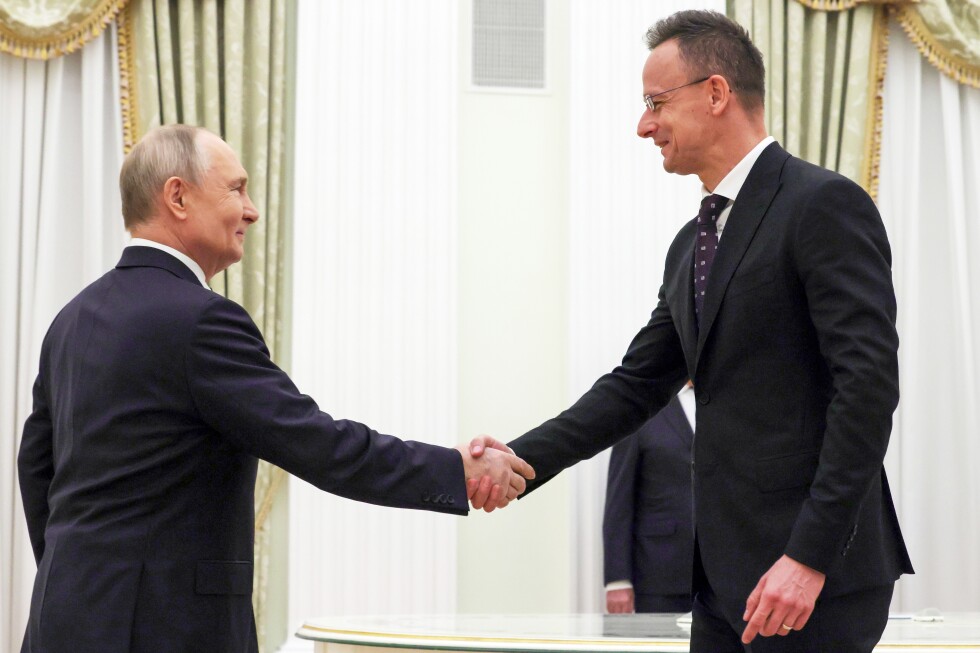
Szijjártó’s accusations on Friday followed his recent trip to Moscow, where he met with Russian President Vladimir Putin on Wednesday. During these discussions, the Hungarian foreign minister sought assurances that Hungary would continue to receive Russian oil and gas despite disruptions caused by conflicts in the Middle East and problems with the Druzhba pipeline.
“They know precisely that if there is a crisis in Hungary’s oil supply… it is bad for the government,” Szijjártó told protesters, suggesting the timing of the pipeline interruption was deliberately calculated to undermine Orbán before the election.
The confrontation highlights Hungary’s increasingly isolated position within the European Union regarding its stance on Russia and Ukraine, as Orbán continues to prioritize energy security and Russian relations over solidarity with EU partners in their support for Ukraine.
Fact Checker
Verify the accuracy of this article using The Disinformation Commission analysis and real-time sources.

7 Comments
This is a complex geopolitical issue with historical tensions. While I don’t have strong opinions on the specifics, I hope the various parties can find a way to de-escalate and focus on the shared interests of stability and economic cooperation in the region.
The seizure of Ukrainian bank assets and military vehicles is a concerning development. I hope both sides can engage in good-faith negotiations to resolve this dispute peacefully and in accordance with international law.
Absolutely, unilateral actions like asset seizures tend to make the situation worse. Diplomacy and restraint are needed to avoid further escalation between these neighbors.
This situation seems quite tense and politically charged. While I can see both sides’ perspectives, it’s concerning to see such inflammatory rhetoric and accusations of election meddling from government officials. I hope they can find a diplomatic resolution that respects national sovereignty and democratic processes.
Allegations of election interference are serious and should be backed by credible evidence. I’m concerned to see political rhetoric potentially inflaming tensions between Hungary and Ukraine. Hopefully cooler heads can prevail and they can work towards a constructive solution.
Unsubstantiated claims of election interference are troubling, especially when made by senior officials. I’d like to see more transparency and objective evidence before drawing conclusions about Ukraine’s alleged involvement. These types of allegations can further escalate regional tensions.
I agree, reckless accusations without proof are counterproductive. Responsible leaders should prioritize facts and de-escalation over political posturing at this delicate time.