


Listen to the article
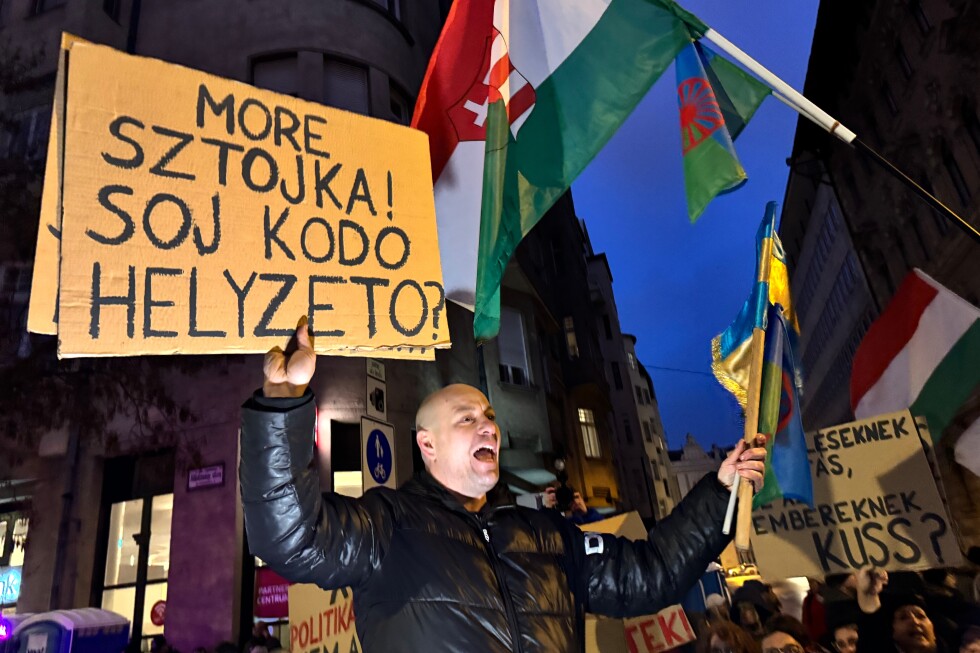
Over 1,000 protesters gathered in Budapest on Saturday, demanding the resignation of a key Hungarian government minister following comments widely perceived as racist toward the Roma community.
Demonstrators, many from Hungary’s Roma minority, assembled outside the offices of János Lázár, a prominent minister in Prime Minister Viktor Orbán’s right-wing populist government. The crowd called for Lázár to apologize and step down over statements he made at a recent community forum.
“Unfortunately, we have always been made to feel that we are considered second-class citizens,” said István Soltész, a Roma community member who traveled from southern Hungary to join the protest. “Many of us also played our part in the world wars, in revolutions, in the construction of the country. But we were always just humiliated.”
The controversy erupted when Lázár, speaking earlier this month, described Hungary’s Roma population as a labor “reserve” that could address the country’s workforce shortages by performing jobs considered undesirable by the ethnic Hungarian majority.
“If there are no migrants, and someone has to clean the toilet on intercity trains, then we must tap into our internal reserves,” Lázár told supporters. “Hungarian voters do not show up with great zeal to clean someone else’s toilets, so the internal reserve is Gypsies in Hungary. This is the reality.”
Hungary’s Roma population, estimated to be around 1 million people—more than 10% of the country’s total—represents its largest yet most marginalized minority group. The community has historically faced persistent challenges including poverty, systemic discrimination, educational segregation, and occasional racial violence.
The minister’s remarks have sparked significant backlash and raised concerns within Orbán’s Fidesz party that they could alienate Roma voters, who have traditionally supported the ruling party. The timing is particularly sensitive, with national elections scheduled for April 12, just ten weeks away.
Prominent Roma leaders and celebrities have expressed outrage on social media, and earlier this week, Roma activists disrupted another forum held by Lázár. While the minister has issued a public apology, he claimed his statements were misinterpreted.
Critics have particularly objected to Lázár’s apparent distinction between Roma and Hungarians, suggesting the minority group isn’t fully part of the nation. Others have condemned the implication that Roma citizens should be relegated to undesirable, low-paying work.
The governing Fidesz party has attempted to defuse tensions, blaming its opposition rival, the center-right Tisza party, for exacerbating divisions between Roma and non-Roma Hungarians. However, Péter Magyar, Tisza’s leader and candidate for prime minister, has publicly condemned Lázár’s comments.
This controversy emerges as Orbán faces perhaps his most significant political challenge since taking office in 2010, with independent polls showing Tisza holding a solid lead over Fidesz ahead of the April election.
At Saturday’s protest, demonstrators waved Romani flags and held up toilet brushes as symbolic references to Lázár’s statements. István Szilvási, a Roma musician attending the demonstration, said the comments had “deeply offended the patriotism” of Hungary’s Roma community.
“It has deeply offended us in our humanity, it has offended our children, our mothers, our fathers, our ancestors, our culture and our future,” Szilvási told fellow protesters. “Lázár won’t resign, the government won’t resign, but it’s okay. On April 12, however, we will know for whom we should cast our vote.”
The controversy highlights ongoing tensions regarding minority rights and representation in Hungary, issues that have increasingly come to the forefront as the country approaches a potentially pivotal election that could reshape its political landscape after fourteen years of Orbán’s governance.
Fact Checker
Verify the accuracy of this article using The Disinformation Commission analysis and real-time sources.

7 Comments
While workforce shortages are a concern, the minister’s proposed ‘solution’ of exploiting the Roma community is deeply problematic. Addressing labor needs should not come at the expense of human rights and dignity.
Exactly. There are ethical ways to address workforce needs that don’t involve stigmatizing and marginalizing vulnerable minority groups. The government should explore those instead.
This protest highlights the ongoing struggle for the Roma minority to be recognized and respected in Hungary. The government must address these divisive, inflammatory statements and take steps to promote inclusion and reconciliation.
The minister’s remarks are deeply troubling and reflect a worrying lack of respect and understanding for the Roma people. Equating them to a ‘labor reserve’ is dehumanizing and unacceptable.
I agree. The comments are blatantly racist and discriminatory. The Roma community deserves to be treated with dignity and equality, not reduced to a disposable labor pool.
It’s disheartening to see such blatant discrimination from a government minister. The Roma people deserve to be treated as equal citizens, not as a disposable labor pool. I hope this protest leads to meaningful change.
This is a concerning situation. The minister’s comments seem to promote harmful stereotypes and marginalization of the Roma community. I hope the protesters’ demands for an apology and resignation are taken seriously.