


Listen to the article
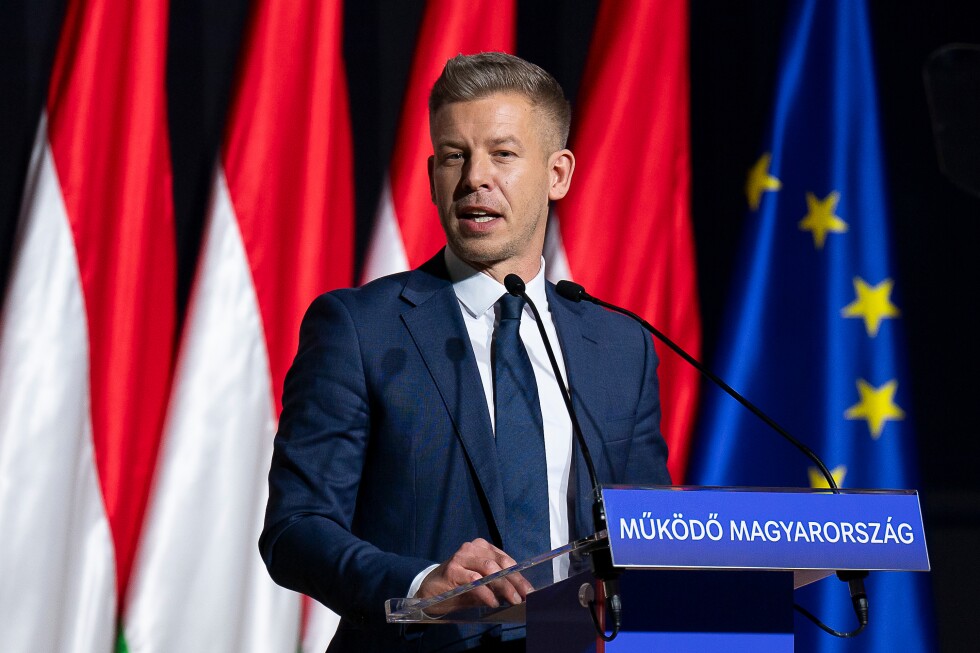
Hungarian opposition leader Péter Magyar officially launched his Tisza party’s election campaign in Budapest on Sunday, positioning himself as the candidate to restore Hungary’s Western alliances ahead of the April 12 vote against long-serving Prime Minister Viktor Orbán.
Magyar, who emerged as a political force after breaking with Orbán’s nationalist Fidesz party earlier this year, told supporters at a Budapest exposition center, “We’re standing on the threshold of victory with 56 days left to go. Tisza stands ready to govern.”
The rapid rise of Magyar and his center-right Tisza party represents the most significant challenge to Orbán’s 16-year grip on power. After capturing approximately 30% of votes in June’s European Parliament elections, independent polls consistently show Tisza maintaining a substantial lead over Fidesz, a trend that has remained stable for over a year.
Magyar has focused his campaign on economic issues affecting ordinary Hungarians, particularly emphasizing low wages and rising living costs that have contributed to Hungary’s position as one of the European Union’s poorest member states. His campaign strategy has involved extensive outreach to rural and conservative areas traditionally loyal to Orbán, holding numerous rallies and town halls across the countryside.
The opposition leader has consistently criticized the Orbán administration for economic mismanagement, deteriorating social services, and what he describes as systemic corruption benefiting a small circle of government-connected elites. He also targets Orbán’s confrontational approach toward the EU while maintaining close ties with Russia despite its invasion of neighboring Ukraine.
“Hungary’s place is in Europe, not only because Hungary needs Europe, but also because Europe needs Hungary,” Magyar declared during Sunday’s rally, referencing recent meetings with European leaders at the Munich Security Conference. He promised to halt what he characterized as Hungary “drifting out of the European Union” under Orbán’s leadership.
Magyar’s pro-European stance stands in sharp contrast to statements made by Orbán at his own campaign launch a day earlier, where the prime minister claimed the EU, rather than military threats from Russia, represented the real danger to Hungary.
Tisza recently released a comprehensive 239-page governing platform outlining its policy agenda, while Fidesz has opted not to publish a formal program, arguing that after 16 years in power, voters already understand their approach.
In his speech, Magyar clarified that Tisza would maintain certain popular Fidesz policies, including the border fence constructed along Hungary’s southern frontier in 2015 and opposition to illegal immigration. He also indicated the party would continue Orbán’s cautious approach regarding Ukraine’s EU accession.
However, Magyar emphasized his commitment to securing billions in EU funding currently suspended due to concerns over democratic backsliding, judicial independence, and corruption under Orbán’s government. The Tisza program includes ambitious goals such as meeting conditions to adopt the euro by 2030 and significant investments in Hungary’s struggling healthcare and public transportation systems.
“It is time to call corruption what it is: theft,” Magyar told the crowd, highlighting his party’s pledge to combat graft and recover misappropriated public funds.
Tisza’s candidate slate largely consists of political newcomers with professional backgrounds in fields like business, medicine, economics, and education. Key party figures include international energy expert Anita Orbán (unrelated to the prime minister) as the prospective foreign policy chief and former Shell executive István Kapitány for a senior economic position.
Magyar presented these candidates as bringing essential expertise currently lacking in government and capable of rebuilding Hungary’s international standing. “We don’t plan to dominate this country, but to serve it,” he concluded.
The upcoming election represents a critical juncture for Hungary’s democratic future and its place within European institutions as voters choose between Orbán’s nationalist vision and Magyar’s promise of renewed Western integration.
Fact Checker
Verify the accuracy of this article using The Disinformation Commission analysis and real-time sources.

12 Comments
Magyar’s campaign strategy of focusing on economic issues affecting ordinary Hungarians seems like a smart move. Bread-and-butter concerns often resonate strongly with voters, especially in times of economic uncertainty.
It will be telling to see if this populist, pocketbook-focused approach can unseat the long-entrenched Orbán government.
The rapid rise of Magyar and Tisza party represents a notable challenge to Orbán’s long dominance. It will be fascinating to see if they can capitalize on the momentum and unseat the incumbent government.
With the election just a couple months away, the campaign dynamics in Hungary will be an important story to follow in the coming weeks.
With Hungary positioned as one of the poorest EU member states, Magyar’s focus on low wages and rising living costs could resonate strongly with voters. Economic concerns often take priority in elections.
It will be interesting to see if Magyar can translate that economic message into electoral success against the long-ruling Orbán government.
The potential shift in Hungary’s foreign policy orientation, from closer ties with Russia to realigning with the West, could have significant geopolitical ramifications in the region. This bears close watching.
As a NATO member, Hungary’s foreign policy direction is consequential not just for the country itself, but for the broader European security landscape.
Interesting to see the opposition leader in Hungary vowing to shift the country back toward Western alliances. This could have significant implications for the country’s foreign policy and economic ties.
Given Hungary’s close ties with Russia in recent years, a shift back toward the West would be a notable change. Curious to see how this plays out in the upcoming election.
The rise of Tisza party as a significant challenger to Orbán’s Fidesz is an intriguing political development in Hungary. It will be fascinating to follow how this plays out in the upcoming election.
The polling data suggesting Tisza maintains a substantial lead is certainly noteworthy. But elections can be unpredictable, so I’ll be watching closely to see how things unfold.