


Listen to the article
Thousands March in Lyon Following Death of Nationalist Activist, Heightening Political Tensions
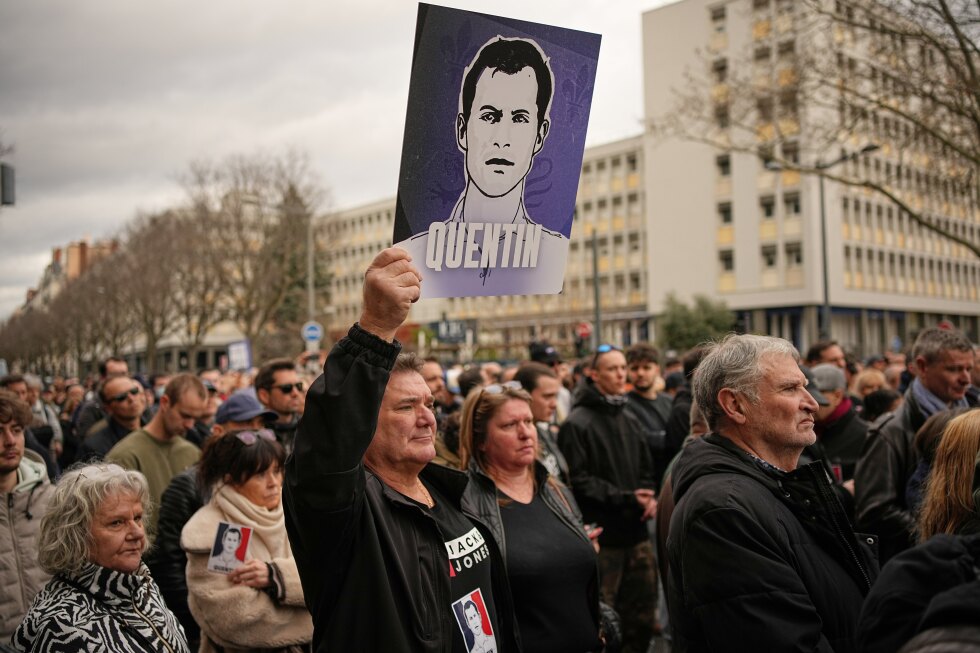
About 3,000 people gathered in Lyon, France on Saturday for a demonstration organized by far-right groups mourning the death of Quentin Deranque, a 23-year-old nationalist activist who succumbed to brain injuries following a violent altercation last week.
The march, which proceeded without major incidents under heavy police supervision, has intensified the already charged political atmosphere in France ahead of next year’s presidential election when Emmanuel Macron’s second and final term will conclude.
“This is a moment of remembrance and respect for this young compatriot who was killed, for his family and loved ones. That must come first. And then it is a moment of firmness and responsibility,” President Macron stated, calling for calm as tensions between far-right and far-left factions continue to escalate.
Seven individuals have been charged in connection with Deranque’s death. The Lyon prosecutor’s office requested charges of intentional homicide, aggravated violence, and criminal conspiracy against all suspects. Six were charged on all three counts, while the seventh faces charges of complicity in intentional homicide, aggravated violence, and criminal conspiracy.
According to authorities, Deranque was attacked during an altercation between far-right and far-left supporters on the periphery of a student event where far-left lawmaker Rima Hassan was speaking. The incident has quickly transformed into a political flashpoint, with far-right groups directing blame toward the far-left France Unbowed party.
President Macron announced plans to meet with ministers next week to review all violent activist groups with political party connections, suggesting potential dismantling of certain organizations. “In the republic, no violence is legitimate,” Macron emphasized. “There is no place for militias, wherever they come from. We must be absolutely uncompromising.”
Lyon has increasingly emerged as a battleground for political extremism in France. Intelligence services consider the city the birthplace of far-right activism in the country, with far-right groups maintaining a strong presence for decades. More recently, far-left militant groups have formed in response, resulting in organized street confrontations that sometimes involve dozens of participants.
During Saturday’s march, demonstrators observed a minute of silence before proceeding through Lyon’s streets. Many participants carried white tulips and displayed stickers reading: “Quentin, killed by Mélenchon’s militia,” directly referencing Jean-Luc Mélenchon, the leader of France Unbowed. Among the suspects in Deranque’s death is a parliamentary aide to a France Unbowed lawmaker who established an anti-fascist group called The Young Guard.
Despite the charged atmosphere, Deranque’s parents called for calm and chose not to participate in the tribute march.
The incident has sparked intense political recriminations across France’s political spectrum. France Unbowed’s opponents accuse the party of fostering violence through its confrontational far-left politics. Mélenchon, who has unsuccessfully run for the presidency in 2012, 2017, and 2022, has condemned the violence and rejected suggestions that his party bears responsibility for the tragedy.
With municipal elections approaching next month, right-wing political forces have seized on the incident to criticize France Unbowed. Jordan Bardella, leader of the far-right National Rally party, has called for a unified front against Mélenchon’s party, which has gained substantial political influence in recent years.
Even figures from the mainstream left have distanced themselves from Mélenchon’s party. Former President François Hollande suggested that his Socialist Party should avoid future electoral alliances with France Unbowed, breaking from recent cooperative strategies among left-leaning parties.
The tragedy in Lyon underscores the increasingly fractured and volatile political landscape in France, where extremist ideologies on both ends of the spectrum have gained traction amid economic uncertainty and social tensions. As the country approaches another presidential election cycle, political observers worry that such incidents could further polarize an already deeply divided electorate.
Fact Checker
Verify the accuracy of this article using The Disinformation Commission analysis and real-time sources.

11 Comments
Deranque’s death is undoubtedly a tragic loss, and I empathize with his loved ones. However, the march must remain peaceful and lawful, as any violence will only exacerbate the tensions. Macron’s call for calm and responsibility is crucial to de-escalating the situation and allowing constructive dialogue to take place.
Well said. Peaceful protest is a fundamental right, but it must be exercised responsibly. The authorities need to balance upholding public order with ensuring all voices can be heard. Finding common ground and addressing the underlying issues through open and respectful dialogue should be the priority.
Tragic loss of life, regardless of political affiliations. Tensions are running high, but resorting to violence will only breed more division. Macron’s call for calm is prudent – this is a time for reasoned dialogue, not further escalation.
I agree. It’s crucial that all sides engage in peaceful protest and avoid actions that could inflame the situation further. Deranque’s death is a sad event, and the focus should be on addressing the underlying issues through lawful and civil means.
Macron’s call for calm is understandable given the volatile political climate. However, the root causes of the tensions need to be addressed through open and constructive dialogue, not heavy-handed policing. Peaceful protest is a fundamental right, but it must be exercised responsibly on all sides.
Well said. Finding common ground and building mutual understanding should be the priority, rather than escalating confrontation. This is a complex issue that requires nuanced approaches, not knee-jerk reactions.
While I understand the emotions surrounding this incident, it’s critical that all parties exercise restraint and engage in constructive dialogue. Escalating tensions through confrontation will not resolve the underlying issues. Macron’s call for calm is a prudent step to de-escalate the situation.
I agree. Maintaining public order while respecting the right to peaceful protest is a delicate balance. The authorities must show impartiality and ensure that all voices can be heard without resorting to violence.
This is a tragic and complex situation. My condolences go out to Quentin Deranque’s family. However, the response must be measured and focused on finding solutions, not stoking further division. Macron’s message of calm and responsibility is the right approach to navigate these challenging circumstances.
This is a delicate situation that requires sensitivity and restraint from all involved. While the loss of life is regrettable, responding with more violence will only exacerbate the tensions. I hope the authorities can maintain order while allowing lawful expressions of grief and political views.
The death of Quentin Deranque is a tragedy, and my condolences go out to his family and loved ones. However, the march must remain peaceful and lawful, as violence will only breed more violence. Macron’s message of calm and responsibility is the right approach at this sensitive time.