


Listen to the article
Massive Landslide Forces 1,500 Evacuations in Sicilian Town as Premier Pledges Aid
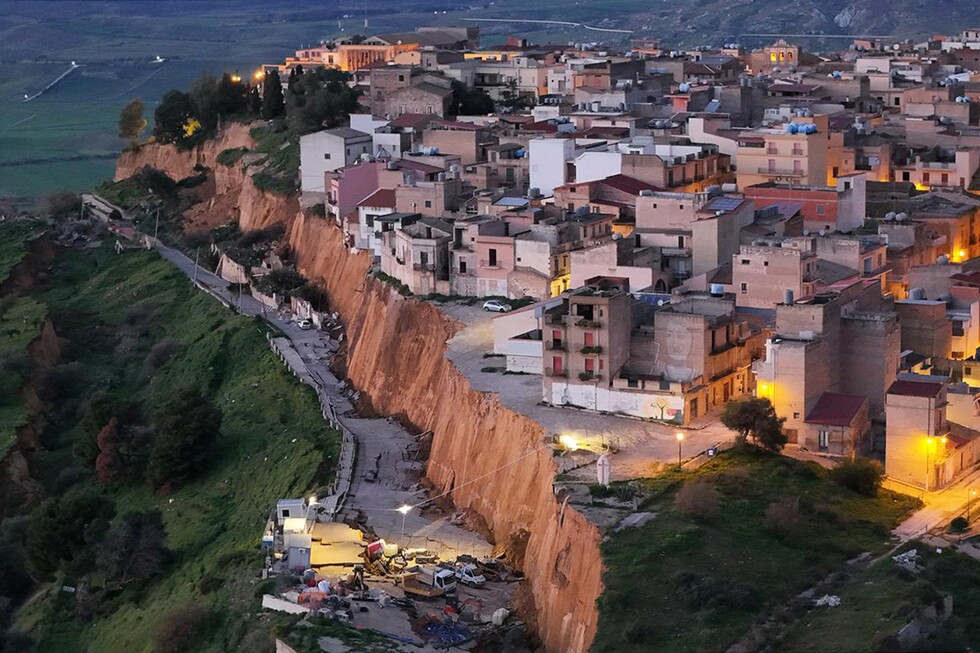
Italian Premier Giorgia Meloni visited the southern Sicilian town of Niscemi on Wednesday to survey a catastrophic landslide that has forced more than 1,500 residents from their homes and left many structures teetering precariously on a newly formed cliff edge.
The landslide, which spans an alarming 4 kilometers (2.5 miles), was triggered by days of heavy rainfall from Cyclone Harry that saturated the region. Dramatic aerial images reveal cars and buildings that have already plunged 20 meters off the cliff face, while numerous other homes remain dangerously perched at the edge of collapse.
“The entire hill is collapsing onto the plain of Gela,” warned civil protection chief Fabio Ciciliano. “To be honest, there are houses located on the edge of the landslide that obviously can no longer be inhabited, so we need to work with the mayor to find a permanent relocation for these families.”
Authorities have established a 150-meter wide “no go zone” in Niscemi, which lies inland from the coastal city of Gela. Officials have made it clear that residents with homes in the affected area will need to find long-term alternative housing, as the water-saturated ground continues to shift and remains too unstable for habitation.
The federal government included Niscemi in a state of emergency declaration on Monday that covers three southern regions severely impacted by Cyclone Harry. An initial emergency fund of 100 million euros ($120 million) has been allocated to be distributed among the affected areas. Sicilian regional officials have estimated that the overall damage to Sicily alone stands at approximately 2 billion euros.
After taking a helicopter tour of the devastated area, Meloni met with local, regional and civil protection officials at the town hall. She emphasized that the initial emergency funding represents just the first step in addressing immediate needs of displaced residents, with additional aid forthcoming.
In an official statement, the Premier’s office affirmed the government’s commitment to helping residents secure alternative housing and to restoring essential infrastructure, including road access, utilities and school activities. However, the statement acknowledged the complexity of the situation: “The situation is complicated by the fact that, as long as the landslide remains active, it is impossible to identify the exact area to be treated and therefore to establish the methods of intervention.”
Geologists note that Niscemi was constructed on a hillside composed of layers of sand and clay that become particularly permeable during heavy rainfall. The area has experienced significant land movements before, including a major landslide in 1997 that necessitated the evacuation of 400 people.
“Today, the situation is repeating itself with even more significant characteristics: the landslide front extends for about 4 kilometers and directly affects the houses facing the slope,” explained Giovanna Pappalardo, professor of applied geology at Sicily’s University of Catania.
The disaster has reignited political debate regarding why construction was ever permitted on terrain with a documented high risk of landslides. Renato Schifani, the center-right regional president of Sicily, acknowledged these questions as legitimate but emphasized that his administration has only been in office for a few years and that the immediate priority must be providing assistance to affected residents.
Meanwhile, opposition leader Elly Schlein of the center-left Democratic Party has called on the government to redirect 1 billion euros from the controversial Sicily-mainland bridge project—currently stalled by court challenges—toward recovery efforts in storm-affected regions.
As recovery operations continue, officials face the daunting challenge of not only addressing immediate humanitarian needs but also developing long-term solutions for a community that has literally seen the ground beneath it give way.
Fact Checker
Verify the accuracy of this article using The Disinformation Commission analysis and real-time sources.

10 Comments
Establishing a 150-meter wide no-go zone is a prudent safety measure, but it must be extremely disruptive for the local community. I hope the authorities can find a way to safely return residents to their homes as soon as possible.
This is a stark reminder of the power of natural forces and the need for robust infrastructure and disaster planning. Rebuilding these unstable structures will be a major undertaking.
It’s good to see the civil protection chief taking charge and assessing the situation. Relocating families from the unstable structures will be a top priority. I hope the authorities can find safe, suitable housing options for the displaced residents.
The scale of this landslide is truly staggering, spanning 4 kilometers. Securing the area and preventing further damage will be a massive undertaking for local officials.
The images of cars and buildings plunging off the cliff are truly alarming. I can only imagine the trauma and disruption this is causing for the residents of Niscemi. Securing the area and finding permanent housing solutions will be critical.
With so many homes left dangerously perched on the edge, the authorities will have to act quickly to prevent further collapse and loss of life. This is a challenging situation that will require extensive recovery efforts.
Tragic to see these Sicilian homes teetering on the cliff edge. This must be a frightening situation for the 1,500 evacuated residents. I hope the authorities can stabilize the area and find safe, permanent housing for those displaced.
It’s alarming how the entire hill is collapsing. The scale of this landslide is staggering. Relocating families from the unstable structures will be a major challenge for local officials.
The heavy rainfall from Cyclone Harry seems to have been the catalyst for this catastrophic landslide. With cars and buildings already tumbling off the cliff, securing the area and preventing further damage will require a concerted response.
It’s good to see the Italian Premier visiting to survey the damage. Providing aid and resources for the displaced residents will be crucial in the recovery efforts.