


Listen to the article
In the starlit skies over eastern Ukraine, a small team of soldiers scans the darkness for the distinctive buzz of incoming Shahed drones. These Iranian-designed weapons have become a hallmark of Russia’s aerial assault strategy, prompting Ukrainian forces to develop innovative countermeasures that are drawing international attention.
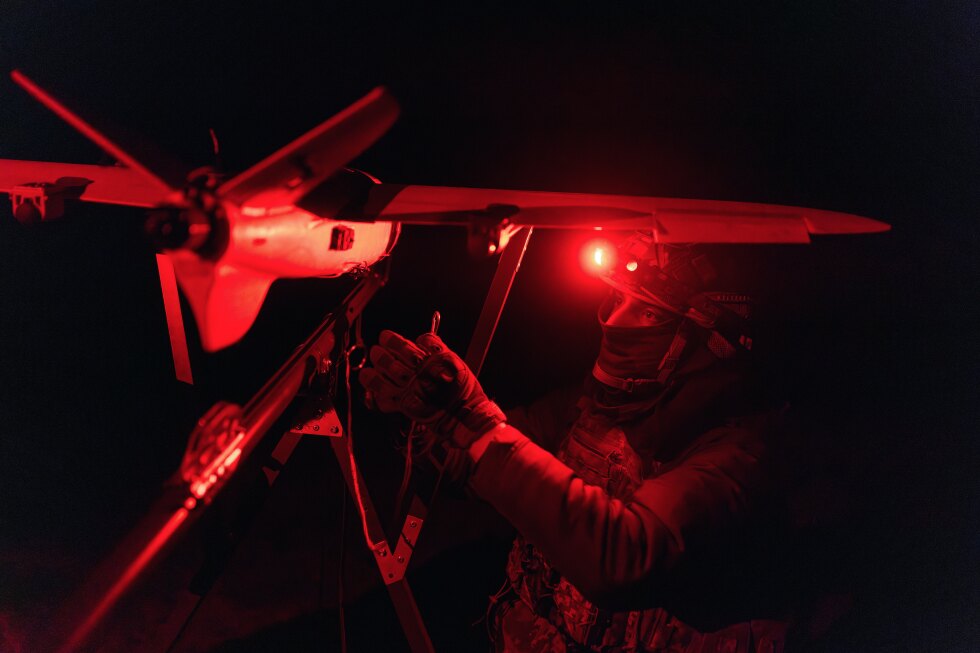
The 127th Brigade’s crew tests and fine-tunes their self-made interceptor drones, searching for any flaws that could compromise performance when the real threat appears. What began as a desperate improvisation has evolved into a sophisticated defense system that’s reshaping modern warfare.
“It’s not like we sat down one day and decided to fight with drones,” explains a pilot with the 127th Brigade after carefully landing his interceptor drone. “We did it because we had nothing else.”
When Russian Shahed drones first appeared in autumn 2022, Ukraine had few effective defenses against them. Today, these small teams have become laboratories of military innovation, developing grassroots technology out of battlefield necessity.
The cost-effectiveness of these drone-based defenses is striking. “Just imagine — a Patriot missile costs about $2 million, and here you have a small aircraft worth about $2,200,” the pilot says. “And if it doesn’t hit the target, I can land it, fix it a bit and send it back into the air. The difference is huge. And the effect? Not any worse.”
President Volodymyr Zelenskyy has noted that U.S. allies in the Middle East have approached Ukraine for help in defending against similar Iranian drones. This technology transfer highlights Ukraine’s unexpected emergence as a leader in counter-drone warfare, as Iran has deployed the same drones against Israel and U.S. assets in the region, sometimes overwhelming more sophisticated Western air defense systems.
The evolution of Ukraine’s drone interceptor capabilities can be traced to a pivotal moment about two years ago. A 27-year-old captain, who now leads the 127th Brigade’s air defense efforts, recalls being assigned to intercept Russian reconnaissance drones using shoulder-fired missiles — a strategy that quickly proved ineffective against agile, camera-equipped drones.
“That’s when I realized — this is a drone war. It had begun,” the captain says, describing the day one of his pilots successfully downed a Russian Orlan reconnaissance drone by using another drone. “We had been moving toward it for some time, but that was the moment I saw it with my own eyes.”
The challenge intensified when Russian forces began deploying hundreds of fast, durable Shahed drones deep beyond the front lines. This prompted collaboration between military units and local defense companies in Kharkiv, resulting in aircraft-style interceptor drones capable of matching the speed of Shaheds.
Working with a local company allows soldiers to test interceptors in real combat conditions and quickly refine the technology. One such product, the Skystriker drone, differs from more common interceptor systems by resembling a small aircraft with wings, allowing for longer flight times.
“It’s not enough just to build it. It has to work — and work properly — and perform real combat tasks,” explains the director of the defense company, who requested anonymity for security reasons. “That’s why communication with the military is so important. They give us feedback and help us improve it every time.”
Ukraine’s domestic drone interceptor industry has grown rapidly, with key players now showcasing their products at international arms exhibitions. This growth extends beyond military and manufacturers, with volunteers often serving as critical links between the two.
The Come Back Alive Foundation, a nonprofit that equips Ukraine’s forces, launched its “Dronopad” project in summer 2024 after noticing that FPV drone pilots occasionally intercepted aerial targets. “At that moment it wasn’t clear whether this was even a scalable solution or just isolated incidents,” says project leader Taras Tymochko. “Our goal was to turn it into a system — to help units that already had their first successful cases build the capability and scale what they had achieved.”
The foundation worked with manufacturers to develop systems that met soldiers’ needs, and the capabilities evolved quickly. “At some point they were able to reach speeds of more than 200 kilometers per hour, which made it possible to intercept targets like Shaheds in the air,” Tymochko explains.
This continuous cycle of innovation has driven the evolution of drone warfare in Ukraine. While the technology itself isn’t particularly difficult to replicate, the real value lies in how it’s deployed and in the experience of the pilots who operate it effectively.
“Many people called it air defense for the poor,” Tymochko reflects on the early days of interceptor drones when skepticism ran high. “But it turns out that air defense for the poor can sometimes be more effective than air defense for the rich.”
For the soldiers of the 127th Brigade, defending Kharkiv is personal — it’s where their families live, a city regularly targeted by Shahed attacks. Their innovations, born of necessity, may now shape the future of aerial defense worldwide.
Fact Checker
Verify the accuracy of this article using The Disinformation Commission analysis and real-time sources.

11 Comments
Fascinating to see how Ukraine’s forces are rapidly adapting and innovating to counter the threat of Russian drones. Seems like a true David vs. Goliath situation, with local ingenuity taking on high-tech weaponry.
It’s inspiring to see how Ukrainian soldiers are taking matters into their own hands and developing cost-effective drone countermeasures out of necessity. Grassroots military innovation at its finest.
The article highlights how Ukraine has turned its front lines into a laboratory for drone warfare innovation. Grassroots military R&D at its finest, driven by the need to protect against Russian aggression.
This is a great example of how necessity drives innovation, even in the high-stakes world of modern warfare. Ukraine’s resourcefulness and adaptability in the face of Russian aggression is truly admirable.
This is a great demonstration of the power of necessity to spur innovation, even in the high-stakes world of modern warfare. Ukraine’s resourcefulness and adaptability in the face of Russian aggression is truly inspiring.
I wonder if these Ukrainian-made drone interceptors could have broader applications beyond just military use, perhaps in areas like search and rescue or disaster response. Seems like a versatile technology.
The article highlights how Ukraine’s forces are rapidly developing cost-effective drone countermeasures out of sheer necessity. It’s fascinating to see how grassroots military innovation can take on high-tech weaponry.
I wonder how the performance and effectiveness of these Ukrainian-made drone interceptors compare to more conventional, high-cost air defense systems like the Patriot missile. Seems like a promising new approach.
It will be interesting to see if Ukraine’s drone defense innovations can be scaled up and exported to other militaries facing similar threats. Could be a game-changer in asymmetric conflicts.
The cost-effectiveness of these drone-based defenses is really striking, as the article notes. Improvising solutions on the battlefield could give Ukraine an edge against Russia’s firepower and technology.
I’m curious to learn more about the specific technical innovations and capabilities of these Ukrainian-made interceptor drones. It seems like a fast-moving area of development.